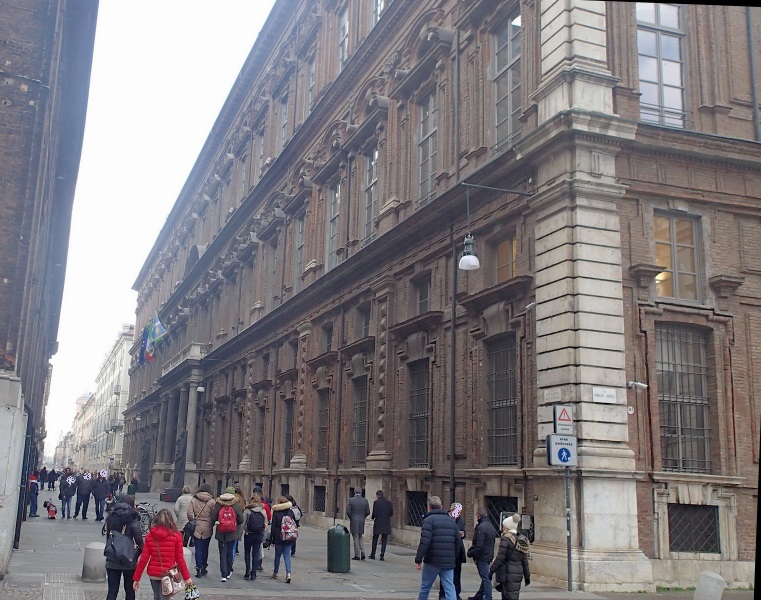
Via Accademia delle Scienze, Turin
A short street connecting science, archaeology and Italian history
The Palace of the Academy of Sciences, home of the Egyptian Museum, and the nearby Baroque façade of Palazzo Carignano.
Via Accademia delle Scienze is a street in Turin’s historic centre distinguished by an exceptional concentration of cultural institutions and monumental architecture. It takes its name from the Academy of Sciences, an institution founded during the eighteenth century and housed in the palace bearing the same name.
The entrance to the Egyptian Museum stands on the street, while Palazzo Carignano, the National Museum of the Italian Risorgimento, Piazza Carignano, Teatro Carignano and the Galleria Subalpina are all nearby.

Origin of the name
The street takes its name from the Turin Academy of Sciences, founded in 1757 as a private scientific society and officially recognised in 1783.
In 1787, Victor Amadeus III assigned the Academy rooms in the palace previously occupied by the College of Nobles.
The institution contributed to the spread of Piedmontese scientific culture through research, publications, conferences and relationships with Italian and European scholars.
The street name therefore reflects the role of this part of the historic centre as a place devoted to study, conservation and the dissemination of knowledge.
Urban history
The area developed during Turin’s seventeenth-century expansion towards the south and the River Po.
Construction of the College of Nobles and Palazzo Carignano progressively transformed the district into one of the principal aristocratic and cultural areas of the Savoy capital.
During the nineteenth century, the public opening of the Egyptian Museum and the presence of parliamentary institutions inside Palazzo Carignano substantially increased the street’s importance.
Scientists, archaeologists, politicians, diplomats, students and travellers frequented the area. Its history is consequently associated with both the development of Egyptology and the formation of the Italian State.
Palace of the Academy of Sciences
The street’s principal building is the Palace of the Academy of Sciences, constructed between 1679 and 1687 to house the College of Nobles.
For many years, the entire project was attributed to Guarino Guarini. More recent studies have reduced the extent of his direct involvement, recognising important contributions by the Jesuit Carlo Maurizio Vota and the architect Michelangelo Garove, who directed the work.
The palace has an exposed-brick façade articulated by windows, frames and stone elements. The original project was more extensive but was never completed in every part.
During the nineteenth century, the entrance was altered with a Neoclassical portico and balcony designed by Giuseppe Maria Talucchi.
Academy of Sciences
The Academy of Sciences remains based in the palace. It is organised into two main areas:
- physical, mathematical and natural sciences;
- moral, historical and philological sciences.
The institution maintains an important library and archive containing books, journals, letters, drawings, engravings and documents associated with European scientific and cultural history.
One of its most representative rooms is the Hall of Globes, decorated during the eighteenth century with scientific subjects.
The Academy’s rooms do not normally operate as a continuously open museum. Visits, meetings and special openings depend on the institution’s programme.
Egyptian Museum
The entrance to the Egyptian Museum stands at number 6 Via Accademia delle Scienze.
The museum was founded in 1824 after Charles Felix purchased Bernardino Drovetti’s extensive collection. It is the world’s oldest museum entirely devoted to ancient Egypt.
Its holdings include statues, coffins, mummies, papyri, funerary assemblages and everyday objects. Highlights include the tomb of Kha and Merit, the Temple of Ellesija and the Gallery of Kings.
The museum makes the street one of Turin’s busiest cultural destinations.
Palazzo Carignano
Via Accademia delle Scienze borders the monumental area of Piazza Carignano, dominated by the Baroque façade of Palazzo Carignano.
The palace was designed by Guarino Guarini for Emmanuel Philibert of Savoy-Carignano. Construction began in 1679.
Its brick façade has an undulating form, with concave and convex surfaces and complex decoration around the windows. It is one of the most original achievements of Piedmontese Baroque architecture.
Palazzo Carignano housed the Chamber of Deputies of the Subalpine Parliament and the first Chamber of Deputies of the Kingdom of Italy. Today it contains the National Museum of the Italian Risorgimento.
The building forms part of the UNESCO-listed Residences of the Royal House of Savoy.
Piazza Carignano

Piazza Carignano opens beside the street and is one of the most atmospheric Baroque spaces in central Turin.
In addition to Palazzo Carignano, it contains Teatro Carignano, historic establishments and eighteenth-century buildings.
A monument to Vincenzo Gioberti, philosopher and leading figure of the Risorgimento, stands at its centre.
The square’s modest dimensions, pedestrian paving and the palace’s curving façade create an intimate setting very different from the monumentality of Piazza Castello.
Teatro Carignano
Teatro Carignano stands in the square bearing its name, a few steps from Via Accademia delle Scienze.
Its origins date from the seventeenth century, when the site contained a court used for the game of pallacorda. During the early eighteenth century, it was converted into a theatre.
The building was reconstructed and altered several times following fires and architectural interventions. Today it is one of the city’s principal historic theatres and mainly presents spoken drama.
Galleria Subalpina
The nearby Galleria Subalpina is a nineteenth-century covered passage connecting Piazza Castello with Piazza Carlo Alberto.
It has an iron-and-glass structure and elaborate eclectic decoration. It contains businesses, cafés and the Cinema Romano.
The gallery provides a useful and attractive connection between Via Accademia delle Scienze, Piazza Carignano and other monuments in the city centre.
Cultural importance
Via Accademia delle Scienze brings together three fundamental aspects of Turin’s history within a very limited area:
- scientific research, represented by the Academy;
- archaeology and Egyptology, represented by the Egyptian Museum;
- the Risorgimento and formation of Italy, represented by Palazzo Carignano.
Few streets connect science, art, archaeology and political history so directly.
The street is therefore more than an urban route: it forms part of a major cultural itinerary through central Turin.
Visitor experience
The street is relatively short and can be walked in a few minutes. To appreciate its significance, visitors should stop to observe the buildings and continue into Piazza Carignano.
An itinerary may include:
- façade of the Palace of the Academy of Sciences;
- Egyptian Museum;
- Piazza Carignano;
- Palazzo Carignano;
- National Museum of the Risorgimento;
- Teatro Carignano;
- Galleria Subalpina;
- Piazza Castello.
The walk alone takes approximately 20–30 minutes. Including the Egyptian Museum and Museum of the Risorgimento can occupy most of a day.
Photography and viewpoints
The Palace of the Academy of Sciences can be photographed from the opposite side of the street, although the limited space makes it difficult to include the entire façade.
Piazza Carignano provides a better perspective on Palazzo Carignano’s curved surface and terracotta decoration.
Morning or late afternoon may offer more favourable light and fewer pedestrians. Groups and queues are common outside the Egyptian Museum during opening hours.
Accessibility
The street and Piazza Carignano are predominantly level and largely pedestrianised or subject to restricted traffic.
Historic paving, joints and minor changes in level may require care from wheelchair users and people with reduced mobility.
Interior accessibility should be checked separately for:
- Egyptian Museum;
- Academy of Sciences;
- Palazzo Carignano;
- Museum of the Risorgimento;
- Teatro Carignano.
The Egyptian Museum and Museum of the Risorgimento normally provide accessible routes, but checking for temporary changes before visiting is advisable.
Location and transport
Location: Turin’s historic centre, near Piazza Carignano and Piazza Castello.
The area is approximately fifteen minutes on foot from Porta Nuova railway station and around twenty minutes from Porta Susa.
Several bus and tram routes serve Piazza Castello, Via Bertola, Via Pietro Micca and the surrounding streets.
Visitors arriving by car should consider the limited-traffic zone and shortage of street parking. Paid underground car parks are available nearby.
Useful information
Access to the street and Piazza Carignano is free of charge.
Museums, theatres, Academy visits and events require separate tickets, reservations or opening hours.
The area contains cafés, restaurants, bookshops and other businesses. It can become very busy at weekends and during holidays, particularly outside the Egyptian Museum.
Pros and cons
Pros
- Exceptional cultural concentration: the Egyptian Museum, Academy of Sciences and Palazzo Carignano are extremely close together.
- Major architectural value: the area contains important Baroque and Neoclassical buildings.
- Free access to the street: it can be included in any itinerary without charge.
- Central location: it provides easy connections with Piazza Castello, Piazza Carignano and Via Roma.
- Historical importance: the area brings together Egyptology, science and the Risorgimento.
- Predominantly pedestrian: the visit is generally pleasant.
- Numerous nearby museums: an entire cultural day can be organised in the area.
- Nearby arcades and covered galleries: these provide shelter in rainy weather.
- Good architectural photography: particularly around Piazza Carignano.
Cons
- Narrow street space: observing or photographing certain façades in full is difficult.
- Crowding outside the Egyptian Museum: queues and groups may occupy part of the street.
- Occasionally uneven paving: this may create difficulties for people with reduced mobility.
- Traffic in adjacent streets: care is required at crossings.
- Different accessibility for each building: museums and institutions must be checked separately.
- Difficult parking: public transport is generally preferable.
- Limited historical signage: the significance of some buildings is not always immediately clear.
- The street itself is quickly visited: its main interest comes from the surrounding monuments and museums.
Overall assessment
Via Accademia delle Scienze is one of the most culturally concentrated streets in central Turin. Within a few metres, it connects the Egyptian Museum, the Academy of Sciences and the monumental area of Palazzo Carignano.
Its importance derives not from its length or width, but from the buildings and institutions situated along and around it. It is an excellent starting point for an itinerary devoted to archaeology, Piedmontese Baroque architecture and the history of Italian unification.
Crowding, limited space and parking difficulties are its principal disadvantages. Overall, it is a recommended destination for understanding the exceptional cultural concentration of Turin’s historic centre.
Mini-glossary
Academy: an institution devoted to study, research and the dissemination of knowledge.
College of Nobles: an institution established to educate young members of aristocratic families.
Piedmontese Baroque: an architectural language developed in Piedmont during the seventeenth and eighteenth centuries, characterised by dynamic forms and theatrical solutions.
Concave-convex façade: an architectural surface alternating inward and outward curves.
Risorgimento: the political and military process leading to Italian unification during the nineteenth century.
Observatory: a structure used for astronomical or meteorological observations.
Picture gallery: a museum or collection devoted primarily to paintings.
Limited-traffic zone: an urban area in which vehicle access is restricted.



 Via Accademia delle Scienze - Torino