

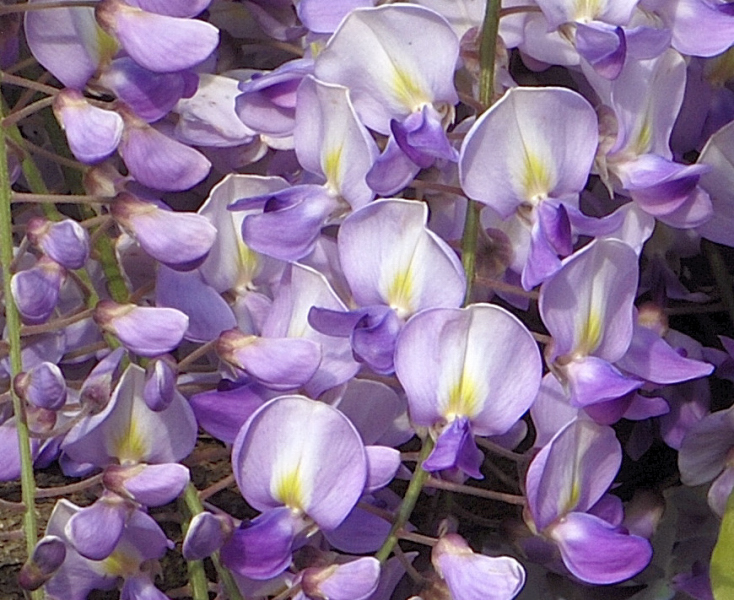
Wisteria
Rating : 7
| Evaluation | N. Experts | Evaluation | N. Experts |
|---|---|---|---|
| 1 | 6 | ||
| 2 | 7 | ||
| 3 | 8 | ||
| 4 | 9 | ||
| 5 | 10 |
Cons:
Danger to pets (1)0 pts from Al222
| Sign up to vote this object, vote his reviews and to contribute to Tiiips.Evaluate | Where is this found? |
| "Descrizione" about Wisteria by Al222 (24012 pt) | 2026-Jan-12 12:42 |
| Read the full Tiiip | (Send your comment) |
Wisteria (Wisteria sinensis): : properties, uses, pros, cons, safety
Wisteria (Wisteria sinensis) is a deciduous woody climber in the Fabaceae family. It is native to China and is widely cultivated in temperate climates for its pendulous, highly ornamental flower clusters (racemes). The species climbs by twining woody stems around supports, shows vigorous growth, and can be very long-lived; for these reasons it requires careful horticultural management (training, pruning, and suitable structural supports).

Botanical classification
Kingdom: plantae
Order: fabales
Family: fabaceae
Genus: wisteria
Species: wisteria sinensis
Plant characteristics
Wisteria sinensis is typically characterized by:
Habit and growth: a vigorous woody climber; it can cover large structures and exerts substantial weight and pulling force over time, so it requires robust supports (pergolas, trellises, wall systems).
Stems: twining stems that progressively lignify; secondary thickening may compress supports and host vegetation if not controlled.
Leaves: pinnate compound leaves with multiple leaflets; leaf emergence is often concurrent with, or shortly after, spring flowering (variable by climate and cultivar).
Flowers: borne in pendulous racemes, often noticeably fragrant during peak bloom; the scent is linked to floral volatile emissions (see chemical composition).
Fruits and seeds: legumes (pods) containing seeds; mature pods may split open and release seeds.
Growing requirements: prefers bright exposure (full sun to bright partial shade), well-drained substrates, and regular watering without waterlogging; pruning is a key factor for controlling vigour and supporting flowering.
Chemical composition and structure
Below is a “by organ” overview (flowers, leaves, roots) with compound classes and representative molecules reported for Wisteria sinensis.
Floral volatiles (flowers; aromatic profile, headspace GC–MS)
Flower emissions include multiple chemical families (fatty-acid derivatives, benzenoids/phenylpropanoids, terpenoids, and nitrogen-containing compounds). Frequently reported or quantitatively relevant examples include:
Terpenoids: linalool, (E)-β-ocimene.
Benzenoids/phenylpropanoids: methyl benzoate, benzaldehyde, benzyl alcohol, methyl salicylate, chavicol, methyl chavicol, eugenol, isoeugenol, methyl isoeugenol, benzyl isovalerate.
Lipid derivatives (esters/methyl esters): methyl hexadecanoate, ethyl hexadecanoate, and shorter-chain methyl esters such as methyl octanoate, methyl decanoate, methyl pentanoate.
Nitrogen-containing compounds (trace/variable): for example o-nitroaniline has been listed among identified compounds.
Flavonoids and polyphenols (leaves; methanolic extracts and chromatographic fractionation)
Leaf extracts include both aglycones and glycosylated flavonoids. Representative markers include:
Flavone C-glycosides: orientin, isoorientin, vitexin, isovitexin.
Flavone aglycones: apigenin, luteolin.
Acylated flavone glycoside (complex structure): a chrysoeriol derivative described as an acylated glycoside with sugar units (glucose, apiose) and a caffeic acid moiety.
Triterpenes and saponins (leaves and roots; triterpene aglycones and triterpenoid glycosides)
Oleanane-type triterpenes are reported, including both aglycones and triterpenoid glycosides (saponins):
Triterpene aglycones (leaves): oleanolic acid and hederagenin.
Oleanane saponins (roots; oleanane-type glycosides): multiple triterpenoid glycosides have been isolated, including:
wistariasaponin A and wistariasaponin D
dehydroazukisaponin V, azukisaponin V
astragaloside VIII
additional oleanane glycosides described in the literature (including acetylated oleanane derivatives and a glycoside of wistariasapogenol A).
Lectins and glycosidic constituents of toxicological relevance
Toxicity is commonly attributed to a lectin and to a glycoside often referred to as “wisterin glycoside” in veterinary and safety summaries. Unlike small volatiles (e.g., linalool), these refer to macromolecular/protein components (lectins) and glycosides that are not always reported with detailed structural nomenclature in non-specialist sources.
Uses and benefits
Ornamental and landscape use: the primary use in pergolas, façades, arches, and robust support structures, with strong visual impact during flowering.
Phytochemical and research interest: the presence of flavonoids (e.g., orientin/vitexin, apigenin/luteolin) and triterpenoid saponins has motivated isolation work, structural characterization, and in vitro bioactivity screening in research contexts.
Safety note: it is not intended for general food use; accidental ingestion—especially of pods and seeds—should be avoided due to the toxicity profile.
Applications
Gardening and ornamental landscaping: vegetative cover for robust structures; suitable for historical gardens and residential contexts where pruning can be managed.
Technical management: targeted pruning to contain growth and support flowering; structural assessment of supports (load, traction, potential compression).
Spread control: in some non-native areas it may naturalize and behave invasively; management may be needed to reduce competition with local vegetation.
Cultivation
Planting and placement: plant in autumn or spring; install a very robust support from the start.
Exposure: full sun is preferred to maximize flowering; excessive shade increases vegetative growth and reduces blooms.
Soil and irrigation: use well-drained soil; water regularly after planting, then provide supplemental irrigation during prolonged drought, avoiding waterlogging.
Fertilization: avoid high nitrogen inputs; excessive nitrogen favours foliage over flowers.
Training and pruning: train a small number of main leaders on the support; prune in summer to reduce long current-year shoots and in winter to shorten to short spurs (typically a few buds) to concentrate flowering near the framework.
Propagation: layering (including air-layering) is typically reliable; cuttings may be variable; seed propagation is slower to reach flowering.
Environmental and safety considerations
Environmental impact: in favourable conditions it can spread vigorously and smother vegetation; management (pruning, controlling regrowth, and, where necessary, removal) is the usual approach where ecological pressure is relevant.
Human safety: all parts are generally considered potentially toxic, with pods and seeds often cited as the more critical parts. Reported effects after ingestion are primarily gastrointestinal (nausea, vomiting, diarrhea, abdominal pain), with systemic signs described in some documented cases.
Pet safety: commonly reported as toxic to dogs and cats (and also horses); ingestion may cause mainly gastrointestinal signs, with severity influenced by dose (including pods/seeds).
Good practices: prevent access by children and pets to pods and seeds; collect fallen pods; use gloves during pruning if prone to irritation or sensitivity; dispose of prunings and pods appropriately.
References__________________________________________________________________________
Rokosz P, Stachowicz K, Kwiecień H. Phytochemical analysis of non-polar solvent extracts of the Wisteria sinensis leaves. Nat Prod Res. 2018 Oct;32(20):2487-2489. doi: 10.1080/14786419.2017.1416375.
Abstract. A comparative study on the phytochemical composition of the n-hexane and chloroform extracts from Wisteria sinensis leaves collected in June and October is described. Continuous extraction in Soxhlet apparatus, as well as ultrasound-assisted technique, was used for the preparation of the extracts. All the extracts were analysed by GC/MS method. As a result, α-tocopherol was identified as the main component (56%) of the extracts from October leaves, whereas, β-sitosterol was identified as the main compound (47%) in the extracts from the June leaves. Additionally, pure α-tocopherol was isolated from n-hexane extract of the October leaves using column chromatography. A total of 6.25 mg of α-tocopherol was isolated from 1 g of dried leaves. The presence of the vitamin E in extracts from W. sinensis leaves is described here for the first time.
Keskin, S., Sirin, Y., Cakir, H. E., & Keskin, M. (2019). Phenolic composition and antioxidant properties of Wisteria sinensis. International Journal of Scientific and Technological Research, 5(2), 98-103.
Abstract . Wisteria is a plant species of the Fabaceae family with woody, flowering and climbing characteristics and has about 10 subspecies. Wisteria sinensis, abundant in Asian countries, is highly attractive for honey bees due to its blue-violet, fragrant flowers. The flowers of the plant are mixed with sugar and flour to make a local meal (Teng Lo) in the East Asian countries. Flowers can also be consumed as a tea. Wisteria sinensis have antioxidant and antibacterial properties. It is very rich plant in terms of polyphenols, saponins, flavones and lectins. Because of these properties, Wisteria sinensis can be used in the treatment of rheumatoid arthritis, stomach and breast cancer diseases. In this study, antioxidant properties and phenolic composition of the flower, leaf and branch parts of Wisteria sinensis collected from Trabzon/Turkey were investigated. Antioxidant capacity and HPLC-UV phenolic composition were determined according to Ferric reduction capacity (FRAP), 2,2-diphenyl-1 picrylhydrazyl (DPPH) and total phenolic substance (TPC) methods. Flowers of the plant were rich in cinnamic acid, vanillic acid, rutin, daidzein and luteolin. Extracts obtained from leaf and branch part were found to be rich in epicatechin, rutin, luteolin and cinnamic acid. A high correlation between antioxidant capacity and its total phenolic contents indicated that phenolic compounds were a major contributor of antioxidant activity of the plant.
Liu JS, Chen AM, Xu YS, Zhang CE, Wang G. Study on triterpenoids from Wisteria sinensis. Zhong Yao Cai. 2012 Aug;35(8):1246-50.
Abstract. Objective: To study the triterpenoids constituents from Wisteria sinensis Sweet Caulis. Methods: The compounds were beta-solated and purified with silica gel and Sephadex LH-20 column chromatography from the petroleum ether extract. Their structures were determined on the basis of physicochemical properties and spectroscopic analysis. Results: They were identified as beta-sitosterol palmitate (1), alpha-spinasterol (2), (22E, 24R)-5alpha, 8alpha-epidioxy-ergosta-6, 22-dien-3beta-ol (3), (22E, 24R)-ergosta-5, 7, 22-trien-3beta-ol (4), (22E, 24R) -ergosta-7, 22-dien-3beta-ol (5), 11alpha, 12alpha-oxidotaraxerol (6), lupeol (7), betulinic acid (8), 22-oxo-3beta, 24-dihydroxyolean-12-ene (9), 2alpha, 3beta, 23-trihydroxyolean-12-ene (10), soyasapogenol E (11), 3alpha, 21beta-dihydroxy-olean-12-ene (12). Conclusion: Compounds 1 - 12 are isolated from this plant for the first time.
| Sign up to vote this object, vote his reviews and to contribute to Tiiips.EvaluateClose | (0 comments) |
Read other Tiiips about this object in __Italiano (1)
Hardiness:   Hardiness:   Natural fertilizer:   Hazards/diseases:   Last update:   2026-01-12 18:13:39 | Sun exposure:   Family:   Commercial fertilizer:   Main substances contained:   |

