



Bicarbonato d'ammonio - Ammonium Bicarbonate: properties, uses, pros, cons, safety
Ammonium Bicarbonate, also known as Ammonium Hydrogen Carbonate, is an inorganic ammonium salt widely used as a raising agent in food production, particularly in dry baked goods such as biscuits, crackers, wafers, and similar products.
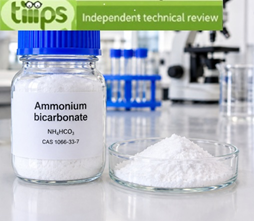
In the European Union it is identified as E 503(ii) – Ammonium Hydrogen Carbonate. Codex/JECFA identifies it as INS 503(ii) and classifies it functionally as an acidity regulator and raising agent. In the United States, it is affirmed as GRAS for direct use in food under 21 CFR §184.1135, where its technical effects include dough strengthening, leavening, pH control, and texturizing.
Its particular technological value derives from the fact that, when heated, it decomposes into ammonia, carbon dioxide, and water, leaving essentially no alkaline mineral residue in a correctly processed low-moisture baked product.
Description
Ammonium Bicarbonate is a simple inorganic salt composed of ammonium and hydrogen carbonate ions.
At room temperature it occurs as a white crystalline material. It dissolves readily in water and produces a mildly alkaline solution.
Its most distinctive characteristic is its thermal instability. As temperature rises, decomposition becomes progressively faster and gaseous products are released. This behavior explains its effectiveness as a raising agent: the gases generated during baking expand the dough and contribute to porosity and crispness.
Unlike sodium bicarbonate, it does not leave a sodium-containing alkaline residue after complete decomposition. This makes it especially useful in thin, dry baked products, where ammonia can escape efficiently during baking.
It is less suitable for thick or high-moisture products because insufficient removal of ammonia can leave an undesirable ammoniacal odor or taste.
Manufacturing process
Industrial Ammonium Bicarbonate is produced by reacting gaseous carbon dioxide with aqueous ammonia.
The U.S. regulation specifically describes a process in which carbon dioxide is introduced into aqueous ammonia, causing Ammonium Bicarbonate crystals to precipitate. The crystals are subsequently washed and dried.
A typical industrial process therefore includes:
preparation of an aqueous ammonia solution;
introduction of purified carbon dioxide;
controlled reaction temperature and concentration;
crystallization;
separation of the crystals;
washing;
drying at controlled temperature;
particle-size classification;
purity and moisture control;
packaging designed to limit exposure to heat and humidity.
Temperature control is particularly important because excessive heat during drying or storage can initiate decomposition and reduce the active content of the material.
Main compounds present
Food-grade material consists predominantly of Ammonium Bicarbonate.
Depending on raw-material quality and manufacturing conditions, small quantities of the following may also be present:
water;
non-volatile residues;
chlorides;
sulphates;
trace metals;
decomposition products resulting from unsuitable storage.
EU purity specifications require an assay of at least 99.0% and establish limits for non-volatile material and specific contaminants.
Identification data and specifications
| Characteristic | Value | Note |
|---|---|---|
| Name | Ammonium Bicarbonate | common English name |
| Chemical name | Ammonium Hydrogen Carbonate | official EU/JECFA name |
| Other synonyms | Ammonium Acid Carbonate; Monoammonium Carbonate | alternative names |
| Chemical category | inorganic ammonium salt / hydrogen carbonate | ionic compound |
| Molecular formula | NH₄HCO₃ | conventional formula |
| Molecular weight | 79.06 g/mol | EU specification |
| CAS | 1066-33-7 | substance identifier |
| EC/EINECS | 213-911-5 | European identifier |
| EU food additive number | E 503(ii) | Ammonium Hydrogen Carbonate |
| Codex INS number | 503(ii) | international food-additive number |
| Food functions | Raising agent; Acidity regulator | Codex functional classes |
| Cosmetic function | Buffering / pH adjustment | cosmetic use |
| Cosmetics Regulation provisions | no specific Annex II–VI provision identified | no specific cosmetic restriction identified |
The European food-additive specification defines E 503(ii) as Ammonium Hydrogen Carbonate with a minimum content of 99.0%.
Indicative physicochemical properties
| Characteristic | Indicative value | Note |
|---|---|---|
| Appearance | white crystals or crystalline powder | official EU description |
| Odor | slight ammonia odor may develop | especially during decomposition |
| Water solubility | freely soluble | suitable for aqueous food systems |
| Ethanol solubility | insoluble | official specification |
| pH | about 8.0 in a 5% solution | mildly alkaline |
| Thermal stability | low | decomposition accelerates with heating |
| Volatility after decomposition | high for decomposition products | ammonia, carbon dioxide, and water are released |
| Storage sensitivity | heat and moisture sensitive | tightly closed, cool storage is preferable |
| Behavior during baking | releases gaseous products | responsible for leavening action |
These properties correspond closely to the specifications established for E 503(ii) in Regulation (EU) No 231/2012.
Food applications
Ammonium Bicarbonate is particularly suited to low-moisture baked foods.
Typical applications include:
biscuits;
crackers;
wafers;
cookies;
crisp baked products;
certain flat baked goods;
products in which a porous and crisp texture is desired.
During heating, its decomposition produces gases that expand the dough. Because the gaseous decomposition products can escape efficiently from thin products, little or no alkaline residue remains when processing is properly controlled.
In the United States, FDA regulations permit its use under current good manufacturing practice as:
a dough strengthener;
a leavening agent;
a pH control agent;
a texturizer.
In the United Kingdom, E503 Ammonium carbonates remains on the current list of approved food additives.
Pros
It is a highly effective raising agent for dry baked products.
It produces rapid gas release during heating.
It contributes to an open, porous, and crisp texture.
Unlike sodium bicarbonate, it does not contribute sodium to the finished product.
When decomposition is complete, it leaves very little mineral residue.
It is particularly effective in thin biscuits, crackers, and wafers.
It is highly soluble in water.
It is authorized as E 503(ii) in the European Union.
It is recognized internationally as INS 503(ii).
It is affirmed as GRAS in the United States under the specified conditions of use.
Cons
It is not suitable for every type of bakery product.
In thick, dense, or high-moisture products, ammonia may not escape completely and can leave an unpleasant smell or taste.
It decomposes during storage if exposed to excessive heat.
Dust can irritate the eyes and respiratory tract during industrial handling.
The release of ammonia during processing requires adequate ventilation in industrial environments.
Its use can contribute to conditions favoring acrylamide formation in certain cereal-based baked foods.
Purity and contaminant levels must comply with food-grade specifications.
It should not be confused with ammonium carbonate, which has a different composition and corresponds to E 503(i).
Safety, regulation and environment
European Union
Ammonium Bicarbonate is authorized as E 503(ii) – Ammonium Hydrogen Carbonate within the EU food-additive framework established by Regulation (EC) No 1333/2008. The permitted food categories and conditions of use are determined by the applicable provisions of Annex II.
Regulation (EU) No 231/2012 establishes detailed purity requirements including:
assay ≥99.0%;
non-volatile matter ≤500 mg/kg;
chlorides ≤30 mg/kg;
sulphates ≤30 mg/kg;
arsenic ≤3 mg/kg;
lead ≤2 mg/kg;
mercury ≤1 mg/kg.
Acrylamide warning
An important technological caution concerns acrylamide formation.
Commission Regulation (EU) 2017/2158, which establishes measures for reducing acrylamide in food, specifically instructs manufacturers of relevant fine bakery products to consider reducing or completely or partially replacing ammonium bicarbonate with alternative raising agents where technically possible.
The Regulation also specifically highlights recipes containing Ammonium Bicarbonate when addressing the use of fructose and other reducing sugars.
This does not mean that Ammonium Bicarbonate itself is acrylamide. Rather, under certain baking conditions it can promote reaction conditions that increase acrylamide formation, particularly where asparagine and reducing sugars are present.
For this reason, acrylamide mitigation is an important consideration in biscuits, crackers, gingerbread, wafers, and similar products.
United States
Under 21 CFR §184.1135, Ammonium Bicarbonate is affirmed as GRAS as a direct human food ingredient when used according to current good manufacturing practice.
The regulation identifies its functions as dough strengthener, leavening agent, pH control agent, and texturizer and does not establish a numerical general maximum level beyond GMP.
Codex/JECFA
JECFA maintains a specific food-additive monograph for Ammonium Hydrogen Carbonate, while Codex identifies it as INS 503(ii), with the functional classes acidity regulator and raising agent.
Cosmetic use
Ammonium Bicarbonate is also used in cosmetics primarily for pH adjustment/buffering.
The Expert Panel for Cosmetic Ingredient Safety evaluated Ammonium Bicarbonate with other carbonate salts and concluded that the evaluated salts are safe in the present practices of use and concentration when formulated to be non-irritating.
The main cosmetic concern is therefore local irritation rather than systemic toxicity under normal formulation conditions. Concentrated material or dust should not be assumed to have the same tolerability as a properly formulated finished cosmetic product.
No specific Cosmetics Regulation provisions / Cosmetic restrictions under Annexes II–VI were identified for Ammonium Bicarbonate.
Raw-material quality
For professional food or cosmetic use, it is advisable to obtain:
an updated SDS;
a Certificate of Analysis (COA);
assay/purity;
moisture content;
non-volatile matter;
chloride and sulphate levels;
arsenic, lead, mercury, and other relevant contaminant data;
particle-size specification;
pH;
storage conditions;
food-grade or cosmetic-grade conformity documentation, as applicable.
Environment
Ammonium Bicarbonate does not persist as a stable organic environmental contaminant. It dissociates and decomposes into naturally occurring inorganic species.
Environmental issues are therefore more closely related to:
ammonia release;
nitrogen loading into water;
local pH effects;
concentrated industrial discharges;
manufacturing emissions.
Normal use in food products is very different from large industrial releases and should not be evaluated using the same exposure scenario.
Conclusion
Ammonium Bicarbonate is an inorganic ammonium salt widely used as an effective raising agent, particularly in thin, dry baked foods such as biscuits, crackers, and wafers.
Its main technological advantage is that heating generates volatile products and leaves little mineral residue, allowing the development of a light and crisp structure without increasing sodium content.
Its regulatory status is well established: it is E 503(ii) in the European Union, INS 503(ii) under Codex, an approved E503 ammonium carbonate additive in the United Kingdom, and a GRAS direct food ingredient under 21 CFR §184.1135 in the United States.
The most important limitation is technological: it is less suitable for moist or thick products because residual ammonia may remain, and in relevant cereal-based bakery products its use must also be considered within acrylamide-mitigation strategies. EU legislation specifically recommends considering partial or complete replacement where appropriate to reduce acrylamide formation.
Ammonium Bicarbonate can be considered a useful and well-established food additive when used correctly, with particular attention to product moisture, complete ammonia removal during baking, purity, storage stability, and acrylamide control in susceptible baked foods.

