



o-Cymen-5-ol: properties, uses, pros, cons, safety
o-Cymen-5-ol is an aromatic phenolic compound used mainly in cosmetics as an antimicrobial, deodorant, and preservative. It is also known as 4-isopropyl-3-methylphenol, 3-methyl-4-isopropylphenol, or IPMP. Its molecular formula is C10H14O, its molecular weight is about 150.22 g/mol, and the main CAS number is 3228-02-2. In the European cosmetic database CosIng, it is linked to Annex V/38, the list of preservatives allowed in cosmetics, with a maximum concentration of 0.1%.
Description
o-Cymen-5-ol is a technical-cosmetic raw material, not a food ingredient. From a chemical standpoint, it belongs to the family of substituted phenols, meaning aromatic compounds containing a phenolic hydroxyl group associated with alkyl substituents. This structure explains both its antimicrobial activity and the need to use it at controlled concentrations.
It is used mainly in products where microbial growth must be controlled, bad odors reduced, or the microbiological stability of the formula supported. In practice, it may appear in deodorants, cleansers, products for impure skin, shampoos, scalp products, toothpastes, mouthwashes, and aqueous cosmetics that require an effective preservative system.
Production process
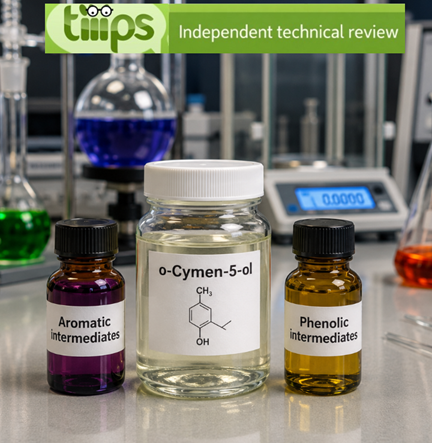
Industrially, o-Cymen-5-ol is obtained by chemical synthesis, starting from appropriately substituted aromatic and phenolic intermediates. Production requires control of the position of the substituents on the aromatic ring, because very similar molecules, such as thymol, carvacrol, and other phenolic isomers, may have different properties, odor, and regulatory profiles.
After synthesis, the usual steps include purification, crystallization or separation, assay control, verification of isomers, residual solvents, color, melting point, and impurity profile. In cosmetic grades, purity is an important point because the ingredient is often used at low concentrations but with a critical function: protecting the product from microbial contamination.
Main compounds present
In the pure grade, the main compound is o-Cymen-5-ol. Commercial grades may contain small amounts of phenolic isomers, process residues, traces of solvents, or aromatic impurities, depending on the production route and supplier quality.
For this reason, it is important to distinguish between the INCI name O-CYMEN-5-OL, the chemical name 4-isopropyl-3-methylphenol, the technical grade purchased, and the actual specification reported in the technical data sheet, SDS, and certificate of analysis.
Identification data and specifications
| Characteristic | Value | Note |
|---|---|---|
| INCI name | O-CYMEN-5-OL | cosmetic designation |
| Synonyms | 4-isopropyl-3-methylphenol; 3-methyl-4-isopropylphenol; IPMP | common technical synonyms |
| Chemical category | substituted phenol / alkylphenol | phenolic antimicrobial |
| Molecular formula | C10H14O | compound formula |
| Molecular weight | about 150.22 g/mol | theoretical value |
| Main CAS | 3228-02-2 | most common identifier |
| Alternative CAS reported | 39660-61-2 | present in some commercial databases |
| EC | 221-761-7 | European reference |
| Cosmetic functions | antimicrobial, deodorant, preservative | according to CosIng/COSMILE |
| EU restriction | Annex V/38 | allowed preservative |
| Maximum EU concentration | 0.1% | as preservative in cosmetics |
| Food use | not relevant | not a food additive |
Indicative physicochemical properties
| Characteristic | Indicative value | Note |
|---|---|---|
| Appearance | crystalline powder or crystals | white or yellowish-white |
| Color | white / very pale | depends on commercial grade |
| Odor | mild, characteristic phenolic | varies according to purity |
| Melting point | about 111-114 °C | commonly reported value |
| Boiling point | about 233-246 °C | depending on source and method |
| Density | about 1.0 g/cm³ | indicative value |
| Water solubility | low | typical of alkylphenols |
| Solubility in organic solvents | good in alcohols and organic solvents | useful in formulation |
| Log P | about 3.28 | moderate-high lipophilicity |
| Formulation status | solid antimicrobial/preservative | often pre-solubilized in a suitable phase |
Food
o-Cymen-5-ol has no relevant food role. It is not a nutrient and should not be confused with natural food aroma compounds such as thymol or carvacrol, even though it belongs to a related chemical family of aromatic phenolic compounds.
For a food assessment, therefore, the judgment is simple: the food focus is not relevant. Its typical use concerns cosmetics, personal care, personal hygiene, and technical formulations with antimicrobial or deodorant purposes.
Cosmetics
In cosmetics, o-Cymen-5-ol is used as an antimicrobial, deodorant, and preservative. COSMILE describes the antimicrobial function as controlling the growth of microorganisms, the deodorant function as reducing or masking unpleasant body odors, and the preservative function as protecting the cosmetic product from microbial deterioration.
It is particularly useful in formulations where microbial load must be reduced or a broader preservative system needs support. It may be present in products for impure skin, facial cleansers, shampoos, deodorants, scalp products, toothpastes, mouthwashes, and aqueous cosmetic preparations. Under EU legislation, when used as a preservative, it falls under Annex V with a maximum limit of 0.1%.
It is a relatively new product that is used as a bactericide and antiseptic in face and personal care creams. It is present in many toothpastes as a bactericide and to improve the rate of gum bleeding (1).
Pros
It is an effective antimicrobial at low concentrations.
It can contribute to the microbiological preservation of the product.
It is useful in deodorant products because it helps control microorganisms involved in the formation of bad odor.
It can be used in products for impure skin or formulas intended to control excessive surface microbial growth.
It is compatible with many cosmetic formulas, provided it is correctly solubilized.
It has a clear technical function: it does not only improve sensory properties, but helps protect the formula or support product hygiene.
Its presence in Annex V provides a precise European regulatory framework for use as a preservative.
Cons
It is not a food ingredient and has no nutritional value.
It is a phenolic substance: it must be used at controlled concentrations and not as a “free” ingredient without evaluation.
Its water solubility is low, so it requires a good formulation strategy.
It does not automatically replace a complete preservative system: pH, free water, packaging, and challenge testing must always be evaluated.
It may be less suitable for formulas that aim to avoid phenolic preservatives or synthetic antimicrobial ingredients.
Quality depends on purity, isomers, process residues, and supplier documentation.
As a concentrated raw material, it may require caution in handling for eyes, skin, and respiratory tract.
Safety, regulatory aspects, and environment
From the European cosmetic standpoint, the most important point is that o-Cymen-5-ol is allowed as a preservative in Annex V, entry 38, with a maximum concentration of 0.1%. This does not mean that any formula containing o-Cymen-5-ol is automatically safe: it means that the ingredient may be used within that limit and that the finished product must still pass cosmetic safety assessment and, when relevant, verification of preservative efficacy.
The CIR assessment on substituted phenols, including o-Cymen-5-ol, thymol, and carvacrol, reported that o-Cymen-5-ol was used in cosmetics and that it did not appear to be a significant skin irritant at the use concentrations considered; the same assessment indicates that these ingredients are not, overall, significant sensitizers or photosensitizers. CIR also selected a 0.5% concentration limitation to avoid the risk of chemical leukoderma in the assessed family, but this figure should not be confused with the current EU limit of 0.1% as a preservative.
In practical terms, the main risk is not regulated use in the finished cosmetic product, but improper use: excessive concentration, poor solubilization, irritating formula, untested product, or inadequately controlled raw material. In products intended for sensitive areas, mucous membranes, the eye contour, or compromised skin, assessment should be more cautious.
From an environmental perspective, o-Cymen-5-ol should be considered an antimicrobial substance: even when used at low doses, its function is to interfere with microbial growth. For this reason, overdosing should be avoided, formulas should follow good manufacturing practice, regulatory limits should be respected, and the environmental profile of the finished product should be evaluated, especially in rinse-off products discharged into wastewater.
Conclusion
o-Cymen-5-ol is a technical cosmetic ingredient with a well-defined role: microbial control, deodorization, and product preservation. It is particularly useful in formulas where the aim is to reduce bacterial and fungal proliferation or build an effective preservative system at low concentrations.
Its profile is generally favorable when used correctly, but it requires formulation attention. The key points are: EU limit of 0.1%, low water solubility, quality of the commercial grade, correct solubilization, compatibility with the preservative system, and verification in the finished product. It is not a food ingredient nor a “nutritive” cosmetic active; it is primarily a preservative/antimicrobial ingredient to be used with technical precision.

