



C13-15 Alkane: properties, uses, pros, cons, safety
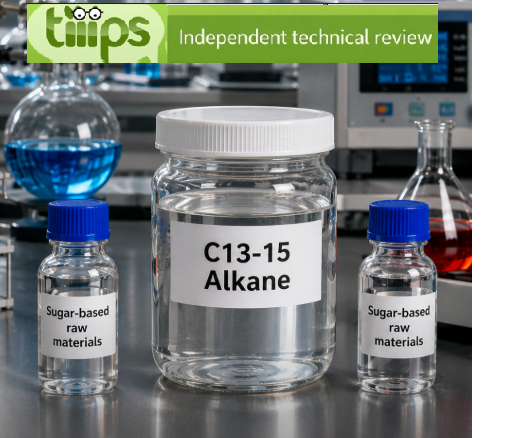
C13-15 Alkane is a mixture of saturated alkanes with carbon chains generally ranging from 13 to 15 carbon atoms. In cosmetics it is used mainly as a solvent, light emollient, texture enhancer, and carrier for lipophilic ingredients. In the cosmetic market it is also associated with the concept of hemisqualane, especially when the commercial grade is obtained from renewable sources through fermentation of sugar-based raw materials.
Description
This is a technical-cosmetic raw material, not a food ingredient. From a chemical standpoint, it belongs to the family of saturated hydrocarbons, meaning molecules made only of carbon and hydrogen, without double bonds and therefore generally more stable against oxidation than many unsaturated vegetable oils.
Its main function is to improve the sensory profile of a formula: it makes creams, serums, foundations, sunscreens, facial oils, balms, and hair products more spreadable, silky, lightweight, and less greasy. It is often used as a lighter alternative to some mineral oils, isoparaffins, volatile silicones, or traditional synthetic emollients.
Production process
C13-15 Alkane may derive from different supply chains. In the most valued modern cosmetic grades, it is often produced from sugar-based raw materials through fermentation processes, followed by chemical transformations and purification to obtain a light and stable hydrocarbon mixture. In other cases, the cosmetic alkane family may also be obtained from petrochemical or synthetic routes.
After production, the usual steps include distillation, purification, control of the carbon-chain profile, and verification of color, odor, acid value, oxidative stability, and impurities. The commercial result is generally a very clear, almost odorless liquid with high affinity for oils, waxes, esters, and lipophilic ingredients.
Main compounds present
The commercial material consists mainly of saturated C13-C15 alkanes. In some grades marketed as hemisqualane, the dominant component may be a branched C15 alkane, such as 2,6,10-trimethyldodecane, but in regulatory practice the INCI name C13-15 Alkane identifies a mixture, not a perfectly unique single molecule.
Small variations in alkane distribution may occur depending on the supplier and production process. For this reason, in technical assessment it is useful to distinguish between the INCI name, commercial grade, renewable or synthetic origin, purity, and the analytical specification of the batch.
Identification data and specifications
| Characteristic | Value | Note |
|---|---|---|
| INCI name | C13-15 Alkane | cosmetic designation |
| Chemical category | saturated alkanes / light hydrocarbons | C13-C15 mixture |
| Chemical description | mixture of alkanes with 13-15 carbon atoms | according to cosmetic definition |
| Commonly reported CAS | 64742-46-7 | may vary depending on commercial grade |
| Commonly reported EC | 934-954-2 | reference reported in cosmetic databases |
| Possible relevant component | 2,6,10-trimethyldodecane | typical of some hemisqualane grades |
| Main cosmetic functions | solvent, emollient, skin conditioning | technical-sensory function |
| Additional functions | hair conditioning, carrier for UV filters or pigments | depends on the formula |
| Technical origin | renewable from fermentation, synthetic, or petrochemical | depends on supplier |
| Food use | not relevant | not a common food additive |
Indicative physicochemical properties
| Characteristic | Indicative value | Note |
|---|---|---|
| Appearance | clear liquid | typical of cosmetic grades |
| Color | colorless | may vary slightly |
| Odor | almost absent | useful in fragrance-free formulas |
| Water solubility | insoluble | hydrocarbon behavior |
| Oil solubility | high | compatible with fatty phases |
| Density at 20 °C | about 0.770 g/cm³ | indicative value from technical specifications |
| Viscosity at 20 °C | about 2.7 cP | very fluid liquid |
| Refractive index at 20 °C | about 1.431 | indicative technical value |
| Flash point | about 110 °C | depends on commercial grade |
| Oxidative stability | good | saturated structure, no double bonds |
Cosmetics
In cosmetics, C13-15 Alkane is used as a lipophilic solvent, light emollient, and texture enhancer. It is particularly useful in products where a dry, silky, non-sticky, and less heavy feel is desired compared with many traditional oils.
It is found in face creams, serums, foundations, concealers, sunscreens, cleansing oils, make-up removers, hair products, conditioners, masks, body products, and “dry touch” formulations. In sunscreens it can help disperse UV filters and improve spreadability; in hair products it can make the formula lighter and easier to distribute without excessively weighing down the hair fiber.
It is not a dermatological active in the strict sense: it does not perform a deep biological function, but it improves formula quality and user feel. In many modern formulations it is appreciated because it can replace, at least in part, volatile silicones or heavier hydrocarbons.
Pros
It provides a light, silky, and dry touch, useful in creams, serums, sunscreens, and make-up.
It is a good lipophilic solvent for oils, esters, waxes, UV filters, and some functional ingredients.
It improves spreadability and reduces greasy feel.
It is oxidation-stable because it consists of saturated hydrocarbons.
It may be suitable for “silicone alternative” formulas or lightweight textures.
In hair products it improves distribution without excessively weighing the hair down.
In fermentation-derived grades, it may have a more interesting positioning for formulas oriented toward renewable raw materials.
Cons
It is not a food ingredient and has no nutritional value.
It is not a true cosmetic active: its role is mainly sensory and formulation-related.
Origin may vary: not all grades are automatically bio-based or fermentation-derived.
Being lipophilic and water-insoluble, it must be correctly incorporated into the oil phase or into well-designed systems.
In very rich formulas it may contribute to a film-forming feel, although it is normally lighter than heavy oils.
Quality depends greatly on purity, carbon-chain distribution, residues, and supplier specification.
In complex SPF or make-up systems, compatibility with filters, pigments, elastomers, and structuring agents must be verified.
Safety, regulation, and environment
From a cosmetic safety standpoint, C13-15 Alkane is generally considered a low-concern ingredient under normal cosmetic conditions of use. Its saturated and chemically low-reactive structure reduces the risk of oxidation and formation of irritating by-products compared with some unsaturated lipids. However, assessment must always concern the finished product, because irritation, perceived comedogenicity, or tolerability depend on the whole formula and not on the single ingredient alone.
It is not among the classic fragrance allergens requiring specific declaration. However, in very sensitive individuals, any cosmetic product may cause discomfort if the complete formula is poorly balanced, too occlusive, very rich, or applied to already irritated skin.
From a regulatory perspective, in European cosmetic databases it is described as a mixture of C13-C15 alkanes and is used as a functional ingredient in cosmetics, particularly as a solvent and technical-sensory component. It should not be confused with essential oils, allergenic fragrances, or dermatological actives.
The environmental aspect depends strongly on the origin of the raw material. A C13-15 Alkane obtained from renewable supply chains through fermentation may have a different environmental positioning from a petrochemical grade. However, “bio-based” does not automatically mean fully sustainable: raw materials, energy consumption, industrial yields, transport, biodegradability, aquatic impact, and supplier documentation must all be evaluated.
Cosmetics Regulation provisions II/875 Distillates (petroleum), hydrotreated middle, except if the full refining history is known and it can be shown that the substance from which it is produced is not a carcinogen.
Conclusion
C13-15 Alkane is a modern and very useful cosmetic ingredient for improving texture, spreadability, lightness, and sensoriality. Its main value is formulation-related: it helps build more elegant, less greasy, and more pleasant products, especially in skin care, sun care, make-up, and hair care.
Correct assessment requires distinguishing between the INCI mixture, commercial hemisqualane, renewable or synthetic origin, and the actual supplier specification. In a well-designed formula it is generally a favorable and versatile ingredient; the points to control are purity, origin, formulation compatibility, and behavior in the finished product.

