



Carvone: properties, uses, pros, cons, safety
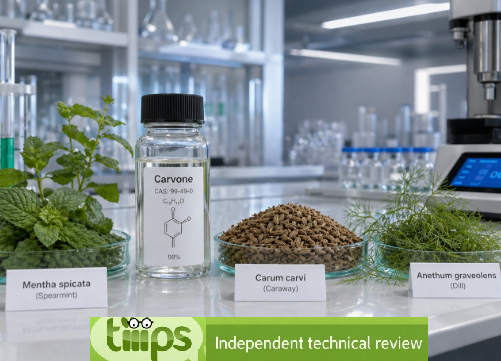
Carvone is a monoterpene ketone with the formula C10H14O and a molecular weight of about 150.22 g/mol. It is particularly interesting because it exists in two enantiomers with different olfactory profiles: (R)-(-)-carvone is associated mainly with the aroma of spearmint (Mentha spicata), while (S)-(+)-carvone is typical of caraway (Carum carvi) and dill (Anethum graveolens). For this reason, Carvone is used mainly as a flavouring and fragrance substance in foods, oral care, perfumery, and cosmetics.
Description
This is a raw material of interest in both the food and cosmetic sectors, unlike many ingredients used exclusively in personal care. From a chemical standpoint, it belongs to the family of oxygenated terpenoids and is a relatively small, volatile, lipophilic molecule capable of giving aromatic notes that can range from fresh minty to caraway-like/spicy, depending on its stereochemical configuration. This difference between enantiomers is one of the classic cases in which the same molecular formula generates a very different sensory perception.
In industrial practice, Carvone is important not for any nutritional role, but for its function as a flavouring agent, fragrance component, and in some cases a sensory modifier in oral hygiene products. It is also relevant because, in the current European cosmetic framework, it is among the substances that must be considered carefully from the standpoint of skin sensitization and label declaration.
Production Process
Carvone can be obtained from natural sources or by synthesis. The natural route generally starts from essential oils rich in Carvone, especially from spearmint, caraway seeds, and dill seeds, through extraction/distillation of the essential oil followed by purification and, when necessary, fractionation to enrich the desired isomer. The starting raw materials are therefore the aromatic plant parts or seeds from which the essential oils containing the compound are obtained.
On the industrial side, Carvone can also be produced through chemical or biotechnological transformation of other terpenes, especially limonene, which is one of the most frequently cited intermediates in the synthesis route. This point is important because the market may distinguish between Carvone isolated from natural sources and Carvone obtained by conversion/synthesis, with differences relating to raw material origin, enantiomeric purity, and commercial positioning.
Key Constituents Present
In the case of the pure substance, the reference compound is Carvone itself. However, from a technical point of view, it is correct to note that there may be three commercial/regulatory references: the racemate and the two separate enantiomers. In practice, when Carvone is derived from a natural essential oil, the source material often also contains other representative terpenes such as limonene, dihydrocarvone, and, in the case of spearmint oil, compounds such as 1,8-cineole or small amounts of other monoterpenes. For this reason, it is important to distinguish between the pure molecule and the source essential oil.
Identification Data And Specifications
| Parameter | Value | Note |
|---|---|---|
| Name | Carvone | common designation |
| Chemical category | monoterpene ketone | flavour/fragrance substance |
| Molecular formula | C10H14O | compound formula |
| Molecular weight | about 150.22 g/mol | theoretical value |
| Main CAS | 99-49-0 | reference commonly associated with the racemate |
| Enantiomer CAS numbers | 6485-40-1 / 2244-16-8 | optically active forms |
| Main EC number | 202-759-5 | compound reference |
| Enantiomer EC numbers | 229-352-5 / 218-827-2 | references for the optical forms |
| FEMA | 2249 | flavour use reference |
| JECFA | 380 | international flavour reference |
| Technical origin | natural or synthetic | from essential oils or from limonene/terpene intermediates |
| Sensory profile | minty or caraway/spicy | depends on the enantiomer |
Indicative Physicochemical Properties
| Property | Indicative value | Note |
|---|---|---|
| Appearance | clear liquid | may vary slightly with isomer and temperature |
| Color | colorless or very pale yellow | typical of pure grades |
| Odor | spearmint / caraway-spicy | depends on optical configuration |
| Boiling point | about 227–231 °C | indicative value |
| Density | about 0.956–0.965 g/mL | at room temperature |
| Water solubility | low | in the range of about 1.3 g/L |
| Solubility in ethanol | good | typical of aromatic terpene compounds |
| Log P | about 2.4 | moderate lipophilicity |
| Formulation status | liquid flavour/fragrance | often used at low dosage |
These values are indicative and may show slight variations depending on commercial grade, purity, and the enantiomer considered.
Food
In the food sector, Carvone is used mainly as a flavouring substance. Its use is well known in products with a mint, caraway, or dill profile, in candies, chewing gum, confectionery, sweet sauces, and other preparations where a characteristic fresh or spicy note is desired. The FEMA documentation lists it as a flavour substance with FEMA No. 2249, JECFA No. 380, and the regulatory reference 21 CFR 182.60, with reported use levels in various food categories.
From a technical standpoint, it does not provide any meaningful nutritional contribution: its value is almost entirely sensory. In practice, it is used at low dosages to shape the aromatic profile of the product and to reinforce minty or spicy notes without necessarily using large quantities of the whole essential oil.
Cosmetics
In cosmetics and oral care products, Carvone is used mainly as a fragrance/flavour ingredient. It is particularly relevant in toothpastes, mouthwashes, breath-freshening products, mint-flavoured perfumes, and some aromatic compositions for hair care and personal care. According to the available EFSA opinion, overall oral exposure is significantly derived precisely from personal care products and flavourings.
From the European regulatory point of view, Carvone has been included among the fragrance allergens in Annex III of the EU Cosmetics Regulation. Its presence must be declared in the ingredient list when it exceeds 0.001% in leave-on products and 0.01% in rinse-off products. In addition, the transitional period provided by Regulation (EU) 2023/1545 allows the placing on the market of products not yet compliant until July 31, 2026, and their making available on the market until July 31, 2028.
Identified INGREDIENTS or substances: 2-methyl-5-(prop- 1-en-2-yl)cyclohex- 2-en-1-one;(5R)- 2-Methyl-5-prop- 1-en-2-ylcyclohex- 2-en-1-one;(5S)- 2-Methyl-5-prop- 1-en-2-ylcyclohex- 2-en-1-one
INCI Functions
Fragrance. It plays a very important role in the formulation of cosmetic products as it provides the possibility of enhancing, masking or adding fragrance to the final product, increasing its marketability. It is able to create a perceptible pleasant odour, masking a bad smell. The consumer always expects to find a pleasant or distinctive scent in a cosmetic product.
Perfuming. Unlike fragrance, which can also contain slightly less pleasant or characteristic odours, the term perfume indicates only very pleasant fragrances. Used for perfumes and aromatic raw materials.
Flavoring agent. The purpose of this ingredient is to modify the solution to impart a certain flavour. Natural flavouring extracts are rather expensive, so the cosmetic and pharmaceutical industries resort to synthesised substances that have sensory characteristics mostly similar to natural flavourings or are naturally equivalent. This ingredient is isolated through chemical processes or is synthesised from chemicals. It is also referred to as Aroma.
Pros
- It Is a highly effective flavouring substance, with strong sensory impact even at low dosage.
- The presence of two enantiomers with different odors offers good formulation flexibility between minty and spicy/caraway-like notes.
- It Can be obtained both from natural sources and by synthesis, offering different industrial sourcing options.
- It Is used in foods, oral care, and cosmetics, so it has broader application versatility than many fragrance ingredients used only in cosmetics.
- In technical contexts it has also been studied for additional uses, for example as a bioactive compound or as a sprout suppressant in potatoes, showing that it is a molecule of broad applied interest.
Cons
- It Has no relevant nutritional role: its use is almost exclusively sensory/functional.
- In cosmetics it must now also be considered a fragrance allergen with labeling obligations above threshold.
- The presence of different isomers requires attention, because origin, odor, and sometimes commercial use change depending on the optical form.
- In sensitized individuals it may cause contact or oral mucosal problems, especially in products such as toothpaste and other mint-flavoured preparations.
- Like many concentrated odor substances, it requires careful control of purity, dosage, and supplier documentation.
Safety, Regulatory Aspects, And Environment
From a safety standpoint, Carvone should not be evaluated only as a “pleasant aromatic” molecule, but also as a substance that may have allergological relevance. The literature and SCCS documents report cases of contact sensitization, including cases linked to mint-flavoured products and toothpastes. In particular, there are clinical reports of cheilitis and oral/perioral lesions in sensitized individuals exposed to Carvone in oral hygiene products.
From the cosmetic regulatory perspective, the most important point today is its inclusion in Annex III of the European regulation as a fragrance allergen that must be specifically indicated on the label above the threshold. This does not mean that Carvone is prohibited, but that its presence must be made transparent in order to protect sensitized consumers. As of April 28, 2026, the sector is still within the transitional period preceding the first deadline of July 31, 2026 for new products placed on the market.
From an environmental and production-technical point of view, the assessment depends greatly on the origin of the Carvone, the process used to obtain it, and the final matrix in which it is used. The compound is naturally derived in many supply chains, but this does not automatically remove the need for controls on purity, stability, impurities, and the toxicological profile of the finished product.
Conclusion
Carvone is a substance of considerable technical interest because it combines simple chemistry, strong sensory impact, and a variety of applications. Its main value emerges in the food, oral care, and cosmetic sectors, where it functions mainly as a flavour and fragrance component. Its most important feature is the presence of two enantiomers with different odors, an aspect that directly influences sourcing, use, and perception of the final product.
From a practical standpoint, today the central issue is not so much its aromatic functionality — which is well established — but the correct management of origin, purity, stereochemical form, and above all the cosmetic regulatory obligations linked to labeling it as a fragrance allergen. In a technical report, these are the points that deserve the greatest attention.

