



Distearoylethyl Dimonium Chloride: properties, uses, pros, cons, safety
Distearoylethyl Dimonium Chloride is a cationic surfactant and conditioning agent belonging to the esterquat family. From a chemical point of view, it is a quaternary ammonium salt with the formula C42H84ClNO4 and a molecular weight of about 702.6 g/mol. In cosmetics it is used mainly in hair products and, to a lesser extent, in some skin emulsions, where it mainly performs hair conditioning, skin conditioning, and antistatic functions.
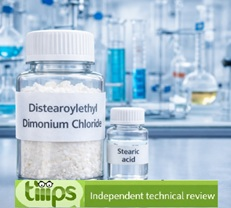
Description
It is a technical/cosmetic raw material rather than a food ingredient. Its structure includes a cationic portion, which readily adsorbs onto keratin surfaces, and two long lipid chains that contribute to its detangling, softening, and improved combability effects. In practice, it is often regarded as a next-generation conditioning agent compared with some more traditional quats, with a formulation profile oriented toward strong performance and the improved biodegradability typically associated with esterquats.
Production process
Industrial Distearoylethyl Dimonium Chloride is produced as an esterquat, starting from stearic acid derivatives and an appropriate amine/alkanolamine precursor, followed by a quaternization step. The presence of ester groups in the molecule is one of the defining features of this family of cationic conditioning agents.
In industrial practice, synthesis is followed by purification, standardization, and preparation of the commercial grade. In many products intended for cosmetic formulation, the active may be marketed in blends with other structuring components, for example Cetearyl Alcohol, in order to improve processability, consistency, and sensory performance; however, these co-formulants belong to the commercial grade and not to the essential chemical definition of the substance.
Key constituents
In the case of the pure substance, the reference compound is Distearoylethyl Dimonium Chloride itself. However, in the most common commercial grades for the personal care sector, the active is often present in a mixture with Cetearyl Alcohol, with an active content that in some products is around 65%. For this reason, in practical formulation work it is important to distinguish between the INCI name of the active and the actual composition of the purchased commercial blend.
Identification data and specifications
| Characteristic | Value | Note |
|---|---|---|
| INCI name | Distearoylethyl Dimonium Chloride | cosmetic denomination |
| Chemical category | quaternary ammonium / esterquat | cationic conditioning surfactant |
| Molecular formula | C42H84ClNO4 | reference substance |
| Molecular weight | 702.6 g/mol about | theoretical value |
| CAS number | 67846-68-8 | commonly reported identifier |
| EC number | 267-382-0 | EU identifier |
| Technical origin | synthetic / derived from fatty fractions | depends on the industrial process |
| Commercial form | pellets, flakes, or blend | often with Cetearyl Alcohol |
| Typical active content | about 65% in common commercial blends | to be checked in supplier specifications |
Physico-chemical properties (indicative)
| Characteristic | Indicative value | Note |
|---|---|---|
| Appearance | waxy solid, pellets or flakes | depends on the commercial grade |
| Color | white or off-white | may shift to light cream |
| Odor | slight or almost absent | depends on the blend |
| Solubility/dispersibility | used in hot aqueous phase | typically dispersed/melted in hot water |
| Ionic nature | cationic | high affinity for hair and skin |
| pH stability | better at acidic pH | above pH 5 the risk of hydrolysis may increase |
| Formulation compatibility | good in conditioners, masks, cationic emulsions | should be checked with anionics and complex systems |
This ingredient is particularly relevant in conditioners, hair masks, leave-in products, and some cationic body/face emulsions. Its main function is to improve detangling, combability, softness, and reduction of electrostatic effect. In technical dossiers it is often described as an ingredient with strong performance in wet combing, dry combing, and hair sensoriality, with applications also in skin care emulsions thanks to the characteristic feel of cationic bases.
From a formulation point of view, it is often used in acidic pH systems, typically around 4–4.5, because under these conditions it shows better stability. In commercial blends with Cetearyl Alcohol, it also contributes to the structure and viscosity of the formula. It should, however, be handled carefully in the presence of strongly anionic ingredients, because its cationic nature may reduce compatibility or alter system performance.
Cosmetics
Commonly associated cosmetic functions: hair conditioning, skin conditioning, antistatic; in commercial grades it may also contribute to the profile of a cationic emulsion and to the sensorial properties of the finished product.
Pros
- It is a highly effective cationic conditioning agent for detangling and improving hair combability.
- It provides a strong contribution to reducing static effect and improving tactile feel.
- In commercial blends it also helps the structure and creaminess of formulations.
- Esterquats are often valued for better biodegradability than some traditional quats.
- It can be used in both rinse-off products and some leave-in products, as well as in skin emulsions.
Cons
- It is not a food ingredient, and the food focus is effectively not relevant.
- It requires careful formulation management, especially regarding pH and compatibility with anionic systems.
- In concentrated grades or as a raw material it may require attention from a handling safety perspective, especially for eyes and skin.
- In many real-world applications it is used as a blend rather than as a pure substance, so supplier specifications must be read carefully.
- At higher pH values, the risk of hydrolysis and performance loss may increase.
Safety, regulatory aspects and environment
From a cosmetic safety perspective, evaluation should always refer to the finished product and the real use concentration, not only to the raw substance. As a concentrated raw material or in technical blends, SDS documents may report significant handling warnings, including risks of skin irritation or serious eye damage in some concentrated commercial forms. This does not automatically mean the same level of risk in the finished cosmetic, but it does require proper formulation and toxicological assessment.
From an environmental point of view, Distearoylethyl Dimonium Chloride belongs to the esterquat group, which is often described as readily biodegradable or at least more favorable than older quaternary conditioning agents. However, real sustainability depends on the production process, the commercial grade, the final formulation, and the full ecotoxicological profile of the product.
Conclusion
Distearoylethyl Dimonium Chloride is an ingredient of almost exclusively cosmetic interest, where it plays an important role as a cationic conditioning agent for hair and, in some formulations, for skin. Its main value emerges in products aimed at softness, detangling, antistatic performance, and rich but controlled sensoriality. From a technical point of view, the key points are the management of pH, the distinction between pure active and commercial blend, and the correct evaluation of formulation compatibility.

