REVIEW
Review

Al222 (26685 pt) • 2026-Feb-27 17:53
Chocolate brown HT : properties, uses, pros, cons, safety
Chocolate brown HT (E155 is the E-number for the food colour. (common synonyms: Brown HT, Food Brown 3, C.I. 20285). It is a synthetic colour belonging to the azo dye class (diazo), typically supplied as a disodium sulfonated salt, designed to provide a stable brown shade and to replace or visually reinforce “cocoa/caramel-like” tones in various food matrices.
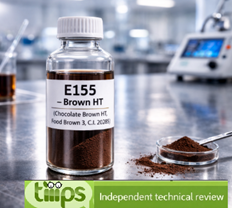
Definition
Chocolate Brown HT is a water-soluble colour (thanks to sulfonate groups) used to achieve a stable, reproducible brown colour. As with many azo colours, the key evaluation points are purity, the profile of aromatic impurities, and compliance with the authorised use conditions and maximum levels in the relevant categories.
Production process
It is produced via organic synthesis through diazotisation and azo coupling reactions, followed by sulfonation (to increase solubility) and purification, filtration, and drying. For food-grade material, critical controls include residual inorganic salts, reaction by-products, and identity/assay parameters (spectral profile, colouring strength).
Key constituents
The functional component is Brown HT in the salt form defined by the specifications. Trace components (within specification) may include salts (e.g., sodium), moisture, and synthesis-related impurities (to be minimised and controlled by specifications).
Identification data and specifications
| Characteristic | Value | Note |
|---|
| Additive name | E155 | E-number |
| Common name | Brown HT | “Chocolate brown HT”, “Food Brown 3” |
| Chemical class | azo dye (diazo) | synthetic |
| Molecular formula | C₂₇H₁₈N₄Na₂O₉S₂ | disodium salt form |
| Molecular weight | ≈ 652.6 g/mol | indicative value |
| CAS number (commonly reported) | 4553-89-3 | frequently used identifier |
| Technological function | colour | provides/enhances brown colour |
Physicochemical properties (indicative)
| Characteristic | Indicative value | Note |
|---|
| Physical state | powder | brown to reddish-brown |
| Water solubility | good | typical of sulfonated dyes |
| Oil solubility | negligible | typical behaviour |
| Heat stability | generally good in moderate processing | depends on matrix and pH |
| Light sensitivity | possible over time | depends on packaging and formulation |
| pH stability | variable | very acidic/basic systems may shift shade |
| Interactions | possible sensitivity to strong oxidants/reductants | can affect tone and intensity |
Functional role and mechanism of action
The function is purely colourant: the dissolved/dispersed dye selectively absorbs light and delivers the desired brown shade. In formulation, compatibility with pH, ions, potential oxidants (e.g., matrices under strong oxidative stress), and management of light/shelf-life stability are the main technical points.
Main uses in food
It is used as a food colour in authorised categories where a stable brown is required (e.g., to obtain “cocoa/caramel” tones or to standardise the appearance of processed products). Actual use depends on the applicable legislation and the maximum permitted levels for each category.
Pros and cons
Pros
Strong colour performance and reproducibility compared with many natural colour sources.
Generally good solubility and ease of use in aqueous systems.
Useful when avoiding variability typical of natural colouring ingredients.
Cons
It is a synthetic colour: it may be less acceptable to “clean label” consumers.
As with other azo colours, it requires strict control of specifications and impurities.
In high consumers of coloured foods, overall exposure can become a dietary-management topic (depending on habits and actual use levels).
Safety, regulatory, and practical aspects
Safety profile (practical)
For Brown HT, authorities have established an ADI (acceptable daily intake) and exposure evaluations showing that, at maximum levels in some categories, high consumers of products containing the colour may approach or exceed the ADI. In practice, safe use depends on compliance with category limits, actual use levels, and overall consumption patterns.
Allergen
It is not a “classic” declarable food allergen. However, as with several colours, intolerance-like reactions or individual sensitivities can occur in predisposed subjects (generally rare and highly variable).
Contraindications and cautions
For products aimed at sensitive populations, it is prudent to assess the opportunity of use and to target the lowest technologically effective levels. In product development, check stability to light, pH, and interactions with oxidising/reducing ingredients in the matrix.
Conclusion
Chocolate brown HT is a synthetic azo food colour effective for delivering stable, reproducible brown shades. Its main advantages are technological performance and ease of use; its limitations relate to “clean label” acceptability and the need for rigorous management of specifications, use limits, and overall exposure considerations.
Safety
The problem with azo dyes (monoazo or diazo) is photocatalytic degradation leading to oxidation and subsequent formation of impurities such as aromatic amines some of which have carcinogenic activity.
This study finds that following repeated daily dosing, despite the rapid elimination of most of an oral dose of Brown HT, some metabolites accumulate in most tissues of laboratory animals (1).
No adverse effects were observed in this long-term study (2) and no adverse effects in this other study in three generations of rats (3).
A reduction in HDL-cholesterol and a decrease in weight of the rats was observed (4).
References_____________________________________________________________________
(1) Phillips JC, Mendis D, Gaunt IF. Metabolic disposition of 14C-labelled Brown HT in the rat, mouse and guinea-pig. Food Chem Toxicol. 1987 Dec;25(12):1013-9. doi: 10.1016/0278-6915(87)90297-3.
Abstract. The absorption, metabolism, tissue distribution and excretion of 14C-labelled Brown HT has been studied in the rat, mouse and guinea-pig. Following administration of a single oral dose of either 50 or 250 mg Brown HT/kg, substantially all of the dose was excreted in the urine and faeces within 72 hr, with the majority (more than 80%) being accounted for in the faeces. A significant difference in urinary excretion of radioactivity was seen between male and female rats, as well as clear species differences at the two dose levels used. In all species studied, naphthionic acid was the major urinary metabolite, whereas in the faeces naphthionic acid, trace quantities of unchanged dye and at least two unidentified metabolites were found. Pregnant rats eliminated a single oral dose of 14C-labelled colouring at a rate similar to that in non-pregnant females, but some retention of radioactivity was found in the foetuses. Radioactivity was present in all tissues of male rats 24 hr after an oral dose of 250 mg 14C-labelled Brown HT/kg, with the highest concentrations in the gastro-intestinal tract, kidney and lymph nodes. Clearance from the gastro-intestinal tract was more rapid than from other tissues, but by day 7, the concentration of radioactivity (less than 0.001% of the dose/g) was similar in all tissues except the kidney and mesenteric lymph nodes. Similar results were obtained with animals pretreated for 21 days with either unlabelled or 14C-labelled Brown HT (250 mg/kg/day) prior to a radioactive dose. For most tissues examined, the concentration of radioactivity was greater with pretreatment than without. These results suggest that despite the rapid reduction and elimination of the major part of an oral dose of Brown HT, some colouring and/or metabolites accumulate in most tissues of male rats during repeated daily administration, but that only in the kidney and mesenteric lymph nodes is the accumulation tissue-specific. The accumulated radioactivity is cleared rapidly from most tissues on cessation of treatment. No significant absorption of either Brown HT, metabolites or subsidiary dyes was detected using isolated loops of small intestine.
(2) Carpanini FM, Butterworth KR, Gaunt IF, Kiss IS, Grasso P, Gangolli SD. Long-term toxicity studies on Chocolate Brown HT in rats. Toxicology. 1978 Nov;11(3):303-7. doi: 10.1016/s0300-483x(78)91839-5.
Abstract. Groups of 48 males and 48 female rats were given diets containing 0 (control), 500, 2000 or 10,000 ppm Chocolate Brown HT for 2 years. These treatments had no adverse effect on mortality, body-weight gain, food or water consumption, haematology, renal function, serum constituents, organ weight or histopathology. From the incidence of tumours observed in the control and test animals it is concluded that Chocolate Brown HT did not exert any carcinogenic effect and that the no-untoward-effect level was 10,000 ppm.
(3) Mangham BA, Moorhouse SR, Grant D, Brantom PG, Gaunt IF. Three-generation toxicity study of rats ingesting Brown HT in the diet. Food Chem Toxicol. 1987 Dec;25(12):999-1007. doi: 10.1016/0278-6915(87)90295-x.
Abstract. Brown HT was fed to rats of both sexes over three generations at dietary concentrations designed to provide daily intakes of 0, 50, 250 and 500 mg Brown HT/kg body weight/day. During the study a number of females died or failed to nurse their litters. This was so severe following the first mating of F1 adults that the animals were remated to provide the next generation. None of these effects were related to treatment. Body weight and food and water intakes were not adversely affected by treatment. No effects of treatment were seen on reproductive performance or foetal and pup development, apart from slight evidence of a treatment-related retarded ossification of the third sternebrae. Organ weights at autopsy showed two changes, one of which was increased kidney weights which, although not present in every generation, seemed to be related to treatment. The other, increased caecum weights, occurred in adult high-dose females of early generations, but not in males or later generations of the study. Apart from brown coloration of tissues, macroscopic and microscopic examination revealed no treatment-related changes. It was concluded that the no-untoward-effect level in the present study was 250 mg Brown HT/kg/day.
(4) Aboel-Zahab H, el-Khyat Z, Sidhom G, Awadallah R, Abdel-al W, Mahdy K. Physiological effects of some synthetic food colouring additives on rats. Boll Chim Farm. 1997 Nov;136(10):615-27.
Abstract. Three different synthetic chocolate colourant agents (A, B and C) were administered to healthy adult male albino rats for 30 and 60 day periods to evaluate their effects on body weight, blood picture, liver and kidney functions, blood glucose, serum and liver lipids, liver nucleic acids (DNA and RNA), thyroid hormones (T3 and T4) and growth hormone. In addition, histopathological examinations of liver, kidney and stomach sections were studied. These parameters were also investigated 30 days after colourant stoppage (post effect). Ingestion of colourant C (brown HT and indigocarmine) significantly decreased rat body weight, serum cholesterol and HDL-cholesterol fraction, while, T4 hormone, liver RNA content, liver enzymes (S. GOT, S. GPT and alkaline phosphatase), total protein and globulin fractions were significantly elevated. Significant increases were observed in serum total lipids, cholesterol, triglycerides, total protein, globulin and serum transaminases in rats whose diets were supplemented with chocolate colours A and B (sunset yellow, tartrazine, carmoisine and brilliant blue in varying concentrations). Haematological investigations demonstrated selective neutropenia and lymphocytosis with no significant alterations of total white blood cell counts in all rat groups, while haemoglobin concentrations and red blood cell counts were significantly decreased in the rats who were administered food additives A and B. Eosinophilia was noted in rats fed on colourant A only. No changes were recorded for blood glucose, growth hormone and kidney function tests. Histopathological studies showed brown pigment deposition in the portal tracts and Van Küpffer cells of the liver as well as in the interstitial tissue and renal tubular cells of the kidney mainly induced by colourant A. Congested blood vessels and areas of haemorrhage in both liver and renal sections were revealed in those rats who were given colourants B and C. There were no-untoward-effects recorded in the stomach tissue.




