



Natural orange flavor: properties, uses, pros, cons, safety
Definition
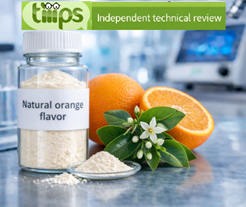
Natural orange flavor is a flavoring ingredient obtained from natural raw materials attributable to sweet orange Citrus sinensis (family Rutaceae) and/or other natural sources that deliver an “orange” sensory profile consistent with the declared name. In practice, it may be an essential oil (typically from peels), a terpene/terpenoid fraction, or a standardised extract/distillate. On label, “natural” indicates that the flavoring substances come from natural sources and authorised processes; the specificity “orange” depends on the applicable regulatory framework and on the link between origin and the declared aromatic profile.
Production process
Depending on the flavor type, common processes include:
Cold pressing of peels (to obtain orange essential oil).
Distillation (steam or fractionated) to select more stable fractions or remove undesired components.
Extraction with suitable solvents (where allowed) followed by solvent removal.
Concentration and standardisation (profile correction with natural fractions) to ensure batch-to-batch consistency.
For food use, key controls include purity, residues, oxidation status, and the presence of photoreactive components (e.g., some furocoumarins—more typical of other citrus but relevant as a quality-control logic).
Key constituents
Composition depends on technology (essential oil vs extract vs distillate), but typical orange constituents include terpenes and aromatic aldehydes/alcohols.
D-limonene: generally the dominant component in orange essential oils; it provides the main “citrus” note. From a health standpoint it is present at very low levels in finished foods; the main criticality is oxidation (formation of more irritating oxidised products) and, in predisposed individuals, potential sensitisation (more relevant in cosmetics).
Citrus aldehydes (e.g., trace citral, decanal, octanal): contribute fresh “peel” notes. Potential downside: they can be more reactive, affecting stability (loss of freshness) and, at higher concentrations, may increase irritation risk (more relevant in cosmetics than in foods).
Aromatic alcohols and esters (linalool, acetates, etc., variable): add roundness and complexity. Potential downside: some (e.g., linalool) can oxidise and become more sensitising.
Minor terpenes: contribute body and character. Potential downside: they increase lipophilic fraction and oxidation sensitivity if not adequately protected.
Identification data and specifications
| Parameter | Value | Note |
|---|---|---|
| Ingredient name | Natural orange flavor | May be essential oil or a standardised blend/extract |
| Botanical name | Citrus sinensis | Family: Rutaceae |
| Plant part | Mainly peel (for essential oils) | Possible contributions from juice/distillates |
| Nature | Mixture of natural flavoring substances | Standardised “orange” profile |
| Key parameters | GC profile, purity, peroxide/oxidation index, residues, stability, flavor intensity | Consistency and safety drivers |
| Allergen | Not typical in foods | Possible individual sensitisation; attention to oxidised fractions |
| Caloric value | Not meaningful at use levels | Typical doses are very low |
| Molecular formula | Not applicable | Mixture of compounds |
| Molecular weight | Not applicable | Complex mixture |
Physico-chemical properties (indicative)
| Property | Indicative value | Note |
|---|---|---|
| Physical state | Liquid (sometimes powder on a carrier) | Depends on presentation |
| Colour | Colourless → yellow | Varies with refining/oxidation |
| Odour | Citrus, orange | Intensity and “peel” note vary |
| Water solubility | Low (if oil-based) | Improved via emulsification or carriers |
| Stability | Medium | Sensitive to light/oxygen/heat |
| Typical criticalities | Oxidation, loss of “fresh” top notes, incompatibility in aqueous systems | Requires protection and proper dispersion |
Main uses
Food
Used to flavour beverages, baked goods, creams, ice cream, confectionery, yogurt and sweet preparations. It provides citrus top notes and improves freshness perception. In aqueous systems it is often supplied as an emulsion or on carriers to ensure dispersion and stability.
Cosmetics
May be used as an odour component in fragrances and rinse-off/leave-on products, with attention to thresholds and potential sensitisation, especially if oxidised fractions are present or if components fall under fragrance-allergen declarations.
INCI functions. Fragrance (when used for perfuming).
Industrial use
Semi-finished flavor systems (emulsions, spray-dried flavors on maltodextrins or gums) to improve dosing accuracy and processing stability.
Health aspect
At typical food-use levels, natural orange flavor has negligible nutritional impact; interest is mainly in tolerability, quality and stability (preventing oxidation/degradation).
Pros
Delivers a strong “orange” profile at very low doses, improving sensory acceptability without adding sugars or acids in meaningful amounts.
Cons
The main criticality is oxidation: if the flavor is old or poorly stored, it may develop rancid notes and potentially more irritating compounds. Predisposed individuals may experience sensitisation, which is generally more relevant in cosmetics than in foods.
Serving note
Not applicable nutritionally: dose is formulation-driven and typically very low.
Safety (allergens, contraindications)
Not a typical food allergen, but individual reactions can occur. Safety depends on product quality (purity, absence of contaminants/residues) and oxidation control. In cosmetics, some constituents (or their oxidised products) may require specific declarations and sensitisation assessment according to applicable rules.
Storage and shelf-life
Store tightly closed, preferably in dark glass or oxygen-barrier packaging, protected from light and heat. Minimise air exposure (oxygen) and close promptly after use. Industrially, supportive antioxidants and headspace inerting are often used where compatible.
Labelling
In foods it may appear as “natural orange flavor” under applicable rules. Exact wording and “natural” usage depend on regulatory requirements and supplier specification. In cosmetics, naming follows the finished-product ingredient list; fragrance allergens must be managed according to thresholds and applicable rules.
Functional role and rationale for use
Its primary role is flavouring: it delivers orange notes (peel/juice) and fresh citrus top notes. Formulation drivers are dispersion (water vs fat) and oxidation protection to maintain aromatic consistency.
Formulation compatibility
In aqueous systems, emulsifiers or encapsulated/spray-dried forms may be needed to prevent separation and aroma loss. In baked goods, some volatiles can evaporate; this is often balanced via appropriate dosing or using more stable fractions. In fat-based matrices, solubility is better, but oxidation must be managed.
Safety, regulatory and quality
GMP/HACCP and quality controls consistent with food flavors: traceability, purity, contaminants, oxidative stability and GC-profile consistency. Robust specifications reduce sensory drift and non-conformity risk.
Conclusion
Natural orange flavor (Citrus sinensis) is a flavouring ingredient used to deliver citrus notes at low dosages across many food applications and, in some cases, cosmetics. Key drivers are oxidation stability, profile consistency and formulation compatibility (dispersion/emulsification). Nutritional impact is negligible, while quality and storage are central to sensory safety and tolerability.
Mini-glossary
GC (gas chromatography): analytical technique used to define the profile of volatile flavor constituents.
D-limonene: the main terpene in orange essential oil, responsible for the dominant citrus note.
Oxidation: degradation of aroma components leading to rancid notes and potentially increased reactivity/sensitisation.
Spray-drying: drying technique that encapsulates flavors on powder carriers to improve stability and dosing.
GMP/HACCP: good manufacturing practices (GMP) and the hazard analysis and critical control points (HACCP) system for safety and contamination prevention.

