



Calcium citrate: properties, uses, pros, cons, safety
Calcium citrate is the calcium salt of citric acid. In food, it is encountered both as an additive (the E333 calcium citrates family) and as a source of calcium in fortified foods and dietary supplements. From a technological standpoint, it is valued for its acidity regulator and buffering functions, as well as for its sequestrant action (binding metal ions), which can support the stability of certain food matrices.
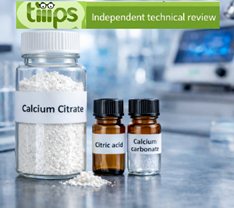
Definition
“Calcium citrate” typically refers to a family of salts: monocalcium citrate (E333(i)), dicalcium citrate (E333(ii)), and tricalcium citrate (E333(iii)). Changing the calcium/citrate ratio affects solubility, solution pH, and formulation behavior. On labels, the generic wording “calcium citrate” or “calcium citrates” is commonly used.
Production process
Industrial production generally involves controlled neutralization of citric acid with a calcium source (for example calcium hydroxide or calcium carbonate), followed by crystallization/precipitation, separation, washing, and drying to specification. For food grade quality, key controls include purity, heavy metals, hydration state (some forms are hydrated), and consistent particle size.
Key constituents
In a product meeting specifications, the constituents essentially correspond to the salt itself: calcium citrate (mono/di/tri-calcium forms, often hydrated) and water of crystallization when present. The most relevant practical differences relate to degree of hydration, powder fineness, and overall purity.
Identification data and specifications
| Characteristic | Value | Note |
|---|---|---|
| Name | calcium citrate / calcium citrates | family of citric acid salts |
| E number | E333 (i–iii) | acidity regulator / sequestrant |
| Representative form | tricalcium citrate | often the most common “reference” form |
| Molecular formula | Ca₃(C₆H₅O₇)₂ (anhydrous) | hydrated forms exist (e.g., tetrahydrate) |
| Molecular weight | 498.43 g/mol (anhydrous) | higher for hydrated forms |
| CAS number | 813-94-5 (tricalcium citrate) | other forms may have distinct CAS numbers |
| EC number (EINECS) | 212-391-7 | EU identifier for tricalcium citrate |
| Caloric value | 0 kcal | mineral salt, no energy contribution |
| Typical food function | acidity, buffering, sequestrant | and, where relevant, calcium source |
Physicochemical properties (indicative)
| Characteristic | Indicative value | Note |
|---|---|---|
| Physical state | powder/crystals | generally white |
| Odor | none | typical of organic salts |
| Water solubility | low–moderate | depends on mono/di/tri form and hydration |
| Alcohol solubility | negligible | typical behavior |
| Thermal behavior | stable under normal processing | not a leavening agent |
| Effect on pH | slightly acidic to buffering | depends on the specific calcium citrate and matrix |
| Interactions | chelation of metal ions | useful to reduce some metal-catalyzed oxidation |
Functional role and mechanism of action
As an acidity regulator, it helps stabilize pH and dampen acid/base fluctuations in a recipe (a buffering role, often alongside other citrates/acids). As a sequestrant, citrate can bind metal ions (e.g., trace iron/copper) that may catalyze oxidation reactions; this can support color and flavor stability in sensitive products.
When used as a calcium source, the goal is to increase calcium content in fortified foods or supplements. In practical terms, performance depends on dose, the matrix, and consumption conditions (for example, whether taken with meals, in the supplement context).
Main uses in food
In foods and beverages it may be used to:
Support acidity regulation in selected formulations (pH stability and taste profile).
Act as a sequestrant to improve stability where trace metals are critical.
Contribute as a calcium source in fortified foods (depending on regulations and the manufacturer’s nutritional target).
Cosmetics - INCI Functions
Buffering agent. It is an iingredient that can bring an alkaline or acid solution to a certain pH level and prevent it from changing, in practice a pH stabiliser that can effectively resist instability and pH change.
Pros and cons
Pros
Strong technological value as a buffer and acidity regulator.
Sequestrant action can be useful for oxidative stability in certain matrices.
Potential use as a calcium source with generally neutral sensory impact (at recipe-compatible doses).
Cons
Limited solubility: in some beverages or high-clarity systems it can be a constraint (haze/sediment if not managed).
At high dosages it may create “chalky” mouthfeel/astringency or alter texture.
As a calcium source, it may have interactions with certain nutrients/medications and requires attention to total calcium intake.
Safety, regulatory, and practical aspects
Safety profile in the finished product
As E333, calcium citrate is used within applicable limits and good manufacturing practice. EU specifications include purity requirements and contaminant limits (heavy metals), with stricter considerations in sensitive contexts (e.g., infant and young child foods).
Allergen
It is not a declarable food allergen. The main considerations relate to dose and individual conditions affecting calcium metabolism.
Contraindications and practical cautions
In individuals prone to hypercalcemia, kidney stones, or significant renal impairment, calcium supplementation should be handled cautiously. In addition, calcium can reduce absorption of some medicines (for example certain antibiotic classes or thyroid hormones) if taken together; this is often managed by separating dosing times.
Conclusion
Calcium citrate (E333) is a versatile ingredient: technologically useful as an acidity regulator/buffer and sequestrant, and nutritionally usable as a calcium source. Practical limitations are mainly related to solubility and sensory/process management, plus the need to consider total calcium intake in consumers who also use supplements (1).
Molecular Formula: C12H10Ca3O14
Linear Formula: Ca3(C6H5O7)2 · 4H2O
Molecular Weight: 498.432 g/mol
UNII: 86117BWO7P
CAS: 813-94-5 5785-44-4 12405-04-8
EC Number: 212-391-7
PubChem Substance ID 329752082
MDL number MFCD00150786
Beilstein Registry Number 3924520
Synonyms:
- Tricalcium dicitrate
- E333
- Acicontral
- Tribasic calcium citrate
- Calcitrate
- Citracal
- 1,2,3-Propanetricarboxylic acid, 2-hydroxy-, calcium salt (2:3)
- Calcium 2-hydroxy-1,2,3-propanetricarboxylate (3:2)
- 2-Hydroxy-1,2,3-propanetricarboxylic acid calcium salt (2:3)
- Calcitrate
- tricalcium 2-hydroxypropane-1,2,3-tricarboxylate
- Lime citrate
- tricalcium citrate tetrahydrate
- Citrical
- Calcium citrate, tribasic
- calcium 2-hydroxypropane-1,2,3-tricarboxylate (3:2)
- 2-hydroxy-1,2,3-propanetricarboxylic acid calcium salt (2:3); tricalcium citrate
References_____________________________________________
(1) Palermo A, Naciu AM, Tabacco G, Manfrini S, Trimboli P, Vescini F, Falchetti A. Calcium citrate: from biochemistry and physiology to clinical applications. Rev Endocr Metab Disord. 2019 Sep;20(3):353-364. doi: 10.1007/s11154-019-09520-0.
Abstract. Adequate daily calcium intake should normally be achieved by dietary sources. Since low calcium diets are quite common in subjects that do not reach the recommended intake and particularly those at risk of fractures, calcium supplements may become necessary. Different forms of calcium salts are available, but products containing calcium citrate and calcium carbonate complexes are the most frequently used. Although only limited evidence on the efficacy and long-term safety of calcium citrate is available, these supplements may represent a valuable product for the management of different chronic pathological conditions. The aim of this review was to evaluate the current and potential clinical applications of calcium citrate. In particular, we focused on the use of calcium citrate supplementation in subjects with osteoporosis or in bariatric patients. Other pathological conditions that could benefit calcium citrate supplementation may include achloridria, chronic hypoparathyroidism and hypocitraturic subjects with moderate/high risk of nephrolithiasis. Indeed, citrate salts are widely used in the treatment of nephrolithiasis, since they have shown an inhibitory effect on kidney stone formation and recurrence.
(2) Sereda G, Saeedi S. Pre-treatment of dentin with chondroitin sulfate or L-arginine modulates dentin tubule occlusion by toothpaste components. Am J Dent. 2019 Apr;32(2):81-88
Quesada Gómez JM, Blanch Rubió J, Díaz Curiel M, Díez Pérez A. Calcium citrate and vitamin D in the treatment of osteoporosis. Clin Drug Investig. 2011;31(5):285-98. doi: 10.1007/BF03256927.
Abstract. The combination of calcium with vitamin D (vitamin D(3) [colecalciferol]) forms the basis of preventive and therapeutic regimens for osteoporosis. A number of studies have suggested that the combination of calcium and vitamin D is effective when administered at respective dosages of at least 1200 mg and 800 IU per day, although efficacy is, as expected, affected by patient compliance. Overall, treatment with this combination appears to be effective in reducing the incidence of non-vertebral and hip fractures. Also, in all drug studies (of antiresorptive and anabolic agents and strontium ranelate) that demonstrated a reduction in risk of osteoporotic fractures, patients also took calcium and vitamin D supplements. An important finding in this regard is that vitamin D levels have been demonstrated to be inadequate in more than half of women treated for osteoporosis in the US and Europe. The capacity of the small intestine to absorb calcium salts depends on the solubility and ionization of the salts. These properties vary for different salts, with fasting calcium citrate absorption being greater than that of calcium lactogluconate and calcium carbonate. Calcium citrate formulations taken between meals may help to prevent abdominal distension and flatulence, as well as minimize the risk of renal calculus formation, thus helping to optimize patient compliance. Therefore, calcium citrate combined with vitamin D is the combination of choice for the prevention or treatment of osteoporosis.
Naciu AM, Tabacco G, Bilezikian JP, Santonati A, Bosco D, Incognito GG, Gaspa G, Manfrini S, Falchetti A, Trimboli P, Mazziotti G, Napoli N, Sanson G, Cesareo R, Vescini F, Palermo A. Calcium Citrate Versus Calcium Carbonate in the Management of Chronic Hypoparathyroidism: A Randomized, Double-Blind, Crossover Clinical Trial. J Bone Miner Res. 2022 Jul;37(7):1251-1259. doi: 10.1002/jbmr.4564. Epub 2022 Jun 24. PMID: 35466449; PMCID: PMC9542059.

