



Black rice flour: properties, uses, pros, cons, safety
Definition
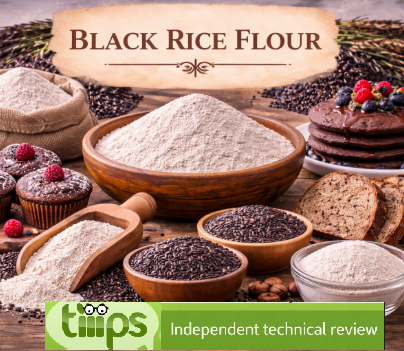
Black rice flour is obtained by milling black rice (Oryza sativa, family Poaceae), generally starting from whole-grain kernels (with bran layers intact) that provide the characteristic dark/purple colour. Compared with white rice flour, it tends to have a more intense sensory profile and a higher share of “outer-layer” components (higher fibre if truly whole grain), as well as pigment compounds such as anthocyanins. It is naturally gluten-free, but “gluten-free” suitability depends on supply-chain control and cross-contact management.
Production process
The typical process includes cleaning and sorting, optional stabilisation/drying to target moisture, then milling (roller or stone) and sifting to define particle size. For fine flours, milling optimisation reduces gritty mouthfeel and improves dispersion in doughs/batters. Industrial critical points include moisture control, microbiological load, foreign bodies and colour consistency (linked to variety and batch).
Key constituents
The matrix is dominated by starch (carbohydrates), with smaller amounts of rice proteins and trace lipids. If whole-grain, it includes more fibre and a more evident mineral fraction than refined flours. Black rice is characterised by anthocyanins (polyphenolic pigments) concentrated in the outer layers, contributing to colour and part of the flavour profile.
Practical note: the pigment fraction can lead to variable tones (purple → brown) and can influence the final colour of doughs and baked products.
For more information: Black rice
Identification data and specifications
| Parameter | Value | Note |
|---|---|---|
| Ingredient name | Black rice flour | Often made from whole black rice |
| Botanical name | Oryza sativa | Family: Poaceae |
| Plant part | Caryopsis (often whole grain) | Bran layers = colour + fibre |
| Nature | Starch-based powder | Characteristic dark/purple colour |
| Key parameters | Moisture, particle size, colour, microbiological load, storage stability | Yield and consistency drivers |
| Allergen | No (intrinsic) | Attention to gluten cross-contact risk |
| Caloric value | Typically ~350–380 kcal/100 g | Depends on moisture and refining degree |
Physico-chemical properties (indicative)
| Property | Indicative value | Note |
|---|---|---|
| Physical state | Powder | Fine to medium depending on use |
| Colour | Dark purple → brown | Varies by variety and batch |
| Odour | Cereal, slightly toasted/earthy | Depends on whole-grain fraction and freshness |
| Water solubility | Insoluble | Forms dispersions; starch gelatinises on heating |
| Water absorption | Medium | Increases with fibre and fineness |
| Stability | Good if kept dry | Key issues: moisture and odour uptake |
| Typical criticalities | Gritty texture if coarse, colour variability | Driven by particle size and batch |
Main uses
Food
Used in baked goods and preparations where a naturally dark colour and more distinctive flavour are desired: biscuits/cookies, shortcrust, pancakes, sweet batters, bases for porridges and creams, and thickening in some applications. In gluten-free breadmaking, black rice flour is often used in blends with starches and binders to improve structure and softness, since it does not form a gluten network. In gluten-free pasta and gnocchi it can contribute colour and flavour but requires hydration and binder tuning to avoid crumbliness.
Nutrition and health
Nutritionally, it mainly provides carbohydrates (starch). If produced from whole black rice, it can offer higher fibre than refined rice flours and contains pigment compounds (anthocyanins) linked to the outer layers. Overall impact depends on the recipe (added sugars/fats) and portion size.
Pros
It can increase sensory and colour variety in gluten-free recipes and—if whole grain—contribute more fibre than white rice flours. It is useful when a “natural” dark colour is desired without cocoa or colourants.
Cons
It remains predominantly starch-based: in sweet or highly refined formulations, the “health” profile is driven mainly by the overall recipe. In gluten-free bakery it often requires blends and rheology supports to avoid fragile or dry products; and batch-to-batch colour variability can complicate industrial standardisation.
Serving note
Serving size depends on the finished product. For practical evaluation, consider the actual percentage of black rice flour in the recipe and pairing with protein/fibre/fat sources depending on the application.
Safety (allergens, contraindications)
Not an intrinsic allergen. For a gluten-free claim, a controlled supply chain and, where needed, analytical verification are essential. As with all flours, microbiological control, moisture management and pest prevention are important. In individuals with particular gastrointestinal sensitivity, increased fibre (if whole grain) should be considered within the overall diet.
Storage and shelf-life
Store in a cool, dry place, tightly closed and away from strong odours. Moisture is the most critical factor (clumping, reduced flowability); barrier packaging improves stability. Stock rotation helps maintain a clean and consistent flavour profile.
Labelling
Declare “black rice flour” (specifying “whole grain” where applicable). A gluten-free statement must be supported by coherent requirements and controls. In composite products, note added ingredients that affect allergens and nutrition profile.
Functional role and rationale for use
Its main function is to provide a starch matrix and natural colour, plus a distinctive flavour contribution. In gluten-free doughs, structure management requires blends: black rice flour contributes more to sensory identity and colour than to elasticity or gas retention. Particle size is a key driver for texture and mouthfeel.
Formulation compatibility
In gluten-free baked goods it performs well in blends with starches and binders to improve cohesion and softness. In creams/porridge, careful dispersion helps reduce lumps and achieve uniform viscosity. If the flour is coarse, gritty perception may increase: finer milling or tighter sieving improves performance.
Safety, regulatory and quality
GMP/HACCP management is relevant for traceability, contamination control, foreign bodies and batch consistency. For gluten-free positioning, supply-chain segregation and dedicated checks are critical. Clear specifications for moisture, particle size and colour reduce variability and waste.
Conclusion
Black rice flour (Oryza sativa) is a gluten-free ingredient oriented toward natural colour and sensory characterisation, useful in gluten-free bakery and mixes. Key drivers are particle size, moisture control, batch-to-batch colour consistency and—when required—rigorous gluten-free supply-chain management.
Mini-glossary
Anthocyanins: polyphenolic pigments responsible for red–purple colours; contribute to colour identity and part of the sensory profile.
Particle size: particle dimension/distribution; affects hydration, texture and perceived grittiness.
Starch gelatinisation: starch transformation with water and heat that increases viscosity and structure.
GMP/HACCP: good manufacturing practices (GMP) and the hazard analysis and critical control points (HACCP) system for food safety.

