



Wholemeal wheat flour: properties, uses, pros, cons, safety
Definition
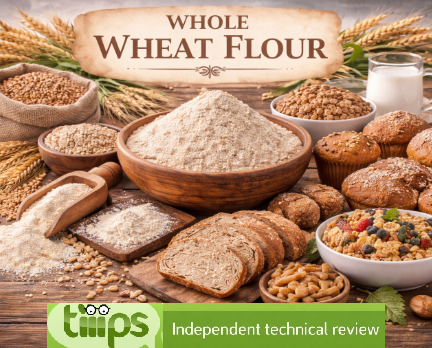
Wholemeal wheat flour is produced by milling the wheat kernel of common wheat (Triticum aestivum, family Poaceae) while retaining a significant share of the outer layers (bran) and the germ, in addition to the endosperm. Compared with more refined flours, it generally contains more fibre, higher ash (mineral fraction), and a more pronounced sensory profile (cereal/toasted notes), with variability linked to cultivar, extraction rate and particle size. It contains gluten and is therefore not suitable for gluten-free diets.
Production process
The process includes cleaning and sorting the grain, tempering to controlled moisture, then milling (roller or stone) and sifting. To obtain “wholemeal”, the sifting system is set to retain (or recombine) bran and germ in proportions defined by the specification (extraction). This is followed by controls on moisture, microbiological load, pests and packaging in barrier materials. Germ presence increases sensitivity to oxidation compared with refined flours, making storage and stock rotation more critical.
Key constituents
The matrix contains mainly starch, wheat proteins (gliadins and glutenins, i.e., gluten), dietary fibre (mainly in the outer fractions), lipids at higher levels than refined flours (due to the germ), trace minerals (e.g., phosphorus, magnesium, potassium), variable levels of B-group vitamins, and trace phenolic compounds associated with bran.
Practical note: the higher lipid fraction from the germ can increase the likelihood of rancid notes if the flour is exposed to heat, light and oxygen.
Identification data and specifications
| Parameter | Value | Note |
|---|---|---|
| Ingredient name | Wholemeal wheat flour | Commercial wording may vary by supply chain and standard |
| Botanical name | Triticum aestivum | Family: Poaceae |
| Plant part | Caryopsis (endosperm + bran + germ) | Extraction rate defines “how whole” |
| Nature | Starch–protein–fibre powder | More pronounced sensory profile than refined flours |
| Key parameters | Protein, gluten quality, ash, moisture, particle size, amylase activity | Dough performance, yield and consistency drivers |
| Allergen | Yes: gluten (wheat) | Not suitable for coeliac disease |
| Caloric value | Typically ~330–370 kcal/100 g | Depends on moisture and extraction |
Physico-chemical properties (indicative)
| Property | Indicative value | Note |
|---|---|---|
| Physical state | Powder | From fine to “rustic” depending on milling |
| Colour | Beige → brown | Increases with bran content |
| Odour | Cereal, lightly toasted | Rancid notes indicate oxidation |
| Water solubility | Insoluble | Forms dough; starch gelatinises on heating |
| Water absorption | Medium–high | Increases with fibre and fineness |
| Stability | Good if dry and protected | More oxidation-sensitive than refined flours |
| Typical criticalities | Denser doughs, lower volume, rheology variability | Driven by batch, extraction and process |
Main uses
Food
Used for wholemeal bread and “brown” leavened products, rustic pizza/focaccia, biscuits/cookies and baked goods with a stronger flavour. In breadmaking, bran can interfere with gluten development and gas retention: higher hydration, autolysis/longer fermentation, or blending with stronger flours is often used to improve volume and crumb structure.
Cosmetics
Not a core use: it may appear as a powder component in scrubs or masks only when cosmetic-grade and microbiological specifications are appropriate.
Industrial use
Dry mixes and bakery semi-finished products: key drivers are moisture consistency, particle size, rheological performance and oxidation management (flavour freshness).
Nutrition and health
Compared with refined flours, wholemeal typically provides more fibre and a higher mineral fraction (higher ash), while energy per 100 g remains typical for cereal flours. Overall effects depend on the finished product (bread, biscuits, pizza) and the consumed portion.
Pros
It can increase fibre intake relative to refined flours and may support greater satiety in balanced recipes. Its richer sensory profile can reduce the need for strong flavouring in some formulations.
Cons
It contains gluten and is contraindicated for coeliac disease. In breadmaking it may produce denser doughs and lower volume when used alone, requiring process tuning. Shelf-life can be more critical due to higher oxidation sensitivity (germ).
Serving note
Serving size depends on the finished product. For a practical assessment, consider recipe, fermentation and the actual proportion of wholemeal flour in the product, together with the portion consumed.
Safety (allergens, contraindications)
Allergen: gluten (wheat). Contraindicated for coeliac disease and for anyone on a gluten-free diet. Control of typical flour contaminants and pests is important, as is moisture management and correct storage to limit sensory defects and oxidative deterioration.
Storage and shelf-life
Store in a cool, dry place in tightly closed containers with good moisture and oxygen barrier. Wholemeal flours tend to lose freshness faster: stock rotation, controlled temperature and protection from light/heat reduce the risk of rancid notes.
Labelling
Declare “wholemeal wheat flour” and indicate the allergen wheat/gluten according to applicable rules. Any claims (e.g., “wholemeal”, “organic”) must align with relevant requirements and certifications.
Functional role and rationale for use
It provides structure through the gluten network and texture through starch, while bran and germ contribute sensory character and water absorption. Bran can disrupt the gluten network and reduce expansion, affecting volume and softness; process management (hydration, fermentation, mixing) is therefore a key technical driver.
Formulation compatibility
In breadmaking it often needs higher hydration and longer times; blending with stronger flours improves volume and handling. In sweet baked goods it can make cereal notes dominant and increase friability, requiring balancing with fats and sugars. Batch-to-batch variability (protein, enzyme activity, particle size) can require small operational adjustments.
Safety, regulatory and quality
Implementation of GMP/HACCP is relevant for contamination control, traceability, pests, moisture and performance consistency. In industrial settings, clear specifications (ash/extraction, protein, particle size, microbiological parameters) reduce variability and waste.
Conclusion
Wholemeal wheat flour (Triticum aestivum) is a gluten-containing flour with a more “complete” profile than refined versions due to bran and germ. It suits wholemeal and rustic products, but requires careful technical management to compensate for fibre effects on gluten development and loaf volume. Main drivers are batch consistency, moisture and oxidation control, gluten allergen management, and hydration/fermentation tuning for the target application.
Mini-glossary
Wholemeal: flour retaining a significant share of bran and germ, with higher fibre and minerals than refined flours.
Germ: kernel fraction richer in lipids; increases oxidation sensitivity in wholemeal flours.
Ash: indicator of mineral fraction; increases with higher extraction/wholemeal flours.
Gluten: protein complex (gliadins + glutenins) responsible for dough elasticity and structure.
GMP/HACCP: good manufacturing practices (GMP) and the hazard analysis and critical control points (HACCP) system for food safety.

