



Oleanoyl tripeptide-1: properties, uses, pros, cons, safety
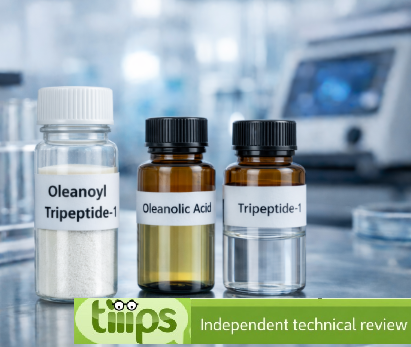
Oleanoyl tripeptide-1 is a lipophilic–peptidic conjugate obtained by reacting oleanolic acid (a plant-derived pentacyclic triterpene) with Tripeptide-1 (a three–amino-acid peptide under INCI nomenclature). Attaching a lipophilic triterpene fragment to the peptide is intended to increase affinity for the skin barrier/hair, improve deposition and persistence on keratinous substrates, and support functional positioning focused on protection and conditioning.
Definition
Oleanoyl tripeptide-1 is an acylated derivative: a tripeptide bearing an “oleanoyl” group derived from oleanolic acid. From a functional perspective, the lipophilic portion facilitates interaction with oily phases and lipid-rich surfaces (stratum corneum, hair fiber), while the peptidic portion contributes to the typical “skin/hair conditioning” profile of cosmetic peptides. In some patent-related descriptions for the “oleanoyl peptide” family, the tripeptide is described as a sequence such as K–V–K linked to oleanolic acid; the commercial INCI definition remains “Oleanoyl Tripeptide-1”, and the actual composition depends on the supplier (form, salt, carrier, purity).
Production process and key constituents
How it is produced (in brief)
Industrial production is generally based on peptide–acid conjugation chemistry:
synthesis or sourcing of Tripeptide-1 (peptide stage)
activation of oleanolic acid (or a reactive derivative) to enable coupling
coupling reaction (formation of an amide/ester bond depending on the chemistry used)
purification (removal of reagents, by-products, and salts) and standardization
optional formulation in a carrier (e.g., glycols, water/glycols, or hydroalcoholic systems) to facilitate cosmetic use
Typical raw materials / reagents (industrial practice)
Oleanolic acid (or activated derivatives such as acylating species, process-dependent)
Tripeptide-1 (free or as a salt)
Coupling agents (carbodiimides or equivalents; alternative routes are possible)
Organic bases (for pH control/neutralization)
Process solvents (removed or controlled to specification)
Relevant components in the finished material (category and examples)
Main conjugate
Oleanoyl tripeptide-1 (functional active)
Controlled impurities/secondary components (examples)
Residual oleanolic acid
Residual Tripeptide-1
Residual salts/inorganics (from neutralization, process-dependent)
Technical note. For this type of raw material, quality is mainly driven by: conjugate purity, limits on “free acid/free peptide”, impurity profile, and stability in the carrier (pH, preservation, electrolyte compatibility).
Main uses
Cosmetics
Typical use in leave-on products (serums, creams, light emulsions) positioned for skin protecting and skin conditioning; it may also be used in hair products (shampoo, conditioner, scalp lotions/care) when hair conditioning and fiber protection are desired.
INCI functions
Antioxidant agent. Ingredient that counteracts oxidative stress and prevents cell damage. Free radicals, pathological inflammatory processes, reactive nitrogen species and reactive oxygen species are responsible for the ageing process and many diseases caused by oxidation.
Hair conditioning agent. A significant number of ingredients with specific and targeted purposes may co-exist in hair shampoo formulations: cleansers, conditioners, thickeners, matting agents, sequestering agents, fragrances, preservatives, special additives. However, the indispensable ingredients are the cleansers and conditioners as they are necessary and sufficient for hair cleansing and manageability. The others act as commercial and non-essential auxiliaries such as: appearance, fragrance, colouring, etc. Hair conditioning agents have the task of increasing shine, manageability and volume, and reducing static electricity, especially after treatments such as colouring, ironing, waving, drying and brushing. They are, in practice, dispersants that may contain cationic surfactants, thickeners, emollients, polymers. The typology of hair conditioning agents includes: intensive conditioners, instant conditioners, thickening conditioners, drying conditioners. They can perform their task generally accompanied by other different ingredients.
Skin protectant. It creates a protective barrier on the skin to defend it from harmful substances, irritants, allergens, pathogens that can cause various inflammatory conditions. These products can also improve the natural skin barrier and in most cases more than one is needed to achieve an effective result.
Skin conditioning agent - Humectant. Humectants are hygroscopic substances used to minimise water loss in the skin and to prevent it from drying out by facilitating faster and greater absorption of water into the stratum corneum of the epidermis. The epidermis is the most superficial of the three layers that make up the human skin (epidermis, dermis and hypodermis) and is the layer that maintains hydration in all three layers. In turn, the epidermis is composed of five layers: corneum, the most superficial, lucidum, granulosum, spinosum and basale. Humectants have the ability to retain in the stratum corneum the water they attract from the air and have the function of moisturising the skin. It is better to use them before emollients that are oil-based.
Skin conditioning agent - Miscellaneous. This ingredient has the task of modifying and improving the condition of the skin when it is damaged or dry, reducing flaking and restoring its elasticity.
Industrial use
A “functionalized peptide” raw material for anti-age/skin defense and haircare lines, often included in complexes with humectants, film formers, and barrier-support systems.
Identification data and specifications
| Characteristic | Value | Note |
|---|---|---|
| INCI name | Oleanoyl tripeptide-1 | Cosmetic denomination |
| Description | reaction of oleanolic acid and Tripeptide-1 | Lipophilic–peptidic conjugate |
| Type | acylated derivative (lipid–peptide) | Increases affinity for lipophilic substrates |
| INCI functions | antioxidant; hair conditioning; skin protecting; skin conditioning – humectant; skin conditioning – miscellaneous | Functional framing |
| Solvent/carrier | variable (grade-dependent) | Often supplied as a solution/dispersible |
| Variability note | medium–high | Depends on salt form, purity, and carrier |
Chemical-physical properties (indicative)
| Characteristic | Indicative value | Note |
|---|---|---|
| Physical state | powder or solution | Depends on commercial grade |
| Color | white/off-white to pale yellow | Variable with purity/carrier |
| Odor | mild or neutral | Carrier-dependent |
| Water solubility | variable | Often improved by the carrier (e.g., glycols) |
| Solubility in oil phase | limited–moderate | More lipophilic than the native peptide |
| Stability | good if pH and temperature are controlled | Can be sensitive to hydrolysis/oxidation under high stress |
| Critical points | electrolyte and preservative compatibility | Formula- and carrier-dependent |
Functional role and mechanism of action
The oleanoyl portion can promote anchoring and deposition on lipidic/keratinous surfaces, increasing peptide residence and its “presence” in the formula microstructure (interfaces, surface film). Practically, this can translate into: support for conditioning perception (more comfortable skin, more manageable hair) and a rationale consistent with skin protecting and antioxidant functions, especially when the system is designed for protection against environmental stressors and barrier support.
Formulation compatibility
Generally compatible with O/W emulsions and aqueous gels/solutions in the presence of co-solvents (glycols). Development points to check:
stability within the finished product pH range (avoid extreme conditions)
compatibility with preservatives and charge-/electrolyte-sensitive polymers
behavior in the presence of salts and surfactants (haircare)
potential haze/precipitation if the carrier is not well integrated into the matrix
Pros and cons
Pros
lipophilic conjugation may improve deposition and persistence versus the unmodified peptide
versatile for skin and hair applications
technically coherent positioning for “skin defense / conditioning”
Cons
performance and compatibility strongly depend on supplier grade and carrier
possible sensitivity to extreme pH and highly electrolytic systems
need for clear specifications on purity and “free acid/free peptide” levels
Safety, regulatory, and environmental aspects
Allergen.
Not a typical fragrance allergen. Tolerability should be assessed on the finished product, considering dose and vehicle, as with many functionalized peptides.
Contraindications (brief).
Use caution on highly reactive skin and in high-dosage leave-on formulas; verify compatibility and stability (precipitation/instability) because these can increase the likelihood of irritation or adverse sensorial effects.
Regulatory/claim note.
As a functionalized peptide, claims (antioxidant, protective) should be supported by a dossier (in vitro/in vivo) consistent with the concentration and commercial form used.
Formulation troubleshooting
Precipitation or haze in aqueous serums.
Action: increase compatible co-solvent fraction, revise order of addition, control electrolytes and final pH.
Loss of perceived performance over time.
Action: run stress tests (temperature/light), optimize barrier packaging, verify peptide stability within the preservative system.
Instability in haircare with surfactants/salts.
Action: verify compatibility in the real matrix (salt, surfactant profile), consider a grade with a more suitable carrier.
Conclusion
Oleanoyl tripeptide-1 is an oleanolic acid–Tripeptide-1 conjugate designed to combine a lipophilic “anchoring” component with a peptidic component, with INCI functions oriented to protection, conditioning, and an antioxidant contribution. Performance in formulas depends strongly on purity, carrier, and compatibility parameters (pH, electrolytes, preservatives), so grade selection and incoming-lot verification are critical.

