



Marrubium vulgare flower/leaf/stem extract: properties, uses, pros, cons, safety
Marrubium vulgare flower/leaf/stem extract is an extract obtained from the flowers, leaves, and stems of Marrubium vulgare L. (family Lamiaceae; historical synonym Labiatae). In cosmetics it is primarily positioned as a fragrance ingredient: it is used to provide an herbal/aromatic note and to contribute to the olfactory profile of fragrance bases and finished products.
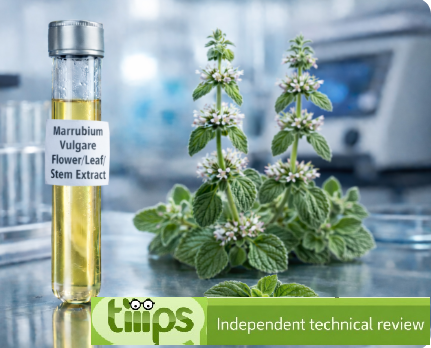
For more information: White horehound
Definition
The term “flower/leaf/stem extract” indicates an extract of the aerial parts (a mix of flowers, leaves, and stems) obtained using suitable solvents and then filtered/standardized. Composition may vary depending on: botanical origin and harvest, drug/extract ratio, solvent system (water, glycols, hydroalcoholic), and the supplier’s level of standardization. Unlike an essential oil, the extract can also contain a portion of less volatile components (phenolics and diterpenes), in addition to the volatiles responsible for odor.
Production process and key constituents
How it is produced (in brief)
The typical chain includes: selection and QC of the botanical raw material, drying and milling, extraction with a cosmetically suitable solvent (water, glycols, or hydroalcoholic mixtures), solid/liquid separation (filtration or pressing), possible concentration, then standardization (solids, markers, color/odor) and stabilization/preservation depending on the carrier.
Key constituents (representative, by category)
Aromatic volatiles
β-Caryophyllene
Germacrene D
α-Humulene
Labdane diterpenes
Marrubiin
Marrubenol
Marrubic acid
Phenylpropanoids/phenylethanoids
Verbascoside (acteoside)
Forsythoside B
Phenolic acids Rosmarinic acid
Caffeic acid
Technical note. In “fragrance-oriented” grades the olfactory contribution is driven mainly by volatile sesquiterpenes; in more “botanical extract” grades (e.g., glycerinated carriers) the phenolic fraction may also become more evident, affecting color and stability.
Main uses
Cosmetics
Typical use as a fragrance component in leave-on and rinse-off products (creams, lotions, cleansers, body/hair products), or as part of fragrance bases with a moderate herbal/medicinal note. Dosage is driven by the olfactory target and formulation compatibility (color/odor, stability).
INCI functions
Fragrance. It plays a very important role in the formulation of cosmetic products as it provides the possibility of enhancing, masking or adding fragrance to the final product, increasing its marketability. It is able to create a perceptible pleasant odour, masking a bad smell. The consumer always expects to find a pleasant or distinctive scent in a cosmetic product.
Industrial use
Raw material for functional perfumery and cosmetics, used in blends where a “green/herbal” aromatic accent and added complexity are desired.
Identification data and specifications
| Characteristic | Value | Note |
|---|---|---|
| INCI name | Marrubium vulgare flower/leaf/stem extract | Cosmetic denomination |
| Botanical origin | Marrubium vulgare L. | Flowers, leaves, stems |
| Botanical family | Lamiaceae | Syn. Labiatae |
| CAS number | 84696-20-8 | Associated with the extract |
| EC number (EINECS) | 283-638-4 | EU identifier |
| Preparation type | extract | Solvent/carrier depends on grade |
| Main function | fragrance | Ingredient-function framing |
| Variability note | high | Raw material, solvent, standardization |
Chemical-physical properties (indicative)
| Characteristic | Indicative value | Note |
|---|---|---|
| Physical state | liquid or powder | Depends on carrier and drying |
| Color | yellow-brown / amber | Variable with phenolic fraction |
| Odor | herbal, aromatic | Intensity depends on grade |
| Solubility | variable | Often good in water/glycols if in carrier |
| Volatility | low–medium (overall) | Depends on the volatile fraction present |
| Stability | moderate | Oxygen/light sensitive (phenolics) |
| Critical points | color/odor and repeatability | Depends on standardization |
Functional role and mechanism of action
The role is mainly sensorial: volatiles (sesquiterpenes) contribute to the odor profile, while the less volatile fraction can influence roundness and aromatic “body,” but also color and stability. Practically, the effect is modulation of perceived odor in the finished product and its evolution over time (note persistence).
Formulation compatibility
Generally compatible with emulsions and aqueous systems, provided the grade (carrier/solvent) matches the matrix. Typical control points:
color stability (possible darkening with oxygen/light)
preservative and pH compatibility (possible interactions with phenolics)
odor management and batch-to-batch consistency
haze risk in surfactant systems if the grade contains poorly compatible fractions
Pros and cons
Pros
Olfactory herbal/aromatic contribution useful for differentiating fragrances.
Can add complexity to perfumed compositions, especially in botanical concepts.
Versatile use (leave-on and rinse-off) if a suitable grade is selected.
Cons
Batch variability (odor/color/markers) if standardization is not robust.
Possible impact on color and olfactory stability over time.
Requires supplier dossier (COA/TDS) to define compatibility and specs.
Safety, regulatory, and environmental aspects
Allergen.
Not a single “unique allergen” in itself; however, as with many plant-derived fragrance materials, components may be present that contribute to sensitization in predisposed individuals. Assessment should be carried out on the finished product and on the batch specification (including oxidation status).
Contraindications (brief).
Use caution on very reactive skin and in leave-on products with high fragrance load. Avoid altered/oxidized batches and manage storage/packaging appropriately.
Formulation troubleshooting
Odor not consistent between batches.
Action: request sensory standards and markers from the supplier, implement blending, define acceptance ranges.
Discoloration or darkening over time.
Action: barrier packaging, reduced headspace, control light exposure, evaluate compatible antioxidants/chelators.
Haze in cleansers or surfactant bases.
Action: select a more water-dispersible grade, revise solubilizer, verify cloud point and electrolytes.
Conclusion
Marrubium vulgare flower/leaf/stem extract is a botanical extract used primarily for the fragrance function, with an herbal aromatic profile driven by a volatile sesquiterpene fraction and modulated by less volatile components. Formulation reliability depends on standardization, grade quality (carrier, markers), and management of stability (color/odor) and compatibility with preservatives and the base matrix.

