Quercetin granules: properties, uses, pros, cons, safety
Quercetin is a polyphenolic flavonoid that is found in many food sources (for example, onion, apple, tomato, grape, blueberry, tea, strawberry, broccoli, walnut) and possesses protective antioxidant, anti-inflammatory properties which act against saturated fatty acids and free radicals, responsible for oxidation and cell aging.
Its action spans several biological mechanisms, making it of interest for numerous therapeutic applications.
Antioxidant Action. Quercetin neutralizes free radicals and protects cells from oxidative damage. This effect is crucial for preventing cellular aging and chronic diseases associated with oxidative stress.
Anti-inflammatory Effect. It modulates the activity of inflammatory pathways by inhibiting the production of inflammatory mediators such as pro-inflammatory cytokines and the activity of cyclooxygenases, thereby reducing inflammation at the cellular and tissue level.
Antiviral Properties. Quercetin has been shown to interfere with the replication processes of various viruses, offering therapeutic potential against viral infections.
Improvement of Cardiovascular Health. It contributes to vascular health by reducing blood pressure, improving endothelial function, and preventing the formation of atherosclerotic plaques.
Effects on Metabolism. Quercetin can positively influence metabolism, improving insulin sensitivity and aiding in weight management and diabetes prevention.
Industrial Production Process
Sources. Found in many foods such as onions, apples, grapes, berries, green tea, and red wine, quercetin is easily incorporated into the daily diet. It is also available as a dietary supplement.
- Extraction - Quercetin is initially extracted from plant sources, such as onions, apples, and green tea, through extraction processes that may involve the use of solvents like ethanol or water.
- Purification - After extraction, crude Quercetin is purified to remove impurities and enhance its quality. This can include techniques such as crystallization, filtration, and chromatography.
- Synthesis - In some cases, Quercetin may be chemically synthesized to improve its stability and bioavailability. This can involve the formation of derivatives or micronization.
- Quality Control - The purified Quercetin undergoes rigorous quality control checks to ensure its purity, potency, and compliance with specifications. This includes tests to identify the presence of heavy metals, residual solvents, and other contaminants.
Form and Color
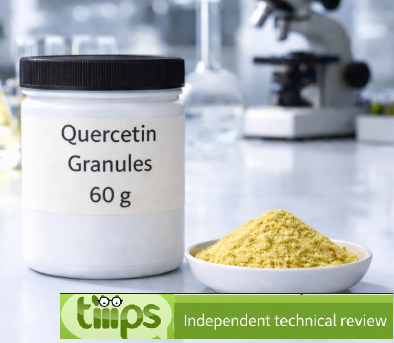
Quercetin is commonly found as a yellow-orange powder, used to make capsules or tablets.
Commercial Applications
Dietary Supplements and Nutrition. Quercetin is a flavonoid found in many foods like onions, apples, and grapes. It's used in dietary supplements for its antioxidant and anti-inflammatory properties.
Antioxidant Properties. Helps neutralize free radicals, protecting cells from oxidative damage and contributing to the prevention of chronic diseases.
Anti-inflammatory Effects. Can reduce inflammation and has shown potential benefits in treating conditions such as arthritis and allergies.
Cardiovascular Health. Studies suggest that quercetin can improve cardiovascular health by reducing blood pressure and cholesterol levels.
Safety
Generally considered safe when taken in moderate doses as part of a balanced diet or through supplements. However, high doses may cause side effects.
Most significant studies
The antiproliferative efficacy of Quercetin in contrast activity to colon cancer has been demonstrated (1).
In vitro and some animal models have shown that quercetin, a polyphenol derived from plants, has a wide range of biological actions including anti-carcinogenic, anti-inflammatory and antiviral activities (2).
Disorder of blood pressure control causes serious diseases in the cardiovascular system. This review focuses on the anti-hypertensive action of quercetin, a flavonoid, which is one of the polyphenols characterized as the compounds containing large multiples of phenol structural units (3).
Quercetin has been shown to activate sirtuins (SIRT1), to induce autophagy, and to act as a phytoestrogen, all mechanisms by which quercetin may provide its neuroprotection (4).
Published adequate scientific data for safety assessment in regard to the long-term use (>12 weeks) of high supplemental quercetin doses (≥1000 mg) are currently not available. (5).
Molecular Formula C15H10O7
Molecular Weight 302.238 g/mol
CAS 204-187-1
References_______________________________________________________________________
(1) Mouat MF, Kolli K, Orlando R, Hargrove JL, Grider A. The effects of quercetin on SW480 human colon carcinoma cells: a proteomic study. Nutr J. 2005 Mar 4;4:11. doi: 10.1186/1475-2891-4-11.
Abstract. Background: High fruit and vegetable intake is known to reduce the risk of colon cancer. To improve understanding of this phenomenon the action of different phytochemicals on colon cells has been examined. One such compound is quercetin that belongs to the group known as flavonoids. The purpose of this study was to determine the influence of quercetin on the proteome of the SW480 human colon adenocarcinoma cell line, specifically to identify proteins that could be the molecular targets of quercetin in its amelioration of the progression of colon cancer. To this end, two-dimensional gel electrophoresis and mass spectrometry were used to identify proteins that underwent a change in expression following treatment of the cells with 20 muM quercetin. This could elucidate how quercetin may reduce the progression of colon cancer. Results: Quercetin treatment of the SW480 human colon cancer cells was found to result in the decreased expression of three proteins and the increased expression of one protein. The identified proteins with decreased expression were type II cytoskeletal 8 keratin and NADH dehydrogenase Fe-S protein 3. The other protein with decreased expression was not identified. The protein with increased expression belonged to the annexin family. Conclusion: Several proteins were determined to have altered expression following treatment with quercetin. Such changes in the levels of these particular proteins could underlie the chemo-protective action of quercetin towards colon cancer.
Chang JH, Lai SL, Chen WS, Hung WY, Chow JM, Hsiao M, Lee WJ, Chien MH. Quercetin suppresses the metastatic ability of lung cancer through inhibiting Snail-dependent Akt activation and Snail-independent ADAM9 expression pathways. Biochim Biophys Acta Mol Cell Res. 2017 Oct;1864(10):1746-1758. doi: 10.1016/j.bbamcr.2017.06.017.
Li H, Chen C. Quercetin Has Antimetastatic Effects on Gastric Cancer Cells via the Interruption of uPA/uPAR Function by Modulating NF-κb, PKC-δ, ERK1/2, and AMPKα. Integr Cancer Ther. 2018 Jun;17(2):511-523. doi: 10.1177/1534735417696702.
(2) Li Y, Yao J, Han C, Yang J, Chaudhry MT, Wang S, Liu H, Yin Y. Quercetin, Inflammation and Immunity. Nutrients. 2016 Mar 15;8(3):167. doi: 10.3390/nu8030167.
Abstract. In vitro and some animal models have shown that quercetin, a polyphenol derived from plants, has a wide range of biological actions including anti-carcinogenic, anti-inflammatory and antiviral activities; as well as attenuating lipid peroxidation, platelet aggregation and capillary permeability. This review focuses on the physicochemical properties, dietary sources, absorption, bioavailability and metabolism of quercetin, especially main effects of quercetin on inflammation and immune function. According to the results obtained both in vitro and in vivo, good perspectives have been opened for quercetin. Nevertheless, further studies are needed to better characterize the mechanisms of action underlying the beneficial effects of quercetin on inflammation and immunity.
(3) Marunaka Y, Marunaka R, Sun H, Yamamoto T, Kanamura N, Inui T, Taruno A. Actions of Quercetin, a Polyphenol, on Blood Pressure. Molecules. 2017 Jan 29;22(2):209. doi: 10.3390/molecules22020209.
Abstract. Disorder of blood pressure control causes serious diseases in the cardiovascular system. This review focuses on the anti-hypertensive action of quercetin, a flavonoid, which is one of the polyphenols characterized as the compounds containing large multiples of phenol structural units, by varying the values of various blood pressure regulatory factors, such as vascular compliance, peripheral vascular resistance, and total blood volume via anti-inflammatory and anti-oxidant actions. In addition to the anti-inflammatory and anti-oxidant actions of quercetin, we especially describe a novel mechanism of quercetin's action on the cytosolic Cl- concentration ([Cl-]c) and novel roles of the cytosolic Cl- i.e.: (1) quercetin elevates [Cl-]c by activating Na⁺-K⁺-2Cl- cotransporter 1 (NKCC1) in renal epithelial cells contributing to Na⁺ reabsorption via the epithelial Na⁺ channel (ENaC); (2) the quercetin-induced elevation of [Cl-]c in renal epithelial cells diminishes expression of ENaC leading to a decrease in renal Na⁺ reabsorption; and (3) this reduction of ENaC-mediated Na⁺ reabsorption in renal epithelial cells drops volume-dependent elevated blood pressure. In this review, we introduce novel, unique mechanisms of quercetin's anti-hypertensive action via activation of NKCC1 in detail.
(4) Costa LG, Garrick JM, Roquè PJ, Pellacani C. Mechanisms of Neuroprotection by Quercetin: Counteracting Oxidative Stress and More. Oxid Med Cell Longev. 2016;2016:2986796. doi: 10.1155/2016/2986796.
Abstract. Increasing interest has recently focused on determining whether several natural compounds, collectively referred to as nutraceuticals, may exert neuroprotective actions in the developing, adult, and aging nervous system. Quercetin, a polyphenol widely present in nature, has received the most attention in this regard. Several studies in vitro, in experimental animals and in humans, have provided supportive evidence for neuroprotective effects of quercetin, either against neurotoxic chemicals or in various models of neuronal injury and neurodegenerative diseases. The exact mechanisms of such protective effects remain elusive, though many hypotheses have been formulated. In addition to a possible direct antioxidant effect, quercetin may also act by stimulating cellular defenses against oxidative stress. Two such pathways include the induction of Nrf2-ARE and induction of the antioxidant/anti-inflammatory enzyme paraoxonase 2 (PON2). In addition, quercetin has been shown to activate sirtuins (SIRT1), to induce autophagy, and to act as a phytoestrogen, all mechanisms by which quercetin may provide its neuroprotection.
(5) Andres S, Pevny S, Ziegenhagen R, Bakhiya N, Schäfer B, Hirsch-Ernst KI, Lampen A. Safety Aspects of the Use of Quercetin as a Dietary Supplement. Mol Nutr Food Res. 2018 Jan;62(1). doi: 10.1002/mnfr.201700447. Epub 2017 Dec 19. PMID: 29127724.




