



SLS Sodium lauryl sulfate: INCI functions, identifiers (CAS/EC), cleansing uses, and formulation notes
Sodium lauryl phosphate
Sodium salt of lauryl phosphate – alkyl phosphate (C12) in neutralized form (sodium)
Synonyms: sodium dodecyl phosphate, sodium monolauryl phosphate, sodium monododecyl phosphate, dodecyl phosphate, sodium salt
INCI / functions: surfactant – cleansing, surfactant – foaming, surfactant – emulsifying (anionic surfactant)
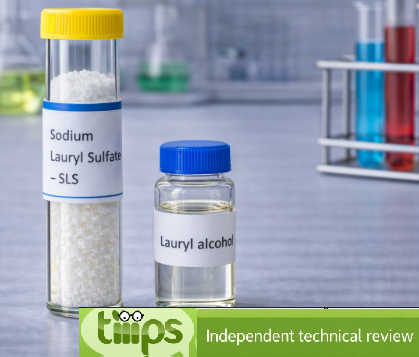
Definition
Sodium lauryl sulfate is an anionic surfactant belonging to the alkyl sulfates family: it is the sodium salt of the sulfuric ester of lauryl alcohol (predominantly a C12 chain). From a compositional standpoint, the core species is sodium dodecyl sulfate; in some industrial/personal care grades, depending on the fatty alcohol feedstock, minor fractions of nearby-chain sulfates (C10–C14) may be present. In formulation it is valued for its high ability to remove lipids/soil, generate foam, and stabilize dispersions/emulsions in cleansing systems.
Main uses
Cosmetics: cleansers and shampoos as a primary or secondary surfactant; sometimes in toothpaste as a foaming/dispersing agent.
Medicine: mainly used as a reagent/auxiliary in laboratory contexts (not as a cosmetic “active”).
Pharmaceutical: may appear as a surfactant excipient or wetting/dispersing agent in specific technical forms (dossier-dependent).
Industrial use: cleansing, wetting, emulsification, and related technical uses.
Identification data and specifications
| Identifier | Value |
|---|---|
| INCI name | Sodium Lauryl Sulfate |
| Formula (main species) | C12H25NaO4S |
| Molar mass | 288.38 g/mol |
| CAS number | 151-21-3 |
| EC/EINECS number | 205-788-1 |
| Typical commercial form | white powder/granules or solution (grade-dependent) |
Physicochemical properties (indicative)
| Property | Value | Note |
|---|---|---|
| Water solubility | high | supports cleansing use |
| pH (aqueous solution, typical spec) | ~8.5–10 | grade- and concentration-dependent |
| Melting point (indicative, technical spec) | ~206 °C | typical value reported in technical sheets |
Functional role and practical mechanism of action
| Function | What it does in the formula | Technical note |
|---|---|---|
| Cleansing (anionic surfactant) | removes soil and sebum via micelles and wetting | very effective on oily soils |
| Foaming agent | generates abundant foam and a “clean” perception | adjustable with amphoterics/nonionics |
| Emulsifier/dispersant | helps disperse oils and particulates in water | also useful in toothpaste |
| Denaturant | function reported in regulatory/ingredient databases | relevant for denatured alcohol products, when applicable |
Formulation compatibility
Sodium lauryl sulfate is typically compatible with anionic and amphoteric surfactants (e.g., betaines), and is often “softened” in formulas by combining it with amphoterics and nonionics to reduce perceived harshness and improve sensorial profile. Compatibility with cationic polymers and cationic conditioners (polyquaterniums, quats) is more critical due to potential complexation (haze, precipitation, performance loss): in “2-in-1” systems, alternative surfactant architectures are often preferred, or the formulation is carefully engineered with charge balance and controlled addition order.
From a rheology standpoint, viscosity in SLS-based cleansers is frequently adjusted via electrolytes (e.g., NaCl) and co-surfactants; the thickening window depends on the surfactant package and temperature. In hard water, foam and sensorial performance may change due to interactions with dissolved salts: robustness testing across different water hardness levels and thermal cycles is standard practice.
Use guidelines (indicative)
| Application | Typical range | Technical note |
|---|---|---|
| Shampoo / body wash / rinse-off cleansers | 2–15% (as surfactant actives) | modulate with amphoterics/nonionics for mildness |
| Bubble bath / foaming cleansers | 3–20% (as actives) | depends on foam and viscosity targets |
| Toothpaste | 0.5–2.0% | for foam and dispersion; check compatibility with flavors/actives |
| Leave-on | generally avoided; if present, ≤0.5% | higher irritation risk vs rinse-off |
Typical applications
High-performance shampoos and body washes with rich foam and strong cleansing.
Face/body rinse-off cleansers where cleansing power is prioritized over maximum mildness.
Toothpaste, to improve paste distribution and “clean” sensory perception (at controlled levels).
Quality, grades and specifications
| QC parameter | What to control |
|---|---|
| Identity | INCI alignment, CAS/EC, and SDS/CoA conformity |
| Assay/actives | active content and distribution (powder vs solution) |
| pH (solution) | batch-to-batch repeatability |
| Impurities | limits for process residues, salts, insolubles |
| Color/odor | stability and absence of off-notes |
| Microbiology (if in solution) | limits and preservation status |
Safety, regulation and environment
Toxicologically, sodium lauryl sulfate is primarily characterized by its nature as a strong cleanser: the main concern is irritation (especially ocular and, in some users or conditions, skin), typically correlated with concentration and contact time. Accordingly, modern formulations often focus on lowering the level of the primary surfactant, using milder co-surfactants, controlling pH, and adding mildness/sensory modifiers. Cosmetic safety assessment is performed on the finished product (use scenario, exposure, target population) within the applicable EU regulatory framework.
Environmentally, as with many surfactants, responsible management is mainly about controlling industrial releases and properly handling wash waters and effluents. In manufacturing, applying GMP and process controls reduces variability and operational risks.
Formulation troubleshooting
| Issue | Likely cause | Recommended action |
|---|---|---|
| Perceived dryness/“stripping” | overly strong cleansing, high actives | reduce SLS level, add amphoterics/nonionics, include refatting/compatible conditioners |
| Eye stinging | foam contact, pH not optimized | optimize pH, reduce actives, use milder systems, run irritation screening |
| Unstable viscosity | salt window off-target, temperature, co-surfactants | retune electrolytes, adjust surfactant ratio, evaluate thickeners |
| Haze/precipitates with cationics | anionic–cationic complexation | avoid/reduce cationics, separate functions, change surfactant architecture |
Conclusion
Sodium lauryl sulfate (SLS) is a highly effective anionic surfactant for cleansing and foam, with broad versatility in rinse-off systems. Its main limitation is potential irritation/dryness, managed through surfactant-package balancing, pH control, and mildness strategies. When used appropriately, it remains a technical benchmark for performance and cost-effectiveness in many cosmetic applications.
Studies
SLS must not be confused with SLES (Sodium laureth sulfate) because, although both are similar and have sulphuric acid and lauryl alcohol as their formula, in SLES, which is less aggressive than SLS but is ethoxylated (obtained from ethylene oxide), it is not uncommon to find in SLES ethylene oxide and 1,4-dioxane residues, chemical compounds that are considered carcinogenic (1).
A preliminary remark must be made about synthetic surfactants, which can be divided into (2):
- Anionic (SLS, ALS, SLES), which solubilises well with lipid monolayers but not with lipid bilayers model of liposomes or cytotoxicity tests towards cultured skin cells
- Nonionic amphoteric (CAPB), which solubilises well with both mono- and bilayers
- Biotensioactive (SAP), which penetrates monolayers at 1% dry mass without solubilisation, and probably penetrates bilayers, increasing their size (without solubilisation).
It is a surfactant chemical compound obtained from the reaction of sulphuric acid with lauryl alcohol by adding sodium carbonate. It also has a 'foaming' action.
Sodium lauryl sulfate (SLS), also known as sodium laurilsulfate or sodium dodecyl sulfate, is an anionic surfactant commonly used as an emulsifying cleaning agent in household cleaning products (laundry detergents, spray cleaners, and dishwasher detergents). The concentration of SLS found in consumer products varies by product and manufacturer but typically ranges from 0.01% to 50% in cosmetic products and 1% to 30% in cleaning products. SLS can be synthetic or naturally derived. This chemical is synthesized by reacting lauryl alcohol from a petroleum or plant source with sulfur trioxide to produce hydrogen lauryl sulfate, which is then neutralized with sodium carbonate to produce SLS. The review of SLS toxicity profiles confirms that SLS is an acceptable surfactant for use in household cleaning product formulations from toxicological and sustainability perspectives. Years of anti-SLS campaigns have led to consumer concerns and confusion regarding the safety of SLS. Yet, the primary concern – that SLS has potential for being irritating to the eyes and skin – can be easily addressed by proper formula development and appropriate irritation testing performed by the product manufacturers. SLS is considered a sustainable material because of its 100% biobased content, biodegradability, and low potential to bioaccumulation. Toxicological data support that SLS is safe for use in cleaning products when formulated to minimize its irritancy potential. It is concluded that the use of SLS in cleaning product formulations does not introduce unnecessary risk to consumers or the environment because of the presence of the ingredient, and, if properly formulated and qualified, does not pose danger to human health and safety (3).
Sodium laurisulphate, an anionic surfactant, is known to induce roughness in the skin, and the mechanism by which it does this may be by disrupting the moisturising function (4).
This cleansing compound (SLS), a common ingredient in soaps, shampoos, toothpastes and other skin care products, is also a commonly used test substance for the induction of skin damage. The time and quality of skin repair are often used as indicators of various treatments, for example, how emollients affect this process (5).
In a comparison of toothpastes with SLS and without SLS, those with SLS caused irritation to the mucosa (6).
However, this study re-proposes the risk of Sodium Lauryl Sulfate (7).
As for infants, the previous roundtable recommendations concerning infant cleansing, bathing, and use of liquid cleansers were critically reviewed and updated and the quality of evidence was evaluated using the Grading of Recommendation Assessment, Development and Evaluation system. New recommendations were developed to provide guidance on diaper care and the use of emollients. A series of recommendations was formulated to characterize the attributes of ideal liquid cleansers, wipes, and emollients. In conclusion : formulations should be effectively preserved; products containing harsh surfactants, such as sodium lauryl sulfate, should be avoided (8).
From the industrial point of view, it is a product that has two great advantages :
- It is cheap
- It is easy to work with
Typical optimal characteristics of a commercial product Sodium Lauryl Sulfate
| Appearance | White powder |
| pH | 6-9 (10g/l, H2O, 20℃) |
| Density | 1.03 g/mL at 20 °C |
| Melting Point | 204-207 °C (lit.) |
| Flash point | >100°C |
| Petroleum ether soluble substances | ≤1.2% |
| Na2SO4 | ≤2.5% |
| NaCL | ≤2.5% |
| Alkalinity | ≤0.6 |
| Water | ≤2.0% |
| Total alcohols | ≥59 |
| Storage | 2-8°C |
| Chemical Risk | 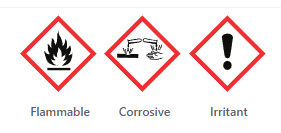 |
 |  |
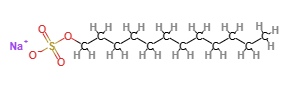 | 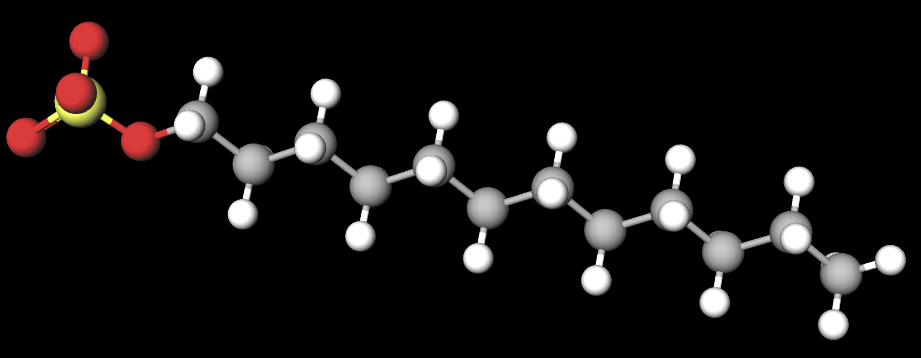 |
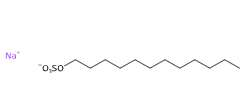
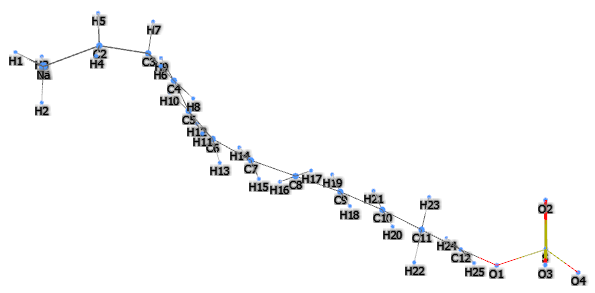
- Molecular Formula : C12H25NaO4S
- Structural formula: CH3-(CH2)11-O-SO3-Na+
- Molecular Weight : 288.38
- Exact Mass 288.137115
- CAS : 151-21-3
- UNII 368GB5141J
- EC Number: 205-788-1
- IUPAC sodium;dodecyl sulfate
- InChI=1S/C12H26O4S.Na/c1-2-3-4-5-6-7-8-9-10-11-12-16-17(13,14)15;/h2-12H2,1H3,(H,13,14,15);/q;+1/p-1
- InChl Key DBMJMQXJHONAFJ-UHFFFAOYSA-M
- SMILES CCCCCCCCCCCCOS(=O)(=O)[O-].[Na+]
- MDL number MFCD00036175
- PubChem Substance ID 24896351
- ChEBI 8984
- ICSC 0502
- RTECS WT1050000
- DSSTox Substance ID: DTXSID1026031
- FEMA number 4437
- MDL number MFCD00036175
- PubChem Substance ID
Synonyms:
- SLS
- Sodium lauryl sulphate
- Sodium dodecylsulfate

