



Disodium phosphate
Disodium hydrogen phosphate (anhydrous) – Na₂HPO₄
Synonyms: disodium phosphate, disodium hydrogen phosphate, dibasic sodium phosphate; E339(ii) (food use)
INCI / functions: buffering (pH regulator / buffer), anticorrosive (packaging protection), support as a weak sequestrant (under specific conditions)
Definition
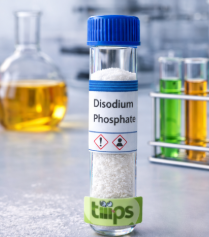
An inorganic phosphate-system salt, typically supplied in anhydrous form (Na₂HPO₄), used as a component of buffer solutions and as a pH regulator in aqueous formulations. From a compositional standpoint, the ingredient consists of sodium ions (Na⁺) and the hydrogen phosphate anion (HPO₄²⁻); controlled trace inorganic impurities may be present depending on grade (technical/food/pharma). In practice, it is often used together with monosodium phosphate (NaH₂PO₄) to obtain buffers in the neutral to slightly alkaline range.
Food: acidity regulator, stabilizer, technological aid (e.g., processed dairy systems, depending on category). In dietary supplements, disodium phosphate mainly serves both nutritional and technological functions. It is a source of phosphorus, which is essential for bone and teeth health. It contributes to energy metabolism through the role of phosphorus in ATP systems. It helps maintain proper electrolyte balance. It acts as a regulator of acid–base balance. It is used as a buffering agent to stabilize formulation pH. It supports the chemical stability of other ingredients. It can improve the solubility of certain nutrients. In some formulations, it may support intestinal function. It also plays a technological role in manufacturing support.
Cosmetics: pH buffer, aqueous-phase stability; also used as anticorrosive support to reduce corrosion phenomena related to packaging/metal contact.
Medical: use in buffer solutions and support preparations (technical-clinical context, per specifications).
Pharmaceutical: excipient for buffers, solutions and processing; supports stability of liquid dosage forms and certain manufacturing steps.
Industrial use: preparation of buffers for laboratory/industry and processes requiring aqueous pH control (sector-dependent requirements).
Calories (energy value)
| Metric | Value |
|---|---|
| Energy value (100 g) | 0 kcal (inorganic compound; provides no metabolizable energy) |
| Technical note | Technological use (pH / buffering), not nutritional |
Identification data and specifications
| Parameter | Value |
|---|---|
| Formula | Na₂HPO₄ |
| Molar mass | 141.96 g/mol |
| CAS number | 7558-79-4 |
| EC number | 231-448-7 |
| Food additive | E339(ii) |
| Property | Indicative value |
|---|---|
| Appearance | white crystals/powder |
| Odor | none |
| Water solubility (20–25 °C) | high (order of tens of g/L, grade- and temperature-dependent) |
| Ethanol solubility | practically insoluble |
| Typical pH (1–2% solution) | ~8.7–9.2 (indicative) |
| Hygroscopicity | moderate (manage moisture during storage) |
| Form | Details |
|---|---|
| Dihydrate form | Na₂HPO₄·2H₂O (CAS 10028-24-7, molar mass 177.99 g/mol) |
| Formulation note | anhydrous vs hydrate changes assay and weighing: for buffers and calculations always use the actual purchased form |
Phosphate buffer system (useful references)
| Parameter | Indicative values (25 °C) |
|---|---|
| Phosphoric system pKa values | pKa₁ ≈ 2.15; pKa₂ ≈ 7.20; pKa₃ ≈ 12.35 |
| Effective buffer window NaH₂PO₄ / Na₂HPO₄ | approx. pH 6.2–8.2 (highest efficiency around pKa₂) |
Functional role and “sequestrant” clarification
| Topic | Detail |
|---|---|
| Primary function | buffering: stabilizes pH by absorbing moderate acid/base additions |
| “Sequestrant” | interaction with Ca²⁺/Mg²⁺ is weak; in hard water and at higher pH it may promote precipitation (e.g., calcium phosphates) |
| Practical approach | if metal/hardness control is required, pair with sodium citrate or low-dose EDTA (depending on regulation and target) |
Formulation compatibility
| System | Compatibility | Control notes |
|---|---|---|
| Surfactants | generally excellent | verify systems with high cationic load |
| Polymers/gellants | often compatible | control viscosity and target pH (24–48 h maturation) |
| Pigments/minerals | compatible | caution with Ca²⁺-rich formulations (haze/precipitation risk) |
| pH-sensitive actives | useful | helps “lock” pH within narrow windows (validate specific compatibility) |
Use guidelines (indicative)
| Application | Typical range | Technical note |
|---|---|---|
| Leave-on / rinse-off cosmetics | 0.05–0.50% | fine pH trim and routine stability |
| Oral care (toothpastes/mouthwashes) | 0.2–2.0% | often paired with NaH₂PO₄ (typical pH target 6.0–7.5) |
| Food (E339(ii)) | category-dependent | dosage and conditions per applicable rules |
| Buffer preparation | — | dissolve salts separately, then combine under agitation; adjust pH with the acidic/basic partner and measure at stabilized temperature |
Practical phosphate buffer examples (purified water, 25 °C, indicative)
| Target pH | NaH₂PO₄ share | Na₂HPO₄ share | Note |
|---|---|---|---|
| ~6.5 | ~80–85% | ~15–20% | mass % on “anhydrous-equivalent” salts |
| ~7.0 | ~60–65% | ~35–40% | always bench-check (ionic strength/concentration matter) |
| ~7.4 | ~45–50% | ~50–55% | common near-physiological range (validate in system) |
| ~8.0 | ~25–30% | ~70–75% | higher risk with hard water (precipitation) |
Typical applications
Mild cleansers, shampoos, shower gels: pH stability and more consistent performance.
Gels and lotions: supports viscosity stability and pH-sensitive active stability.
Oral care: buffering for comfort and stability (within a coherent formulation design).
Food: acidity regulator/stabilizer; technological uses by category.
Quality, grades and specifications
| Topic | Detail |
|---|---|
| Grades | technical, food (E339(ii)), pharmaceutical |
| Typical controls | assay, insolubles, solution pH, moisture/loss on drying, trace metals |
| Operational note | select grade consistent with end use (food/pharma) and require an up-to-date CoA |
Safety, regulation and environment
| Topic | Operational guidance |
|---|---|
| Use safety | low toxicity at use levels; concentrated powder may irritate eyes/skin/respiratory tract |
| EU cosmetics | usable under general rules and GMP (verify finished formula compliance) |
| Food | E339(ii) additive with category-specific conditions of use |
| Environment | phosphates can contribute to eutrophication if released in quantity: manage effluents responsibly |
| Storage | sealed containers, cool dry place; avoid moisture and CO₂ uptake; keep away from strong acids |
Formulation troubleshooting
| Issue | Possible cause | Corrective actions |
|---|---|---|
| White haze/precipitates (hard water) | Ca²⁺ presence and elevated pH | lower target pH, reduce total phosphate, use deionized water; consider low-dose citrate/EDTA |
| pH drift after 24–48 h | dissolved CO₂, insufficient buffer capacity, temperature | increase buffer molarity, standardize temperature, re-tune with acid/base partner |
| Active incompatibilities | specific incompatibilities (cationics, metal salts, etc.) | run compatibility tests, optimize addition order and pH window |
Conclusion
Disodium phosphate (Na₂HPO₄) is a key ingredient for pH control in aqueous systems: reliable, predictable, and widely used in cosmetics, oral care, food, and technical/pharma contexts. Correct management of chemical form (anhydrous vs hydrate), water hardness, concentration, and the target pH window is essential to prevent instability (haze/precipitation) and achieve repeatable performance.

