



Yellow iron oxide
E172 (iii) – CI 77492
Synonyms: hydrated iron(III) oxide, iron hydroxide oxide yellow, Pigment Yellow 42/43; E172 (food use: iron oxides and hydroxides)
INCI / functions: colorant (colors cosmetic products, skin, nails and/or hair)
Definition
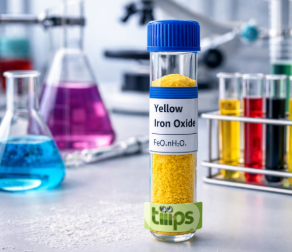
An inorganic mineral-derived pigment, mainly consisting of iron(III) oxyhydroxide (goethite-type structure, often represented as FeO(OH) with associated/bound water; in some descriptions also shown as Fe₂O₃·H₂O). The material is therefore primarily composed of iron and oxygen (with –OH groups and bound water), with possible trace inorganic impurities depending on grade (cosmetic/food/pharma) and manufacturing route. It is used as a warm yellow pigment to provide tone, opacity/coverage, and chromatic stability, often blended with red and black iron oxides to build stable “skin-tone” shade ranges.
Calories (energy value)
| Metric | Value |
|---|---|
| Energy value (100 g) | 0 kcal (an inorganic compound; provides no metabolizable energy) |
| Technical note | Technological use (color), not nutritional |
Identification data and specifications
| Characteristic | Value |
|---|---|
| Name | Yellow iron oxide |
| English name | Yellow iron oxide |
| CI (Colour Index) | CI 77492 |
| Chemical nature | inorganic pigment based on iron(III) oxyhydroxide |
| “Representative” formula | FeO(OH) (often with associated water) / sometimes listed as Fe₂O₃·H₂O |
| CAS number (commonly associated with CI 77492) | 51274-00-1 |
| EC number | 257-098-5 |
| Food additive category | E172 (iron oxides and hydroxides; includes the “yellow” fraction) |
| Characteristic | Value |
|---|---|
| Appearance | yellow powder (from lemon-yellow to ochre-yellow, depending on grade) |
| Odor | none |
| Solubility | practically insoluble in water and in most cosmetic solvents |
| Stability | high stability to light, heat, and oxidation (typical of inorganic pigments) |
| pH behaviour | not applicable as a solid; in aqueous dispersions behaviour depends on surface treatment and formulation |
Functional role and clarification “inorganic pigment”
| Characteristic | Detail |
|---|---|
| Primary function | colorant: provides tone, coverage, and shade modulation |
| Key strengths | high stability (UV/light/heat), good chemical inertness, repeatable color performance |
| Typical limitations | possible sedimentation if dispersion is not optimized; dust risk during handling |
| “Nano” note | some grades may contain a fine/nanoscale fraction: regulatory handling and testing should match the material classification |
Formulation compatibility
| Characteristic | Guidance |
|---|---|
| Anhydrous systems (oils, waxes, silicones) | generally excellent with proper wetting and dispersion |
| O/W and W/O emulsions | compatible; performance depends on dispersion quality and rheology |
| Surfactant systems / cleansers | compatible; note opacity (pigments reduce transparency) |
| Electrolytes / salts | generally compatible; may affect dispersion stability (flocculation) |
| Sensitive actives | generally inert; check only in specific cases (extreme pH, highly complex systems) |
Use guidelines (indicative)
| Characteristic | Typical range | Technical note |
|---|---|---|
| Make-up (foundations, concealers, powders) | 0.1–20% | depends on coverage and shade; often blended with other iron oxides |
| Tinted skincare (BB/CC) | 0.1–10% | optimize sensory feel and stability |
| Bar soaps / cleansers | 0.01–1% | primarily for coloration; ensure uniformity |
| Food use (E172) | category-dependent | use is constrained by applicable specifications and conditions |
| Characteristic | Good practices |
|---|---|
| Dispersion | pre-wet with emollients/esters or use suitable dispersants; apply sufficient shear to avoid lumps |
| Particle size control | check fineness and absence of “specks” with drawdown/spread tests |
| Stability | stress tests (heat/cool cycles, centrifuge) for sedimentation/flocculation |
| Operational safety | minimize dust (local exhaust, PPE), especially at production scale |
Typical applications
Foundations and concealers: modulation of yellow undertones and coverage.
Eye shadows and face products: warm shades, blends for ochre/beige tones.
Tinted sunscreens: chromatic contribution (does not replace UV filters).
Food (E172): coloration of specific categories (per applicable requirements).
Quality, grades and specifications
| Characteristic | Detail |
|---|---|
| Available grades | cosmetic, food (E172), technical; sometimes surface-treated grades |
| Typical parameters | purity, trace metals/impurities, insolubles, color (Lab*), particle size distribution, microbiology (if required) |
| Typical critical points | control of fine fractions and trace impurities (especially for food/pharma) |
Safety, regulation and environment
| Characteristic | Operational guidance |
|---|---|
| Use safety | generally low reactivity; mechanical irritation risk from dust (eyes/respiratory tract) |
| EU cosmetics | used as a colorant (CI 77492) within applicable colorant rules |
| Food | falls under E172 with category-specific specifications and conditions of use |
| Environment | inorganic pigment: manage dust and residues properly; avoid uncontrolled dispersion |
Formulation troubleshooting
| Issue | Possible cause | Corrective actions |
|---|---|---|
| Specking / visible “grit” | incomplete dispersion, insufficient wetting | increase shear, use wetting agents/dispersants, optimize pre-mix step |
| Sedimentation | insufficient rheology or poor particle stabilization | increase viscosity, add anti-settling agents, optimize phase density/structure |
| Flocculation (tone/opacity shift) | electrostatic interactions, electrolyte load | optimize dispersant, reduce electrolytes, adjust addition order |
| Perceived shade drift | unbalanced pigment blend or batch variability | standardize Lab*, tighten CoA targets, adjust blend |
Conclusion
Yellow iron oxide is an inorganic pigment based on iron(III) oxyhydroxide, used as a highly stable and technically reliable colorant. In cosmetics (CI 77492) it is a reference pigment for yellow/ochre tones and for building robust “skin-tone” blends; in food it falls under the E172 family under specific conditions. In practice, dispersion quality (wetting, shear, rheological stabilization) is the primary driver for uniformity, stability, and color repeatability.
Studies
Industrial surface treatments:
- With Triethoxycapilisilane, are easily dispersible in oil, has optimal hydrophobicity.
- With Lauroyl Lysine has optimal skin affinity, is hydrophobic and will look smooth and soft.
- With Perfluorooctyl Triethoxysilane is suitable for long lasting makeup products, excellent hydrophobicity and oleophobicity.
- With Titanium dioxide you can create different shades of color, but it is a chemical compound that is harmful to human health.
Applications:
Cosmetics, construction, paints, detergents, waterproof flooring, ceramics, PVC, plastics, glues, pharmaceuticals, medicine.
Yellow Iron Oxide is an insoluble powder but miscible in oils and water. It has high covering power and high tinting strength. It is easily dispersible, shows excellent light fastness and resistance to external weathering. Non-toxic, non-irritating.
Ultraviolet rays from the sun cause skin aging and smartphones emit high-energy visible light from which you should protect yourself. Iron oxides (yellow, red and black) in sunscreens have the property of effectively blocking high-energy visible light especially when combined with zinc oxide (1).
Safety
The Panel on Food Additives and Nutrient Sources added to Food provides a scientific opinion re‐evaluating the safety of iron oxides and hydroxides used as food additives (E 172): yellow iron oxide (FeO(OH)·H2O), red iron oxide (Fe2O3) and black iron oxide (FeO·Fe2O3). Brown Iron Oxide has been included in this assessment for completeness, due to its importance as a commercial blend. The Panel considered that the particle size and particle size distribution should be included in the specifications. In 1980, an ADI of 0‐0.5 mg/kg bw/day was established by JECFA. Absorption of iron from iron oxides is low. The acute oral toxicity of iron oxides is greater than 10 g iron oxide/kg bw. From a subacute and a subchronic toxicity study, the Panel identified a NOAEL for red iron oxide of 1 000 mg/kg bw/day, the highest dose tested. Red (Fe2O3) and black (FeO·Fe2O3) iron oxide, both in nano‐ and micro‐form, were positive in in vitro genotoxicity assays in mammalian cells. Due to the limitations of the database, and considering the impossibility to read‐across between iron oxides with different redox state, the Panel considered that the genotoxicity of iron oxides cannot be evaluated based on the available data. Concerning carcinogenicity and reproductive and developmental toxicity, no signs of toxicity were observed in unpublished studies which were not available and could not be evaluated by the Panel. The Panel concluded that an adequate assessment of the safety of E 172 could not be carried out because a sufficient biological and toxicological database was not available. Refined exposure estimates show that exposure to E 172 ranged from 0.03 mg/kg bw/day for infants to 3.7 mg/kg bw/day for toddlers at the mean and from 0.1 mg/kg bw/day for infants to 9.5 mg/kg bw/day for toddlers at the 95th percentile for the non‐brand‐loyal scenario (2).
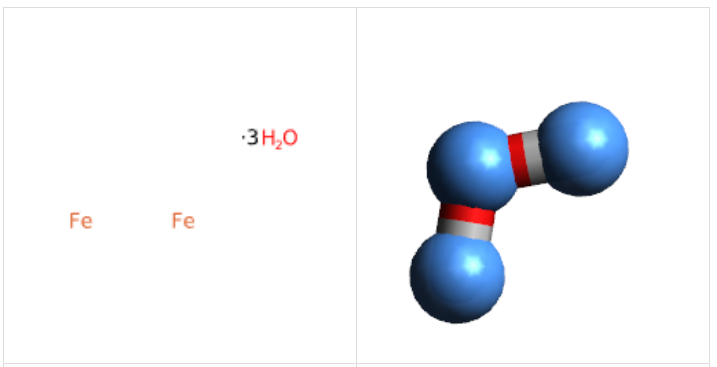
- Molecular Formula : Fe2O3 Fe2H6O3
- Molecular Weight : 159,69 g/mol
- CAS : 1309-37-1 1332-37-2
- UNII
- EC Number: 215-168-2
- DSSTox Substance ID:
- MDL number
- MFCD00011008
- PubChem Substance ID 329753614
- InChI=1S/2Fe.3H2O/h;;3*1H2
- InChl Key YOBAEOGBNPPUQV-UHFFFAOYSA-N
- SMILES O.O.O.[Fe].[Fe]
- IUPAC iron;trihydrate
- ChEBI
Synonyms:
- CI77492
- E172 (iii)
- Ferric oxide

