



Carboxymethyl starch sodium
Sodium carboxymethyl starch / sodium starch glycolate – (carboxymethylated starch polymer, sodium salt)
Synonyms: sodium carboxymethyl starch, sodium starch glycolate, carboxymethyl starch sodium salt, Explotab, Primojel
INCI / functions: binder, emulsion stabilizer, film former, viscosity controlling (thickener/consistency regulator)
Definition
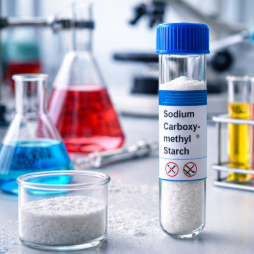
An anionic derivative of starch (a plant polysaccharide), obtained by introducing carboxymethyl groups onto the glucidic backbone and neutralizing them as a sodium salt. Structurally, it is mainly composed of a starch polymer (glucose units linked in polysaccharide chains) bearing carboxymethyl substituents and associated sodium counter-ions. In water it tends to hydrate and swell rapidly, increasing viscosity and supporting the physical stability of dispersions and emulsions. In the pharmaceutical field it is widely used as a superdisintegrant (promotes rapid disintegration of tablets/capsules). In cosmetics it is used as a thickener/consistency regulator, binder, and stability aid in rinse-off products and in appropriately balanced aqueous or hydroalcoholic systems.
Calories (energy value)
| Item | Value |
|---|---|
| Energy value (100 g) | Not practically significant at typical use levels (functional use, not nutritional) |
| Technical note | It is a modified polysaccharide: if ingested, theoretical “carbohydrate energy” is not the driver; in cosmetic use and as an excipient, the energy contribution to the finished product is generally negligible |
Identification data and specifications
| Item | Value |
|---|---|
| Name | Carboxymethyl starch sodium |
| INCI | Sodium Carboxymethyl Starch |
| Chemical nature | polysaccharide (polymer) – sodium salt of carboxymethylated starch |
| CAS number | 9063-38-1 |
| EC number | Not consistently assigned / variable (polymeric material; depends on registers and grade) |
| Identifiers (pharma use, common) | UNII 5856J3G2A2 (reported in some technical sheets) |
| Property / specification (typical pharmaceutical grade, indicative) | Indication |
|---|---|
| Appearance | white to off-white powder |
| pH (1 g in 30 mL water) | 5.5–7.5 |
| Loss on drying | ≤ 10% (indicative) |
| Heavy metals | typically controlled (e.g., ≤ 20 ppm in some specifications) |
| Formulation notes | hydrophilic material with marked swelling capacity; performance depends on starch source, degree of substitution and (if present) crosslinking |
| Cosmetic functions | Operational description |
|---|---|
| Binder | improves cohesion of powders and compact systems |
| Emulsion stabilizer | supports emulsion formation and stability |
| Film former | contributes to a continuous film on skin/hair/nails |
| Viscosity controlling | increases or modulates viscosity in aqueous systems |
Functional role and clarification “thickener / stabilizer / superdisintegrant”
| Function | What it does in formula | Typical use |
|---|---|---|
| Viscosity controlling | viscosity increase via hydration and swelling | cleansers, gels, aqueous systems/dispersions |
| Emulsion stabilizer | reduces physical instability (separation/creaming) as a rheology aid | O/W emulsions, lotions, cleansing |
| Binder | supports cohesion of powders and compacts | pressed powders, tablets (also non-cosmetic) |
| Superdisintegrant (pharma) | accelerates disintegration through imbibition and swelling | tablets/capsules, ODT, solid dosage forms |
Formulation compatibility
| System | Compatibility | Control notes |
|---|---|---|
| Aqueous systems | generally good | check rheology after 24–48 h (progressive hydration) |
| Electrolytes / salts | to be assessed | high salinity can reduce swelling or shift viscosity |
| Surfactants | generally compatible | in cleansers, assess sensory feel, transparency, and cold stability |
| Thickening polymers | often synergistic | possible rheological synergies/antagonisms: optimize ratio and addition order |
| Alcohols (hydroalcoholic) | possible reduced hydration | monitor clarity and viscosity loss as alcohol level increases |
Use guidelines (indicative)
| Application | Typical range | Technical note |
|---|---|---|
| Rinse-off cleansers (gels, body wash, shampoo) | 0.1–2.0% | viscosity modulation and stability; check transparency if required |
| O/W lotions/emulsions | 0.1–1.0% | rheology/stability support; test with electrolytes and preservatives |
| Powders/compacts (binder role) | 0.2–5.0% | depends on cosmetic form and compression target |
| “Topical” use in some non-EU databases | up to 4.7% (contextual indication) | not an EU limit: useful as a comparative reference, to be validated on the finished product |
| Good addition practices | Detail |
|---|---|
| Dispersion | pre-disperse in glycerin/compatible solvent or into water under high shear to reduce lumps |
| Hydration | allow adequate hydration time and re-check viscosity after rest |
| Stability checks | heat/cold cycles and centrifuge to evaluate syneresis, flocculation, and rheology drift |
Typical applications
Cosmetics
Binder agent. Ingredient that is used in cosmetic, food and pharmaceutical products as an anti-caking agent with the function of making the product in which it is incorporated silky, compact and homogenous. The binder, either natural such as mucilage, gums and starches or chemical, may be in the form of a powder or liquid.
Emulsion stabiliser. Emulsions are thermodynamically unstable. Emulsion stabilisers improve the formation and stability of single and double emulsions. as well as their shelf-life. It should be noted that in the structure-function relationship, the molar mass of the ingredient used plays an important role.
Film-forming agent. It produces, upon application, a very thin continuous film with an optimal balance of cohesion, adhesion and stickiness on skin, hair or nails to counteract or limit damage from external phenomena such as chemicals, UV rays and pollution.
Viscosity control agent. It controls and adapts, Increasing or decreasing, viscosity to the required level for optimal chemical and physical stability of the product and dosage in gels, suspensions, emulsions, solutions.
Cleansers and cleansing: viscosity adjustment and support to stability of surfactant systems.
O/W emulsions and lotions: rheology aid and stabilizer.
Film-forming products: contribution to film formation and sensory profile (in synergy with other polymers).
Pharmaceutical: superdisintegrant for rapid disintegration and release in solid dosage forms.
Quality, grades and specifications
| Grade | Typical use | Common checks |
|---|---|---|
| Cosmetic | personal care | purity, microbiology (where applicable), rheology performance, particle profile |
| Pharmaceutical (NF/Ph. Eur. depending on supplier) | solid excipient | pH in suspension, loss on drying, impurities (e.g., glycolate/NaCl in some specs), metals, microbiology |
| Technical | industrial applications | functional/process parameters, sector-dependent impurity profile |
Safety, regulation and environment
| Topic | Operational guidance |
|---|---|
| Use safety | generally low toxicity; dust may irritate eyes and respiratory tract |
| Combustible dust | like many fine organic powders, may present combustible dust risk under unfavorable conditions |
| Allergenicity | not typically associated with sensitization; always assess the finished product |
| EU cosmetics | usable subject to general rules and GMP; always verify finished-formula compliance |
| Environment | polysaccharide-based material; manage effluents/residues according to good practice |
Formulation troubleshooting
| Issue | Possible cause | Corrective actions |
|---|---|---|
| Lumps / “fish eyes” | non-uniform wetting, addition too fast | pre-dispersion, higher shear, sieving, gradual addition |
| Lower-than-expected viscosity | incomplete hydration, high alcohol, high salinity | increase hydration time, rebalance solvents, reduce electrolytes |
| Instability (syneresis / separation) | rheology incompatibility or electrolyte load | optimize with co-thickeners, reduce salts, re-tune aqueous phase |
| Performance loss over time | pH/electrolyte shifts or interactions with other polymers | accelerated stability, optimize addition order and pH window |
Conclusion
Carboxymethyl starch sodium is a modified polysaccharide with strong formulation utility: in cosmetics it mainly provides viscosity control, binding, and stability support; in pharmaceuticals it is a benchmark superdisintegrant. Performance depends materially on grade/quality, particle profile, electrolytes, and hydration conditions: a robust dispersion strategy and rheology checks after rest are the key levers to achieve repeatable results.
Studies
Resists amylase in vitro In the small intestine it is not hydrolyzed by D-glucose in the small intestine, but can be fermented in the colon by anaerobic bacteria (1).
Electrolyte soluble in cold water. Insoluble in ethanol, ether, chloroform and other organic solvents. In aqueous solution above 80°C there is a decrease in viscosity.
It is most commonly called in its abbreviated form CMS-Na.
Carboxymethyl starch ether was first produced in 1924 and as an industrial product in 1940.
Commercially it is a modified starch that is produced in two types: carboxymethyl starch (CMS) and pregelatinized starch. Depending on the raw materials used for preparation, it is marketed as pregelatinized corn starch and pregelatinized tapioca/cassava starch.
Sodium carboxymethyl starch studies
What it is used for
- Detergents and cleaners. It has the ability to improve suspension dispersion and prevents dirt particles or pollutants from entering the suspension.
- Construction. Stucco powder, waterproof wall stucco, cement plastering mortar, cement insulation cracking mortar, tile adhesives, drywall. In cement and gypsum processing, it is used with hydroxypropylmethylcellulose as a thickener, resists cracking, improves the workability of raw materials, and can reduce the content of hydroxypropylmethylcellulose.
- Paper. Has the function of sizing, coagulating to improve tear strength.
- Textile. Finishing agent, sizing agent.
- Petroleum. Has good rheological properties that improve stability, water retention, flow and liquid loss.
- Paints. Anti-suspension agent, emulsifying dispersant, filmogen, thickener and binder.
- Feed. Embedded in formula with carboxymethylcellulose and sodium alginate offers good compatibility with Xanthan gum.
- Pharmaceutical. It functions as a superdisintegrator for all solid oral dosage forms. It has an ability to swell up to 280 - 320 times its original granule volume. It is an excipient especially used for wet or dry granulation and direct compression and can be incorporated in intra- or extra-granular mode. or both. It generally has a potato starch base. It is produced in two types: Type A with low viscosity and low residual solvent and Type B particularly suitable in strongly acidic drug formulations to maintain stability and resist acidic pH.
- PVA. In some sectors it is a good substitute for polyvinyl alcohol.
- Medicine. Sodium carboxymethyl starch (CMS-Na), is a type of food additive with high degree of substitution and is also known as a prebiotic. This study finds that it can be used as an adjuvant in constipation (2).
Where to buy
| 9063-38-1 Sodium carboxyl methylstarch, tech. AKSci O429 | AK Scientific, Inc. 30023 Ahern Avenue Union City, CA 94587, USA |
| Sodium-Starch-Glycolate-pH-55-75-Type-A-NF | CAS 9063-38-1 | S1962 | Spectrum Chemical | Spectrum Chemical Mfg. Corp. 769 Jersey Avenue New Brunswick, NJ 08901-3605 USA |
| Sodium Starch Glycolate, pH 5.5-7.5, Type A, NF, Spectrum Chemical | Fisher Scientific |
- Molecular Formula: [C6H7O2(OH)2OCH2COONa]n [C10H19O8Na]n
- Linear Formula (C2H4O3)x · (Na)x
- PMolecular Weight: 290.243
- Exact Mass 290.097748
- CAS: 9063-38-1
- UNII 5856J3G2A2
- EC Number: 1308068-626-2
- DSSTox Substance ID:
- MDL number MFCD00217761
- PubChem Substance ID
- InChI Key MOSFIJXAXDLOML-UHFFFAOYSA-N
- SMILES
- IUPAC
- ChEBI
Synonyms:
- CMS-Na
- Carboxymethyl starch sodium
- Sodium starch glycolate
- Sodium starch glycolate type B
- Sodium carboxyl methylstarch
- Sodium [(3R,4S,5R)-4,5-dihydroxy-6-methoxy-3-methyltetrahydro-2H-pyran-2-yl]methanolate - hydroxyacetic acid (1:1:1)

