



Triaethylcitrat - Triethyl citrate
Triethyl citrate – C₁₂H₂₀O₇
Synonyms: ethyl citrate, citric acid triethyl ester; E1505 (food use)
INCI / functions: solvent, plasticizer (film former support), deodorant (deodorising ingredient), fixative / support for fragrance longevity in perfumery, support for dispersibility of certain organic UV filters in the oil phase
Definition
An organic ester of citric acid and ethanol, used as a multifunctional liquid ingredient. In cosmetics it is used as a solvent and plasticizer (improves flexibility and durability of films/resins) and as a deodorant active/auxiliary in underarm products, as well as a component that can improve sensory stability and fragrance persistence. In the food sector it is authorised as additive E1505, typically as a solvent/carrier and processing aid in specific technological applications.
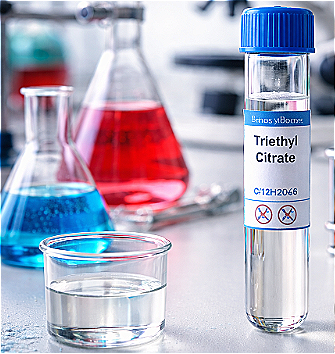
Identification data and specifications
| Item | Value |
|---|---|
| Name | Triethyl citrate (triethyl citrate) |
| INCI | Triethyl Citrate |
| Formula | C₁₂H₂₀O₇ |
| Molar mass | 276.28 g/mol |
| CAS number | 77-93-0 |
| EC number (EINECS) | 201-070-7 |
| Food additive | E1505 |
| Property | Indication |
|---|---|
| Physical state | oily liquid |
| Colour / odour | generally colourless and almost odourless (depends on grade) |
| Density (25 °C, indicative) | ~1.13–1.14 g/mL |
| Melting point | ~-55 °C |
| Boiling point (1 atm) | ~294 °C |
| Flash point (indicative) | ~151–155 °C |
| Water solubility (25 °C, indicative) | moderate (order of tens of g/L) |
| Solubility in organic solvents | generally good (e.g., ethanol and many cosmetic solvents) |
| pH | not applicable (non-aqueous liquid); in aqueous systems it may undergo hydrolysis accelerated by strong acids/bases |
| Stability and reactivity | Formulation implication |
|---|---|
| Hydrolysis | avoid prolonged strongly acidic or strongly basic conditions, especially with water and heat |
| Oxidation | not particularly sensitive; good storage practices reduce olfactory drift |
| Packaging compatibility | generally good; still verify with elastomers/adhesives and plastics sensitive to plasticizers |
Functional role and clarification “solvent / plasticizer / deodorant”
| Function | What it does in formula | Where it is typical |
|---|---|---|
| Solvent | helps solubilise lipophilic components and/or resins | perfumes, sprays, hydroalcoholic solutions, multi-solvent systems |
| Plasticizer | makes the film more flexible and less brittle, improving wear and sensory feel | hairspray, nail care, film formers/resins |
| Deodorant | supports reduction of skin odours linked to microbial/enzymatic activity | underarm deodorants (roll-on, stick, spray) |
| Perfumery support | improves longevity and “roundness” as a diluent/fixative | fragrances and perfumed bases |
Formulation compatibility
Hydroalcoholic systems: generally excellent as a co-solvent; check clarity at low temperature.
Aqueous systems: possible opalescence if the level exceeds effective solubility; use solubilizers or microemulsion strategies.
Resins / film formers: often very useful as a plasticizer; optimise ratio with polymers to avoid tackiness.
Salts and ionic actives: generally compatible; avoid extreme pH (with water present) to limit hydrolysis risk.
Fragrances: good compatibility as a diluent; assess case-by-case with highly reactive essential oils/allergens.
Use guidelines (indicative)
| Application | Typical range | Technical note |
|---|---|---|
| Deodorants (roll-on, spray, stick) | 0.5–5.0% | higher levels increase functional efficacy and solvent contribution |
| Perfumery / perfumed bases | 0.5–10% | as diluent/fixative and sensory modulator |
| Hairspray / film formers | 1–10% | optimise with polymers for flexibility and reduced film brittleness |
| Nail care (nail polish / top coat) | 2–15% | resin plasticizer; verify drying and final hardness |
| Food (E1505) | by category | use as solvent/processing aid within applicable limits |
| Good addition practices | Detail |
|---|---|
| Addition sequence | add into the solvent/oil phase before fragrances and resins, then homogenise |
| Clarity control | bench-check at low temperature (e.g., 5–10 °C) when water is present |
| pH control (if water is present) | keep pH in a moderate range and avoid extremes to limit hydrolysis |
Typical applications
Deodorants: deodorant ingredient and functional solvent to improve performance and sensory profile.
Perfumery: diluent and support for fragrance longevity.
Hairspray and styling: plasticizer for more flexible, less friable films.
Nail care: support for films/resins to improve adhesion, flexibility, and crack resistance.
Food: E1505 as solvent/processing aid in specific applications.
Quality, grades and specifications
| Grade | Typical use | Key parameters |
|---|---|---|
| Cosmetic | personal care | purity, odour/colour, metals, acidity, water |
| Food (E1505) | food processing | compliance with purity specifications, impurities, applicable criteria |
| Pharmaceutical / analytical | controlled applications | stricter impurity profile, traceability, and repeatability |
Note: for deodorants and perfumery, olfactory quality (absence of off-notes) is often as important as chemical parameters.
Safety, regulation and environment
| Topic | Operational guidance |
|---|---|
| Use safety | generally considered low toxicity at use levels; avoid prolonged eye contact and inhalation of concentrated aerosols |
| Allergenicity | not typically associated with sensitisation; still assess the finished formula and fragrance system |
| EU cosmetics | usable subject to general rules and GMP; always verify finished-formula compliance |
| Food | authorised as E1505 with category-based conditions of use |
| Environment | generally favourable biodegradability; manage effluents and process residues per good practice |
Formulation troubleshooting
| Issue | Possible cause | Corrective actions |
|---|---|---|
| Opalescence in water-containing formulas | exceeding effective solubility or interactions with fragrances/resins | reduce dose, increase co-solvent, add a solubilizer, rebalance solvent phase |
| Film too soft/tacky | excess plasticizer vs resin/polymer | reduce triethyl citrate, increase film former, rebalance volatile/non-volatile solvents |
| Background odour in the finished product | suboptimal grade or interactions with the fragrance | select a grade with better odour profile, adjust fragrance, control storage |
| Changes over time (aqueous systems) | possible hydrolysis accelerated by extreme pH or heat | keep pH moderate, reduce free water, control temperature and run accelerated stability |
Conclusion
Triethyl citrate is a versatile ingredient for cosmetic formulations and, as E1505, for specific food applications. In cosmetics it stands out for the combination of solvent, plasticizer, and deodorant functions, making it particularly useful in deodorants, perfumery, and film-forming products (hairspray, nail care). Successful formulation depends primarily on solvent balance, clarity control in water-containing systems, and optimisation of the ratio with resins/polymers.
Studies
Safety
With regard to safety, Triethyl Citrate (in the form of Acetyl Triethyl Citrate) is considered relatively safe based on the toxicological data published to date, and this pharmacokinetics study demonstrated that Acetyl Triethyl Citrate rapidly disappeared from plasma. Metabolite profiling data indicated that Acetyl Triethyl Citrate was extensively metabolized and excreted primarily as metabolites rather than the parent form. This is the first report demonstrating a bioanalytical method for the determination of Acetyl Triethyl Citrate in biological samples and its pharmacokinetic properties (1).
Pharmaceutical
In tablets, it is a non-toxic hydrophilic plasticizer that can be incorporated into the film coating of pressure-coated tablets consisting of hydroxypropyl methyl cellulose acetate succinate or enteric polymer films consisting of polymethyl methacrylate. Triethyl Citrate performs the function of reducing damage during the compression process.
Cosmetics
Chelating agent, a chemical compound that reacts with metal ions to form a stable, water-soluble complex. Used as an antioxidant, solvent, deodorant, odor inhibitor and plasticizer. Skin care products plasticized with Triethyl Citrate have good resistance to oil, light and mildew.
Medical
It is used in protein films composed of sunflower protein or whey protein or for buccal and sublingual films or particulate systems.
A study on hidradenitis suppurativa, a chronic disease of the terminal follicular epithelium in areas bearing apocrine glands, demonstrated the efficacy of a lotion composed of Triethyl citrate, ethyl-linoleate, and g-peptide-10. This composition had already demonstrated efficacy in the treatment of acne (2).
Plastic
Plasticizer for thermoplastic resins such as cellulose resin, vinyl resin and soft toys. As plasticizer for adhesives and sealants, it can replace dibutyl phthalate, diisobutyl phthalate, dimethyl phthalate, diethyl phthalate, etc.
General features for liquid Triethyl Citrate
- Boiling point 235 °C/150 mmHg (lit.)
- Melting point -55 °C
- density 1.14 g/mL at 25 °C (lit.)
- vapor density 9.7 (vs air)
- vapor pressure 1 mm Hg ( 107 °C)
- FEMA 3083 | TRIETHYL CITRATE
- refractive index n20/D 1.442(lit.)
- Fp >230 °F
- storage temp. -20°C
- Molecular Formula: C12H20O7
- Linear Formula: HOC(COOC2H5)(CH2COOC2H5)2
- Molecular Weight: 276.28
- CAS: 77-93-0
- UNII 8Z96QXD6UM
- EC Number: 201-070-7
- DSSTox Substance ID: DTXSID0040701
- MDL number MFCD00009201
- PubChem Substance ID 329823171
- FEMA 3083
- Bellstein: 1801199
- NACRES NA.24
Synonyms:
- Ethyl citrate
- Citric acid, triethyl ester

