



Clascoterone: properties, uses, pros, cons, safety
Clascoterone is a topical antiandrogen originally developed for the treatment of acne vulgaris. It functions as a competitive antagonist of androgen receptors (AR) in the skin, blocking the local action of dihydrotestosterone (DHT) in sebocytes and keratinocytes. This targeted mechanism reduces sebum production, inflammation, and several pathways involved in acne formation, with minimal systemic absorption.
Chemical nature and structure
Clascoterone is structurally related to 11-deoxycortisol and progesterone. It is an ester (typically the 17-propionate), a modification that increases lipophilicity, optimises skin penetration and favours a predominantly local cutaneous action with minimal systemic exposure
Physical and formulation properties
In clinical use, clascoterone is currently marketed mainly as a topical cream 1% (10 mg/g) for acne. The cream is usually white to off-white, formulated for easy spreadability, good cosmetic acceptability and targeted delivery to the pilosebaceous unit.
More recently, Clascoterone has gained significant attention for its potential role in treating androgenetic alopecia (AGA). In this condition, DHT acts on genetically sensitive hair follicles, promoting miniaturization, shortening of the anagen phase, and progressive hair thinning. By blocking androgen receptors directly at the follicular level, Clascoterone may counteract these processes without systemic hormonal effects, making it a novel option in the therapeutic landscape.
For hair-loss research, clascoterone is being developed as a topical 5% scalp solution (often referred to under the development name Breezula). This solution is designed for scalp application, with adequate residence time and limited systemic absorption.
Preliminary and top-line results from large, multicenter phase III clinical trials on men with AGA have reported notable increases in target-area hair count, with improvements far exceeding placebo and suggesting clinically meaningful regrowth. Reported tolerability has been favorable, with adverse effects comparable to placebo and no significant systemic antiandrogenic activity. These findings position Clascoterone as a promising candidate for topical management of AGA, potentially expanding treatment options beyond long-established therapies such as minoxidil and oral finasteride.
Clascoterone’s relevance in hair loss management lies in its combination of localized action, low systemic exposure, and a mechanism directly addressing androgen-mediated miniaturization at the follicle. While full trial data and long-term results are still needed, the emerging evidence suggests that Clascoterone could become an important addition to future hair restoration therapies.
Mechanism of action
Clascoterone acts as a competitive antagonist of the androgen receptor (AR) in skin and hair-follicle cells.
In acne, it competes with dihydrotestosterone (DHT) and other androgens for AR binding in sebocytes and dermal papilla cells, thereby reducing sebum production and down-regulating pro-inflammatory signalling within the pilosebaceous unit.
In androgenetic alopecia (AGA), the same AR blockade at the level of hair-follicle dermal papilla cells is intended to counteract DHT-driven follicular miniaturisation, addressing the biological root cause of pattern hair loss through a local, non-systemic mechanism.
Because it acts locally and is rapidly metabolised after absorption, clascoterone is designed to minimise systemic hormonal side-effects compared with oral antiandrogens.
Medical uses: acne vulgaris (approved)
Clascoterone 1% cream (Winlevi®) is approved in several regions (including the US and EU) for the topical treatment of acne vulgaris:
Indicated in adults and adolescents from 12 years of age (age range and exact wording vary slightly between jurisdictions).
Applied twice daily in a thin layer to affected areas.
Clinical trials have shown significant reductions in inflammatory and non-inflammatory lesions and improvements in global acne severity compared with vehicle cream, with a generally favourable safety profile and mostly mild local reactions.
Medical uses: androgenetic alopecia / hair loss (investigational)
Clascoterone is also being investigated as a topical treatment for male-pattern hair loss:
Two large Phase III trials (SCALP-1 and SCALP-2) of clascoterone 5% solution in male androgenetic alopecia (AGA) have recently reported positive topline results.
Across 1,465 men, these studies showed statistically significant and clinically meaningful increases in target-area hair count (TAHC) versus vehicle (placebo). One trial reported a 539% relative improvement versus vehicle, and the other a 168% relative improvement, figures that have been widely covered in media reports (including Fox News and other outlets) as “dramatic hair-regrowth gains.”
Patient-reported outcomes (PROs) also suggest visible hair-density improvement and high treatment satisfaction in many participants.
Safety in the AGA trials
In these Phase III studies, the safety and tolerability profile of clascoterone 5% solution was reported as similar to vehicle, with treatment-emergent adverse events generally mild and comparable between active and placebo groups.
Regulatory status for hair loss (as of Dec 2025)
Clascoterone 5% solution for AGA is not yet approved for marketing.
The sponsor has announced plans to pursue parallel regulatory submissions in the US and EU after completion of the required 12-month safety follow-up, expected in spring 2026.
Until formal approvals are granted, the use of clascoterone for hair loss remains investigational and should be considered experimental, outside of clinical trials or specific regulatory frameworks.
Safety, adverse effects and contraindications
For topical acne treatment (1% cream)
The most common adverse reactions are local skin events, typically: erythema, scaling/dryness, pruritus, and stinging/burning at the application site. These are usually mild to moderate and often decrease with continued use.
In a minority of patients, clinical studies have detected reversible suppression of the hypothalamic–pituitary–adrenal (HPA) axis and occasional, usually asymptomatic hyperkalaemia, reflecting the steroid-like nature of the molecule. Product information therefore recommends caution and, where appropriate, clinical monitoring in at-risk individuals.
Typical contraindications and cautions (always refer to official product information and a physician):
Hypersensitivity to clascoterone or any excipients.
Use in pregnancy and breast-feeding only if clearly needed, after medical risk–benefit assessment.
Avoid application on broken, severely damaged, or mucosal surfaces and around eyes.
For investigational hair-loss use (5% solution)
Topline Phase III data indicate a safety profile similar to vehicle, with mostly mild local reactions and no major systemic safety signals reported at six months; however:
Full peer-reviewed publications are still pending.
Long-term safety (beyond one year) and effects in broader patient populations remain to be fully established.
Any off-label or early-access use for hair loss should therefore be considered only under specialist supervision and within applicable regulations.
Regulatory status (acne)
United States: WINLEVI® (clascoterone) cream 1% is approved for the topical treatment of acne vulgaris in patients 12 years and older.
European Union: Winlevi received European Commission approval in 2025 for the treatment of acne vulgaris in adults and adolescents (12 to <18 years; facial use in adolescents).
Additional approvals have been granted in other regions (e.g. UK, Canada, Australia, New Zealand) with similar indications.
Regulatory details (age limits, reimbursement, prescribing restrictions) vary between countries and should always be checked in the local product information.
Main INCI-type functional roles (topical use)
Where clascoterone is listed in ingredient terms for topical products (primarily in a medicinal rather than purely cosmetic context), its functional roles can be summarised as:
Anti-acne / sebum-regulating active: reduces androgen-driven sebum production and inflammatory lesions.
Skin conditioning active: over time, contributes to a more uniform, less oily skin appearance in acne-prone areas.
Antiandrogenic functional agent: locally blocks androgen receptor activity in sebaceous glands and hair follicles.
In a strict regulatory sense, clascoterone is handled as a drug substance, not as a conventional cosmetic ingredient, so these functions are usually framed as therapeutic indications rather than cosmetic claims.
Conclusion
Clascoterone is the first topical androgen-receptor inhibitor to reach clinical use in dermatology. In acne vulgaris, it offers a hormone-pathway-targeted option with local action and a generally favourable tolerability profile, expanding the therapeutic toolkit beyond retinoids, benzoyl peroxide and antibiotics.
In androgenetic alopecia, recent Phase III topline data from large trials in men suggest that clascoterone 5% solution can achieve substantial increases in hair count with safety similar to placebo, raising the prospect of the first major innovation for male-pattern hair loss in decades and the first topical AR inhibitor specifically developed for this indication. Media coverage (including the Fox News article you cited) reflects the high level of interest, but key questions remain:
Confirmation of results in peer-reviewed publications.
Robust data on long-term safety and durability of effect.
Clarification of efficacy in different patient groups (age, severity, female AGA).
If forthcoming regulatory submissions are successful and the data hold up under scrutiny, clascoterone may soon play a dual role in clinical practice: as a topical antiandrogen for both acne and pattern hair loss, with a distinctive local mechanism and limited systemic exposure.
Mini-glossary
Androgen receptor (AR): Intracellular receptor that binds androgens (e.g. testosterone, DHT) and regulates gene expression affecting sebum production, hair growth and other skin functions.
Dihydrotestosterone (DHT): A highly potent androgen formed from testosterone via 5-α-reductase; implicated in acne (via sebum stimulation) and androgenetic alopecia (via follicle miniaturisation).
Androgenetic alopecia (AGA): Common form of pattern hair loss in men and women, driven by genetic susceptibility and androgen-dependent follicular miniaturisation.
Target-area hair count (TAHC): Quantitative measure of the number of hairs in a defined scalp area, used as an objective endpoint in hair-growth trials.
Topline results: Initial high-level summary of trial outcomes released by sponsors, usually before full peer-reviewed analysis and publication.
HPA axis (hypothalamic–pituitary–adrenal axis): Hormonal regulatory system controlling cortisol and other steroid hormones; topical steroids and steroid-like drugs can sometimes cause transient suppression.
Topical androgen-receptor inhibitor: A medication applied to the skin or scalp that locally blocks androgen receptor activity, aiming to minimise systemic hormonal effects.
 | 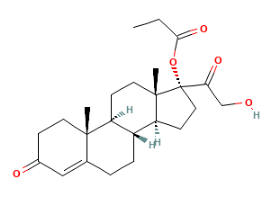 |
Molecular Formula C24H34O5
Molecular Weight 402.5 g/mol
CAS 19608-29-8
UNII XN7MM8XG2M
EC Number 685-282-9
DTXSID10471883
Synonyms:
Winlevi®
Cortexolone 17alpha-propionate

