

Hello, Guest!


  Objects Tiiips Categories
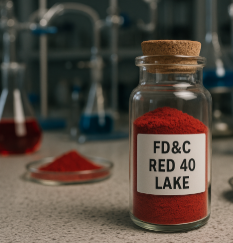
FD&C Red 40 Lake
"Descrizione"
by Al222 (24871 pt)
2025-Nov-20 10:39

FD&C Red 40 Lake, FD&C Red No. 40 lake è un composto chimico,  un colorante, derivato azoico, idrosolubile  (Autorizzazione FDA nel 1971) conosciuto in Europa come E129 o Rosso Allura.

Il nome definisce la struttura della molecola.

  • FD&C sta per "Food, Drug, and Cosmetic" e si riferisce a coloranti e pigmenti che sono stati approvati dalla Food and Drug Administration (FDA) degli Stati Uniti per l'uso in alimenti, farmaci e cosmetici.
  • Red No. 40 è un colorante rosso sintetico prodotto a partire dal petrolio. È uno dei coloranti alimentari più comunemente utilizzati.
  • Lake si riferisce a una versione insolubile di un colorante. I coloranti "Lake" sono spesso utilizzati in prodotti che necessitano di stabilità al colore
Materie prime utilizzate nella produzione. 

  • Le materie prime utilizzate nella sintesi di Allura Red AC sono tipicamente naftalensulfonato, anidride ftalica e acido benzenesulfonico, tra gli altri.

Riassunto passo-passo del processo di produzione industriale.

  • Preparazione delle materie prime. Le materie prime vengono preparate e purificate per essere utilizzate nella reazione di sintesi.
  • Reazione di Sintesi. Le materie prime reagiscono in un ambiente controllato per formare il colorante Allura Red AC.
  • Purificazione. Il colorante grezzo viene purificato attraverso vari passaggi per rimuovere impurità e altri componenti non desiderati.
  • Secco e Granulazione. Il colorante viene poi seccato e trasformato in una forma granulare per facilitare l'uso e il trasporto.

Forma e colore. FD&C Red No. 40 è un polvere cristallina, solubile in acqua, con una colorazione che varia dal rosso all'arancione.

Applicazioni commerciali. 

Viene utilizzato in vari prodotti alimentari, farmaceutici e cosmetici per dare una colorazione rosso-arancio.

Industria Alimentare. Usato ampiamente per colorare cibi e bevande, fornendo una tonalità rossa distintiva.

Cosmetici e Prodotti per la Cura Personale. Applicato in vari prodotti come rossetti e shampoo per offrire colori vivaci e accattivanti.

Farmaceutica. Utilizzato per colorare sciroppi, compresse e capsule per una differenziazione facile e per ragioni estetiche.

Ha moltissimi sinonimi, tra i quali il più comune è Red 40 o Allura Red AC e, nella lista dei coloranti, CI 16035.

Sicurezza

La FDA (Food and Drug Administration) degli Stati Uniti ha approvato l'uso del Red No. 40 e lo considera generalmente sicuro quando utilizzato secondo le direttive. 

Il problema legato ai coloranti azoici (monoazo o diazo) è la degradazione fotocatalitica (1) che porta ad un'eventuale ossidazione ed alla successiva formazione di impurità come le ammine aromatiche alcune delle quali svolgono attività cancerogena.

Rosso allura studi

Rosso allura bibliografia

  • Formula molecolare: C18H14N2Na2O8S2
  • Peso molecolare: 496.416 g/mol
  • UNII: WZB9127XOA
  • CAS: 25956-17-6  64553-31-7  66813-73-8
  • EC Number: 247-368-0
  • PubChem Substance ID 329755751
  • MDL number MFCD00059526
  • Colour Index Number 16035

Sinonimi

  • Allura Red
  • Allura red AC dye
  • C.I. Food Red 17
  • Food red 17
  • Japan Food Red No. 40
  • FD and C Red No. 40
  • FD & C Red no. 40
  • CCRIS 3493
  • CI 16035
  • HSDB 7260
  • E129
  • CI 16035
  • Food Red No. 40
  • FD&C Red No. 40
  • Curry red
  • Fancy Red
  • Allura Red 40
  • FDC Red 40
  • Red No. 40
  • FDC Red 40 dye
  • Food Red No. 17
  • AC1O1BOF
  • DSSTox_CID_4436
  • FD and C Red No.40
  • EC 247-368-0
  • DSSTox_RID_77395
  • DSSTox_GSID_24436
  • Sodium 6-hydroxy-5-((2-methoxy-5-methyl-4-sulfonatophenyl)diazenyl)naphthalene-2-sulfonate
  • 6-Hydroxy-5-[2-(2-methoxy-5-methyl-4-sulfophenyl)diazenyl]-2-naphthalenesulfonic Acid Sodium Salt
  • disodium (5E)-5-[(2-methoxy-5-methyl-4-sulfonatophenyl)hydrazinylidene]-6-oxonaphthalene-2-sulfonate
  • 6-Hydroxy-5-[(6-methoxy-4-sulfo-m-tolyl)azo]-2-naphthalenesulfonic Acid Disodium Salt
  • disodium (5Z)-5-[(2-methoxy-5-methyl-4-sulfonatophenyl)hydrazinylidene]-6-oxonaphthalene-2-sulfonate
  • disodium;(5Z)-5-[(2-methoxy-5-methyl-4-sulfonatophenyl)hydrazinylidene]-6-oxonaphthalene-2-sulfonate
  • disodium;6-hydroxy-5-[(E)-(2-methoxy-5-methyl-4-sulfonatophenyl)diazenyl]naphthalene-2-sulfonate
  • 2-Naphthalenesulfonic acid, 6-hydroxy-5-((2-methoxy-5-methyl-4-sulfophenyl)azo)-, disodium salt
  • Disodium 6-hydroxy-5-((6-methoxy-4-sulfo-m-tolyl)azo)-2-naphthalenesulfonate
  • 2-Naphthalenesulfonic acid, 6-hydroxy-5-((6-methoxy-4-sulfo-m-tolyl)azo)-, disodium salt
  • Disodium 6-hydroxy-5-((2-methoxy-5-methyl-4-sulfophenyl)azo)-2-naphthalenesulfonate
  • Disodium 6-hydroxy-5-((2-methoxy-4-sulphonato-m-tolyl)azo)naphthalene-2-sulphonate
  • 2-Naphthalenesulfonic acid, 6-hydroxy-5-(2-(2-methoxy-5-methyl-4-sulfophenyl)diazenyl)-, sodium salt (1:2)
  • 2-Naphthalenesulfonic acid, 6-hydroxy-5-[2-(2-methoxy-5-methyl-4-sulfophenyl)diazenyl]-, sodium salt (1:2)
  • disodium 6-hydroxy-5-[(E)-(2-methoxy-5-methyl-4-sulfonatophenyl)diazenyl]naphthalene-2-sulfonate
  • SCHEMBL324089
  • SCHEMBL340786
  • C18H14N2Na2O8S2
  • CHEMBL3188816
  • DTXSID4024436
  • Disodium 6-hydroxy-5-((2-methoxy-5-methyl-4-sulfophenyl)azo)-2-naphthalene- sulfonate
  • Disodium 6-hydroxy-5-[(2-methoxy-5-methyl-4-sulfophenyl)azo]-2-naphthalenesulfonate
  • 2-Naphthalenesulfonic acid, 6-hydroxy-5-[(2-methoxy-5-methyl-4-sulfophenyl)azo]-, disodium salt
  • 6-Hydroxy-5-((2-methoxy-5-methyl-4-sulfophenyl)azo)-2-naphthalene- sulfonic acid, disodium salt

Bibliografia_________________________________________________________________________

(1) Barros, W. R., Steter, J. R., Lanza, M. R., & Motheo, A. J. (2014). Degradation of amaranth dye in alkaline medium by ultrasonic cavitation coupled with electrochemical oxidation using a boron-doped diamond anode. Electrochimica Acta, 143, 180-187.

Abstract. Amaranth dye is used widely in the processing of paper, textiles, foods, cosmetics, beverages and medicines, and effluents contaminated with this compound are discharged daily into the environment. Recent studies have shown that azo dyes, especially those such as amaranth dye that have been classified as endocrine disruptors, may cause adverse effects to animal and human health. This paper describes the application of electrochemical oxidation (with a boron-doped diamond BDD thin-film anode) coupled with ultrasound sonolysis (20 kHz and 523 W cm−2) to the removal of amaranth dye from dilute alkaline solution. The electrochemical and sonoelectrochemical processes (ECh and SECh, respectively) were carried out at constant current density (10 to 50 mA cm−2) in a single compartment cylindrical cell. Sonolysis was virtually less useful for the decolorization and degradation of amaranth dye, whilst ECh and SECh were more effective in degrading the dye with almost complete removal (90 - 95%) attained after 90 min of experiment at an applied current density of 50 mA cm−2. Degradation of the dye followed pseudo first-order kinetics in both processes, but the rate of reaction was faster with the SECh treatment confirming a synergistic effect between the cavitation process and the electrochemical system. Additionally, at low applied current densities (10 and 25 mA cm−2), SECh was considerably more effective than ECh for the amaranth dye mineralization. Although at 35 and 50 mA cm−2, the two processes showed the respective removal of total organic carbon values: (i) 85% for the ECh and 90% for the SECh at 35 mA cm−2; (ii) 96% for the ECh and 98% for the SECh at 50 mA cm−2. It is concluded that SECh presented the most favorable results for the decontamination of wastewaters containing azo dye compounds.

Negi S, Bala L, Shukla S, Chopra D. Tattoo inks are toxicological risks to human health: A systematic review of their ingredients, fate inside skin, toxicity due to polycyclic aromatic hydrocarbons, primary aromatic amines, metals, and overview of regulatory frameworks. Toxicol Ind Health. 2022 Jul;38(7):417-434. doi: 10.1177/07482337221100870. 

Abstract. Today, tattooing has become very popular among people all over the world. Tattooists, with the help of tiny needles, place tattoo ink inside the skin surface and unintentionally introduce a large number of unknown ingredients. These ingredients include polycyclic aromatic hydrocarbons (PAHs), heavy metals, and primary aromatic amines (PAAs), which are either unintentionally introduced along with the ink or produced inside the skin by different types of processes for example cleavage, metabolism and photodecomposition. These could pose toxicological risks to human health, if present beyond permissible limits. PAH such as Benzo(a)pyrene is present in carbon black ink. PAAs could be formed inside the skin as a result of reductive cleavage of organic azo dyes. They are reported to be highly carcinogenic by environmental protection agencies. Heavy metals, namely, cadmium, lead, mercury, antimony, beryllium, and arsenic are responsible for cancer, neurodegenerative diseases, cardiovascular, gastrointestinal, lungs, kidneys, liver, endocrine, and bone diseases. Mercury, cobalt sulphate, other soluble cobalt salts, and carbon black are in Group 2B, which means they may cause cancer in humans. Cadmium and compounds of cadmium, on the other hand, are in Group 1 (carcinogenic to humans). The present article addresses the various ingredients of tattoo inks, their metabolic fate inside human skin and unintentionally added impurities that could pose toxicological risk to human health. Public awareness and regulations that are warranted to be implemented globally for improving the safety of tattooing.

Rovina K, Siddiquee S, Shaarani SM. Extraction, Analytical and Advanced Methods for Detection of Allura Red AC (E129) in Food and Beverages Products. Front Microbiol. 2016 May 27;7:798. doi: 10.3389/fmicb.2016.00798.

Abstract. Allura Red AC (E129) is an azo dye that widely used in drinks, juices, bakery, meat, and sweets products. High consumption of Allura Red has claimed an adverse effects of human health including allergies, food intolerance, cancer, multiple sclerosis, attention deficit hyperactivity disorder, brain damage, nausea, cardiac disease and asthma due to the reaction of aromatic azo compounds (R = R' = aromatic). Several countries have banned and strictly controlled the uses of Allura Red in food and beverage products. This review paper is critically summarized on the available analytical and advanced methods for determination of Allura Red and also concisely discussed on the acceptable daily intake, toxicology and extraction methods.

Evaluate