Idrolizzato di proteine del siero del latte
Descrizione
L’idrolizzato di proteine del siero del latte (Whey Protein Hydrolysate, WPH) è un ingrediente proteico ottenuto tramite idrolisi enzimatica delle proteine del siero.
Il processo “predigerisce” le proteine, riducendole in dipeptidi, tripeptidi e piccoli peptidi, favorendo una digestione molto rapida e un’assorbibilità elevata.
È largamente utilizzato in nutrizione sportiva, nutrizione clinica, formulazioni pediatriche ipoallergeniche e prodotti ad alta performance proteica.
Deriva tipicamente da WPC (concentrato) o WPI (isolato).
Valori nutrizionali indicativi per 100 g
(I valori variano in base al grado di idrolisi e alla purezza)
Principali sostanze contenute
Peptidi a basso peso molecolare (dipeptidi, tripeptidi, piccoli oligopeptidi)
Frammenti di β-lattoglobulina
Frammenti di α-lattoalbumina
Frammenti di immunoglobuline
Lattosio residuo (variabile)
Aminoacidi liberi, soprattutto leucina, isoleucina e valina
Processo di produzione
Raccolta del siero di latte dalla produzione casearia.
Chiarificazione e pastorizzazione per ridurre grassi e carica microbica.
Concentrazione tramite ultrafiltrazione o microfiltrazione (da WPC/WPI).
Idrolisi enzimatica controllata: proteasi alimentari degradano le proteine in peptidi; si controllano pH, temperatura e tempo.
Inattivazione enzimatica tramite trattamento termico.
Filtrazione / demineralizzazione (opzionale).
Essiccazione spray per ottenere una polvere stabile.
Controlli qualità (GMP/HACCP): grado di idrolisi (DH), microbiologia, livello di lattosio, purezza proteica, solubilità, indice di amarezza.
Proprietà fisiche
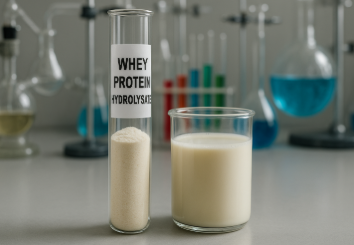
Aspetto: polvere fine bianca o crema, leggermente igroscopica.
Solubilità: eccellente, anche in acqua fredda.
Foaming: schiuma ridotta rispetto alle proteine intatte.
Viscosità: bassa.
Sapore: più amaro rispetto a WPC/WPI, specialmente con idrolisi elevate.
Proprietà sensoriali e tecnologiche
Alta solubilità e rapido scioglimento.
Bassa viscosità, ideale per bevande proteiche chiare.
Minima formazione di schiuma, utile in bevande pronte da bere (RTD).
Maggiore stabilità termica in alcune formulazioni.
Amarezza crescente con l’aumentare del grado di idrolisi.
Impieghi alimentari
Nutrizione sportiva: polveri proteiche pre/post-allenamento.
Nutrizione clinica: formule per anziani, malassorbimento, recupero post-operatorio.
Formule infantili ipoallergeniche: nella versione altamente idrolizzata.
Bevande funzionali: clear protein, shot proteici, gel proteici.
Barrette proteiche: miglioramento della morbidezza nel tempo.
Alimenti speciali: prodotti che richiedono proteine rapidamente disponibili.
Nutrizione e salute
Forma di proteina del siero più rapida da assorbire.
Altissimo contenuto di aminoacidi essenziali e peptidi bioattivi.
Riduce il carico digestivo, risultando utile per persone con digestione o assorbimento compromessi.
Supporta efficacemente il ripristino muscolare dopo lo sforzo fisico.
Le versioni altamente idrolizzate possono essere usate in formule ipoallergeniche, ma non sono adatte in caso di allergia IgE al latte.
Nota porzione
Integratori sportivi: 15–30 g per porzione.
Nutrizione clinica: 10–25 g secondo protocollo.
Formule infantili: dosaggio regolamentato e dipendente dal livello di idrolisi.
Bevande proteiche chiare: 10–20% di proteine in peso.
Allergeni e intolleranze
Contiene l’allergene LATTE.
Ipoallergenico solo nelle forme estensivamente idrolizzate, e comunque non adatto per allergia IgE.
Il contenuto di lattosio varia: negli isolati idrolizzati può essere molto basso.
Conservazione e shelf-life
Conservare in luogo fresco, asciutto, al riparo dall’umidità.
Shelf-life tipica: 18–30 mesi.
Sensibile a:
Sicurezza e regolatorio
Sicuro se prodotto in conformità con GMP/HACCP.
Regolamentazioni specifiche per:
nutrizione infantile
nutrizione clinica
integratori sportivi
Controlli fondamentali: microbiologia, DH, lattosio residuo, contaminanti, solubilità.
Le formule ipoallergeniche richiedono test clinici di tolleranza.
Etichettatura
Troubleshooting
Sostenibilità e filiera
Deriva da un sottoprodotto caseario (siero), quindi contribuisce alla riduzione degli sprechi.
Aspetti ambientali:
consumo energetico di filtrazione ed essiccazione
gestione reflui con controllo BOD/COD
approvvigionamento del latte da filiere sostenibili
La stabilità del prodotto riduce scarti e perdite nella logistica.
Principali funzioni INCI (cosmesi)
(Quando indicato come “Hydrolyzed Whey Protein”, “Hydrolyzed Lactis Proteinum”)
Condizionante cutaneo e capillare
Idratante/umettante
Filmogeno protettivo
Migliora resistenza, elasticità e pettinabilità del capello.
Utilizzato in shampoo, balsami, maschere, creme e sieri.
Conclusione
L’idrolizzato di proteine del siero del latte è un ingrediente ad alta tecnologia, capace di fornire rapidissima biodisponibilità, alta tollerabilità digestiva e prestazioni eccellenti in prodotti sportivi, clinici e infantili. Le sue straordinarie proprietà di solubilità e rapidità di assorbimento lo rendono una delle fonti proteiche più avanzate disponibili sul mercato. Anche in cosmesi offre benefici condizionanti e protettivi. Un controllo accurato del processo e della qualità garantisce prodotti sicuri, stabili ed efficaci.
Mini-glossario
SFA – Saturated Fatty Acids (acidi grassi saturi): da limitare; presenti solo in quantità minime.
MUFA – Monounsaturated Fatty Acids (acidi grassi monoinsaturi): considerati più favorevoli al profilo lipidico.
PUFA – Polyunsaturated Fatty Acids (acidi grassi polinsaturi): includono omega-3 e omega-6; valori molto bassi nei WPH.
TFA – Trans Fatty Acids (acidi grassi trans): indesiderati; assenti in questo ingrediente.
GMP/HACCP – Good Manufacturing Practices / Hazard Analysis and Critical Control Points: sistemi di gestione qualità e sicurezza.
BOD/COD – Biological Oxygen Demand / Chemical Oxygen Demand: indicatori dell’impatto ambientale dei reflui industriali.
Bibliografia__________________________________________________________________________
Tang JE, Moore DR, Kujbida GW, Tarnopolsky MA, Phillips SM. Ingestion of whey hydrolysate, casein, or soy protein isolate: effects on mixed muscle protein synthesis at rest and following resistance exercise in young men. J Appl Physiol (1985). 2009 Sep;107(3):987-92. doi: 10.1152/japplphysiol.00076.2009.
Abstract. This study was designed to compare the acute response of mixed muscle protein synthesis (MPS) to rapidly (i.e., whey hydrolysate and soy) and slowly (i.e., micellar casein) digested proteins both at rest and after resistance exercise. Three groups of healthy young men (n = 6 per group) performed a bout of unilateral leg resistance exercise followed by the consumption of a drink containing an equivalent content of essential amino acids (10 g) as either whey hydrolysate, micellar casein, or soy protein isolate. Mixed MPS was determined by a primed constant infusion of l-[ring-(13)C(6)]phenylalanine. Ingestion of whey protein resulted in a larger increase in blood essential amino acid, branched-chain amino acid, and leucine concentrations than either casein or soy (P < 0.05). Mixed MPS at rest (determined in the nonexercised leg) was higher with ingestion of faster proteins (whey = 0.091 +/- 0.015, soy = 0.078 +/- 0.014, casein = 0.047 +/- 0.008%/h); MPS after consumption of whey was approximately 93% greater than casein (P < 0.01) and approximately 18% greater than soy (P = 0.067). A similar result was observed after exercise (whey > soy > casein); MPS following whey consumption was approximately 122% greater than casein (P < 0.01) and 31% greater than soy (P < 0.05). MPS was also greater with soy consumption at rest (64%) and following resistance exercise (69%) compared with casein (both P < 0.01). We conclude that the feeding-induced simulation of MPS in young men is greater after whey hydrolysate or soy protein consumption than casein both at rest and after resistance exercise; moreover, despite both being fast proteins, whey hydrolysate stimulated MPS to a greater degree than soy after resistance exercise. These differences may be related to how quickly the proteins are digested (i.e., fast vs. slow) or possibly to small differences in leucine content of each protein.
Sun Y, Ling C, Liu L, Zhang J, Wang J, Tong X, Hidayat K, Chen M, Chen X, Zhou H, Xu J, Qin L, Zhu W, Yang J. Effects of Whey Protein or Its Hydrolysate Supplements Combined with an Energy-Restricted Diet on Weight Loss: A Randomized Controlled Trial in Older Women. Nutrients. 2022 Oct 28;14(21):4540. doi: 10.3390/nu14214540.
Abstract. An energy-restricted weight-loss approach has limitations when it used in the elderly, especially because of muscle loss. We aimed to assess the effects of whey protein (WP) or WP hydrolysate (WPH) combined with an energy-restricted diet (ERD) on weight reduction and muscle preservation in older women with overweight and obesity. A total of 60 women were randomized to the control (ERD), WP (ERD + 20 g/d WP) or WPH (ERD + 20 g/d WPH) group, using a 1:1:1 allocation ratio. After an 8-week intervention, body composition, gut microbiota, and serum metabolomics changes were compared among the three groups. The reductions in body weight (−1.11 ± 1.11 vs. −2.34 ± 1.35, p < 0.05), BMI (−0.46 ± 0.45 vs. −0.97 ± 0.54, p < 0.05), and body fat (−0.70 ± 0.92 vs. −2.45 ± 1.65, p < 0.01) were higher in the WPH group than in the control group. Body fat (%) was significantly decreased in the two protein groups. Fat-free mass did not significantly change among the three groups. Serum metabolomics showed that the tricarboxylic acid cycle pathway was upregulated in the WPH group. No significant changes in microbiota were observed among the groups. In conclusion, WP or WPH supplementation combined with an energy-restricted diet benefits older women during weight loss. WPH was more effective, possibly due to increased energy metabolism.
Agarkova EY, Kruchinin AG, Glazunova OA, Fedorova TV. Whey Protein Hydrolysate and Pumpkin Pectin as Nutraceutical and Prebiotic Components in a Functional Mousse with Antihypertensive and Bifidogenic Properties. Nutrients. 2019 Dec 3;11(12):2930. doi: 10.3390/nu11122930. PMID: 31816861;
Abstract. Systematical consumption of functional products has a significant positive effect on health and can reduce the risk of diseases. The aim of this study was to investigate the possibility of using whey protein hydrolysate (WPH) and pumpkin pectin as ingredients in a functional mousse, to evaluate the mousse's antioxidant and hypotensive activities in vitro, and to evaluate the effect of the long-term intake of mousse samples on the progression of hypertension in spontaneously hypertensive rats (SHRs) and on the microbiome status in Wistar rats with antibiotic-induced dysbiosis. The experimental mousse's in vitro antioxidant activity (oxygen radical absorbance capacity) increased by 1.2 times. The hypotensive (angiotensin-1-converting enzyme inhibitory) activity increased by 6 times in comparison with a commercial mousse. Moreover, the addition of pectin allowed the elimination of the bitter aftertaste of WPH. In vivo testing confirmed the hypotensive properties of the experimental mousse. The systolic blood pressure in SHRs decreased by 18 mmHg and diastolic blood pressure by 12 mmHg. The experimental mousse also showed a pronounced bifidogenic effect. The Bifidobacterium spp. population increased by 3.7 times in rats orally administered with the experimental mousse. The results of these studies confirm that WPH and pumpkin pectin are prospective ingredients for the development of functional mousses.
Brown MA, Stevenson EJ, Howatson G. Whey protein hydrolysate supplementation accelerates recovery from exercise-induced muscle damage in females. Appl Physiol Nutr Metab. 2018 Apr;43(4):324-330. doi: 10.1139/apnm-2017-0412.
Abstract. A number of different forms of protein and their analogues have been investigated for their efficacy in ameliorating exercise-induced muscle damage (EIMD) and recovery. Preliminary data regarding whey protein hydrolysate (WPH) supplementation are promising. However, its efficacy beyond acute eccentric/resistance exercise bouts or longer term training programmes are limited and all investigations have been conducted in male or mixed-sex groups. This study sought to elucidate whether the benefits of WPH previously reported can be demonstrated in females following repeated-sprint exercise. Twenty physically active females were assigned to consume 2 doses of 70 mL WPH or isoenergetic carbohydrate (CHO) for 4 days post-EIMD. Measures of muscle soreness, limb girth, flexibility, muscle function, and creatine kinase were collected before, immediately after, and 24, 48, and 72 h postexercise. Time effects were observed for all variables (p < 0.05) except limb girth, which is indicative of EIMD. Flexibility improved beyond baseline measures following WPH by 72 h, but had failed to recover in the CHO group (p = 0.011). Reactive strength index was higher throughout recovery in the WPH group compared with CHO (p = 0.016). Reductions in creatine kinase were greater following WPH compared with CHO at 48 h post-EIMD (p = 0.031). The findings suggest that 4-day supplementation of WPH is beneficial for reducing symptoms of EIMD and improving recovery of muscle function in physically active females.
Zhao T, Sun H, Ji S, Yang B, Wang Z, Liu Y, Chen C, Lu B. The Effect of Whey Protein Isolate Hydrolysate on Digestive Properties of Phytosterol. J Agric Food Chem. 2024 Jun 5;72(22):12738-12751. doi: 10.1021/acs.jafc.4c01111.
Abstract. Phytosterol (PS) is a steroid, and its bioavailability can be enhanced by interacting with protein in the C-24 hydroxyl group. The interaction between sterols and amino acid residues in proteins can be enhanced by enzymatic hydrolysis. Phytosterol and whey insulation hydrolysates (WPH1-4) fabricated by the Alcalase enzyme at different enzymatic hydrolysis times were selected as delivery systems to simulate sterol C-24 hydroxyl group interaction with protein. Increasing hydrolysis time can promote the production of β-Lg, which raises the ratio of β-turn in the secondary structure and promotes the formation of interaction between WPH and PS. The correlation coefficient between hydrogen bonds and encapsulation efficiency (EE) and bioaccessibility is 0.91 and 0.88 (P < 0.05), respectively, indicating that hydrogen bonds of two components significantly influenced the combination by concealing the hydrophobic amino acids and some residues, which improved PS EE and bioavailability by 3.03 and 2.84 times after PS was combined with the WPI hydrolysate. These findings are expected to enhance the absorption of PS and other macromolecules by protein enzymatic hydrolysis to broaden their applications for food.
Chen YC, Smith HA, Hengist A, Chrzanowski-Smith OJ, Mikkelsen UR, Carroll HA, Betts JA, Thompson D, Saunders J, Gonzalez JT. Co-ingestion of whey protein hydrolysate with milk minerals rich in calcium potently stimulates glucagon-like peptide-1 secretion: an RCT in healthy adults. Eur J Nutr. 2020 Sep;59(6):2449-2462. doi: 10.1007/s00394-019-02092-4.
Abstract. Purpose: To examine whether calcium type and co-ingestion with protein alter gut hormone availability. Methods: Healthy adults aged 26 ± 7 years (mean ± SD) completed three randomized, double-blind, crossover studies. In all studies, arterialized blood was sampled postprandially over 120 min to determine GLP-1, GIP and PYY responses, alongside appetite ratings, energy expenditure and blood pressure. In study 1 (n = 20), three treatments matched for total calcium content (1058 mg) were compared: calcium citrate (CALCITR); milk minerals rich in calcium (MILK MINERALS); and milk minerals rich in calcium plus co-ingestion of 50 g whey protein hydrolysate (MILK MINERALS + PROTEIN). In study 2 (n = 6), 50 g whey protein hydrolysate (PROTEIN) was compared to MILK MINERALS + PROTEIN. In study 3 (n = 6), MILK MINERALS was compared to the vehicle of ingestion (water plus sucralose; CONTROL). Results: MILK MINERALS + PROTEIN increased GLP-1 incremental area under the curve (iAUC) by ~ ninefold (43.7 ± 11.1 pmol L-1 120 min; p < 0.001) versus both CALCITR and MILK MINERALS, with no difference detected between CALCITR (6.6 ± 3.7 pmol L-1 120 min) and MILK MINERALS (5.3 ± 3.5 pmol L-1 120 min; p > 0.999). MILK MINERALS + PROTEIN produced a GLP-1 iAUC ~ 25% greater than PROTEIN (p = 0.024; mean difference: 9.1 ± 6.9 pmol L-1 120 min), whereas the difference between MILK MINERALS versus CONTROL was small and non-significant (p = 0.098; mean difference: 4.2 ± 5.1 pmol L-1 120 min). Conclusions: When ingested alone, milk minerals rich in calcium do not increase GLP-1 secretion compared to calcium citrate. Co-ingesting high-dose whey protein hydrolysate with milk minerals rich in calcium increases postprandial GLP-1 concentrations to some of the highest physiological levels ever reported. Registered at ClinicalTrials.gov: NCT03232034, NCT03370484, NCT03370497.




