Proteine del latte
Descrizione
Le proteine del latte includono un insieme di frazioni proteiche estratte dal latte vaccino, principalmente caseine e proteine del siero (whey).
Sono ingredienti ad alto valore tecnologico e nutrizionale, utilizzati in alimenti, integratori proteici, prodotti sportivi e applicazioni funzionali.
Le proteine del siero hanno elevato valore biologico, mentre le caseine garantiscono struttura, stabilità e proprietà emulsionanti.
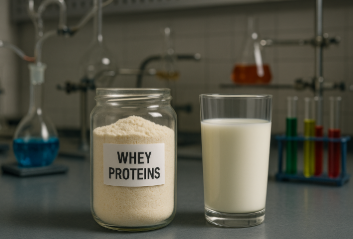
Valori nutrizionali indicativi per 100 g
(Riferiti a proteine concentrate/isolati standardizzati)
Energia: 350–400 kcal
Proteine: 70–95 g
Carboidrati: 1–8 g
Lipidi: 0,5–7 g
Minerali: calcio (soprattutto nelle caseine), fosforo, potassio
Sodio: variabile in base alla lavorazione
Principali sostanze contenute
Caseine (α-, β-, κ-caseina): ~80% delle proteine del latte.
Proteine del siero (~20%):
β-lattoglobulina
α-lattoalbumina
immunoglobuline
lattoferrina
glicomacropeptide
Aminoacidi essenziali, tra cui leucina, isoleucina, valina (BCAA).
Minerali: calcio, fosforo, potassio legati alla frazione caseinica.
Tracce di lipidi e lattosio (in base al grado di purificazione).
Processo di produzione
Separazione del latte in panna e parte magra.
Concentrazione della frazione proteica tramite ultrafiltrazione, microfiltrazione o scambio ionico.
Isolamento delle proteine del siero o delle micelle di caseina.
Essiccazione spray per ottenere polveri fluide e stabili.
Standardizzazione del contenuto proteico, umidità e minerali.
Controlli qualità secondo standard GMP/HACCP: microbiologia, metalli, lattosio residuo, purezza proteica.
Proprietà fisiche
Aspetto: polvere bianca o giallo-pallida, granulometria fine.
Solubilità: elevata per le whey, moderata per le caseine.
Igroscopicità: moderata; richiedono stoccaggio in ambiente asciutto.
Umidità: 3–7%.
Stabilità: buona stabilità a temperatura ambiente se protette da umidità e ossigeno.
Proprietà sensoriali e tecnologiche
Impieghi alimentari
Prodotti lattiero-caseari: yogurt, formaggi, dessert.
Bevande proteiche e prodotti sportivi.
Barrette proteiche, pancake, prodotti fortificati.
Prodotti da forno: panificati, biscotti, muffin proteici.
Salse ed emulsioni: grazie alle proprietà leganti delle caseine.
Gelati: miglioramento della struttura e riduzione della formazione di cristalli di ghiaccio.
Nutrizione e salute
Fonte di proteine ad alto valore biologico.
Ricche di aminoacidi essenziali, in particolare i BCAA, utili per sintesi proteica e recupero muscolare.
Le caseine hanno rilascio lento, mentre le whey hanno assorbimento più rapido.
Contribuiscono al mantenimento della massa muscolare e della funzione immunitaria.
Attenzione per soggetti con allergia alle proteine del latte o con intolleranza al lattosio (a seconda del residuo di lattosio del prodotto).
Ancora attenzione perché studi hanno rivelato che l'uso cronico e senza guida professionale di integratori di proteine del siero può causare alcuni effetti avversi, specialmente sulla funzione renale e epatica (1).
Nota porzione
Bevande e frullati proteici: 20–30 g di proteine del latte per porzione.
Fortificazione alimentare: 2–10% sul totale della ricetta.
Barrette proteiche: 10–25 g per porzione.
Allergeni e intolleranze
Contengono allergeni del latte (obbligo di dichiarazione in etichetta).
Possono contenere residui variabili di lattosio.
Non adatti a soggetti con allergia IgE-mediata alle proteine del latte.
Le versioni altamente purificate possono essere adatte ad alcune formulazioni “low lactose”.
Conservazione e shelf-life
Conservare in ambiente fresco e asciutto, al riparo da luce e umidità.
Shelf-life tipica: 18–36 mesi.
Sensibili all’umidità (formazione di grumi) e all’ossidazione delle frazioni lipidiche residue.
Sicurezza e regolatorio
Etichettatura
Possibili denominazioni:
Obbligatoria indicazione dell’allergene LATTE.
Indicare eventuali additivi, aromi o dolcificanti aggiunti.
Troubleshooting
Sostenibilità e filiera
Derivano dalla lavorazione del latte: impatto dipendente dalla zootecnia.
Possibili miglioramenti:
uso di latte da filiere sostenibili
riduzione dei consumi idrici nei processi di filtrazione
trattamento reflui con controllo BOD/COD
Le proteine del siero valorizzano un sottoprodotto caseario, riducendo sprechi.
Principali funzioni INCI (cosmesi)
(Quando usate come “Hydrolyzed Milk Protein”, “Lactis Proteinum”, “Milk Protein”)
Condizionante cutaneo e capillare.
Idratante/umettante.
Protettivo della fibra capillare.
Migliora la pettinabilità e la morbidezza dei capelli.
Può essere impiegato in creme, shampoo, maschere, balsami e prodotti leave-on.
Conclusione
Le proteine del latte sono ingredienti versatili e altamente funzionali, con un profilo nutrizionale completo e ottime caratteristiche tecnologiche. Trovano impiego in prodotti sportivi, alimenti fortificati, panificati e lattiero-caseari, contribuendo a struttura, cremosità e valore nutritivo. La loro versatilità si estende anche alla cosmesi grazie alle proprietà condizionanti. Un corretto controllo di qualità e un’adeguata gestione dell’allergene sono fondamentali per garantire sicurezza e conformità normativa.
Mini-glossario
SFA – Saturated Fatty Acids (acidi grassi saturi): l’eccesso può influire sul profilo lipidico; presenti solo in tracce nelle proteine purificate.
MUFA – Monounsaturated Fatty Acids (acidi grassi monoinsaturi): generalmente considerati più favorevoli per la salute cardiovascolare.
PUFA – Polyunsaturated Fatty Acids (acidi grassi polinsaturi): includono omega-3 e omega-6, importanti per funzioni metaboliche.
TFA – Trans Fatty Acids (acidi grassi trans): da evitare; assenti nelle proteine purificate.
GMP/HACCP – Good Manufacturing Practices / Hazard Analysis and Critical Control Points: sistemi di qualità e sicurezza alimentare.
BOD/COD – Biological Oxygen Demand / Chemical Oxygen Demand: indicatori dell’impatto ambientale dei reflui industriali.
Bibliografia__________________________________________________________________________
(1) Vasconcelos QDJS, Bachur TPR, Aragão GF. Whey protein supplementation and its potentially adverse effects on health: a systematic review. Appl Physiol Nutr Metab. 2021 Jan;46(1):27-33. doi: 10.1139/apnm-2020-0370.
Abstract. Whey protein comprises soluble whey proteins and its benefits are well described in the literature. However, there are not many studies investigating the potential adverse effect of a diet with indiscriminate use of this supplement. The aim of this study was to perform a systematic review of papers that addressed this theme. A search was conducted in Medline, LILACS, TOXNET, Web of science, and Scopus electronic databases. In the end, 11 documents comprised this review. The majority of the papers associated the damaging effect with the chronic and abusive use of whey protein, with the kidneys and liver being the main organs affected. The other studies related whey protein to aggravation of aggression, presence of acne, and modification of the microbiota. Therefore, excessive consumption over a long period of protein supplementation may have some adverse effects on the body, which is aggravated when associated with sedentary lifestyle. PROSPERO registration no.: CRD42020140466. Novelty: A systematic review of experimental and randomized studies about the use of whey proteins supplements and its impact on physical health. Analysis revealed that chronic and without professional guidance use of whey protein supplementation may cause some adverse effects specially on kidney and liver function. Presented data support a need for future studies co-relating the use of different types of whey protein with and without exercise to better see the impact on human physical health.
Lesgards JF. Benefits of Whey Proteins on Type 2 Diabetes Mellitus Parameters and Prevention of Cardiovascular Diseases. Nutrients. 2023 Mar 6;15(5):1294. doi: 10.3390/nu15051294.
Abstract. Type 2 diabetes mellitus (T2DM) is a major cause of morbidity and mortality, and it is a major risk factor for the early onset of cardiovascular diseases (CVDs). More than genetics, food, physical activity, walkability, and air pollution are lifestyle factors, which have the greatest impact on T2DM. Certain diets have been shown to be associated with lower T2DM and cardiovascular risk. Diminishing added sugar and processed fats and increasing antioxidant-rich vegetable and fruit intake has often been highlighted, as in the Mediterranean diet. However, less is known about the interest of proteins in low-fat dairy and whey in particular, which have great potential to improve T2DM and could be used safely as a part of a multi-target strategy. This review discusses all the biochemical and clinical aspects of the benefits of high-quality whey, which is now considered a functional food, for prevention and improvement of T2DM and CVDs by insulin- and non-insulin-dependent mechanisms.
Thampy A, Palani Kumar MK, Serva Peddha M, Reddy M. The effectiveness of whey proteins in prevention and treatment of cancer: a review. Crit Rev Food Sci Nutr. 2024;64(8):2088-2104. doi: 10.1080/10408398.2022.2121256.
Abstract. Cancer prevalence is rising rapidly around the globe, contributing immensely to the burden on health systems, hence the search for more effective and selective treatments still remains enticing. Whey, as a natural source, has received extensive focus in recent years because of its intriguing applications to health benefits. Growing consumer appreciation of the nutraceutical effects of whey components makes them an attractive field within cancer research. Whey is a valuable source of superior-quality proteins, lactose, vitamins, and minerals that contribute to proper nutrition as well as help hamper illness and even complement certain disease-related therapy prognosis. As a result, industry leaders and dairy producers are devising new ways to valorize it. Great emphasis on cancer prevention and treatment has been given to whey protein (WP) by the scientific community. WP intake has been proven to induce anti-cancer effects in various in vitro and in vivo studies. Nutritionists and dietitians are now enormously endorsing the role of WP in the therapeutic field, notably for cancer cachexia management. However, human intervention studies with WP are in their infancy and remain to be established with different tumor entities to provide valid proof of its ability to act as a coadjuvant in cancer treatment.
Giblin L, Yalçın AS, Biçim G, Krämer AC, Chen Z, Callanan MJ, Arranz E, Davies MJ. Whey proteins: targets of oxidation, or mediators of redox protection. Free Radic Res. 2019;53(sup1):1136-1152. doi: 10.1080/10715762.2019.1632445.
Abstract. Bovine whey proteins are highly valued dairy ingredients. This is primarily due to their amino acid content, digestibility, bioactivities and their processing characteristics. One of the reported bioactivities of whey proteins is antioxidant activity. Numerous dietary intervention trials with humans and animals indicate that consumption of whey products can modulate redox biomarkers to reduce oxidative stress. This bioactivity has in part been assigned to whey peptides using a range of biochemical or cellular assays in vitro. Superimposing whey peptide sequences from gastrointestinal samples, with whey peptides proven to be antioxidant in vitro, allows us to propose peptides from whey likely to exhibit antioxidant activity in the diet. However, whey proteins themselves are targets of oxidation during processing particularly when exposed to high thermal loads and/or extensive processing (e.g. infant formula manufacture). Oxidative damage of whey proteins can be selective with regard to the residues that are modified and are associated with the degree of protein unfolding, with α-Lactalbumin more susceptible than β-Lactoglobulin. Such oxidative damage may have adverse effects on human health. This review summarises how whey proteins can modulate cellular redox pathways and conversely how whey proteins can be oxidised during processing. Given the extensive processing steps that whey proteins are often subjected to, we conclude that oxidation during processing is likely to compromise the positive health attributes associated with whey proteins.
Davies RW, Carson BP, Jakeman PM. The Effect of Whey Protein Supplementation on the Temporal Recovery of Muscle Function Following Resistance Training: A Systematic Review and Meta-Analysis. Nutrients. 2018 Feb 16;10(2):221. doi: 10.3390/nu10020221.
Abstract. Whey protein (WP) is a widely consumed nutritional supplement, known to enhance strength and muscle mass during resistance training (RT) regimens. Muscle protein anabolism is acutely elevated following RT, which is further enhanced by WP. As a result, there is reason to suggest that WP supplementation may be an effective nutritional strategy for restoring the acute loss of contractile function that occurs following strenuous RT. This systematic review and meta-analysis provides a synthesis of the literature to date, investigating the effect of WP supplementation on the recovery of contractile function in young, healthy adults. Eight studies, containing 13 randomised control trials (RCTs) were included in this review and meta-analysis, from which individual standardised effect sizes (ESs) were calculated, and a temporal overall ES was determined using a random-effects model. Whilst only half of the individual studies reported beneficial effects for WP, the high-quality evidence taken from the 13 RCTs was meta-analysed, yielding overall positive small to medium effects for WP from < 24 to 96 h (ES range = 0.4 to 0.7), for the temporal restoration of contractile function compared to the control treatment. Whilst the effects for WP were shown to be consistent over time, these results are limited to 13 RCTs, principally supporting the requirement for further comprehensive research in this area.
Smithers GW, Ballard FJ, Copeland AD, De Silva KJ, Dionysius DA, Francis GL, Goddard C, Grieve PA, McIntosh GH, Mitchell IR, Pearce RJ, Regester GO. New opportunities from the isolation and utilization of whey proteins. J Dairy Sci. 1996 Aug;79(8):1454-9. doi: 10.3168/jds.s0022-0302(96)76504-9.
Abstract. Management of dairy whey has often involved implementation of the most economical disposal methods, including discharge into waterways and onto fields or simple processing into low value commodity powders. These methods have been, and continue to be, restricted by environmental regulations and the cyclical variations in price associated with commodity products. In any modern regimen for whey management, the focus must therefore be on maximizing the value of available whey solids through greater and more varied utilization of the whey components. The whey protein constituents offer tremendous opportunities. Although whey represents a rich source of proteins with diverse food properties for nutritional, biological, and functional applications, commercial exploitation of these proteins has not been widespread because of a restricted applications base, a lack of viable industrial technologies for protein fractionation, and inconsistency in product quality. These shortcomings are being addressed through the development of novel and commercially relevant whey processing technologies, the preparation of new whey protein fractions, and the exploitation of the properties of these fractions in food and in nontraditional applications. Examples include the following developments: 1) whey proteins as physiologically functional food ingredients, 2) alpha-lactalbumin and beta-lactoglobulin as nutritional and specialized physically functional food ingredients, and 3) minor protein components as specialized food ingredients and an important biotechnological reagents. Specific examples include the isolation and utilization of lactoferrin and the replacement of fetal bovine serum in tissue cell culture applications with a growth factor extract isolated from whey.




