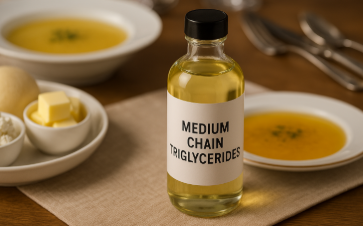
Medium chain triglycerides (MCT)
(food-grade neutral oil from C6–C10 fatty acids; liquid or spray-dried on carriers)
Description
• Neutral, colorless, virtually odorless oil composed of triacylglycerols built from medium-chain fatty acids (chiefly caprylic/C8 and capric/C10). MCT = medium-chain triglycerides, rapidly absorbed fats that are preferentially oxidized for energy versus storage.
• Produced from fractionated coconut or palm kernel sources; designed as a clean-tasting energy lipid and technical carrier.
• Supplied as bulk liquid, or as MCT powder (spray-dried onto carbohydrates/proteins) for dry-blend applications.
Indicative nutritional values (per 100 g, oil grade)
• Energy: 830–860 kcal
• Fat: 100 g — first mention lipids SFA/MUFA/PUFA (saturated/mono-/polyunsaturated fatty acids; limiting saturated fat is generally recommended)
• Carbohydrates: 0 g • Sugars: 0 g • Protein: 0 g • Sodium: 0 mg
• TFA (trans fatty acids) ≈ 0 g
• Essential fatty acids (linoleic/α-linolenic): negligible → do not rely on MCT as the sole fat source.
Key constituents
• Typical fatty-acid profile (of total FA): C8:0 50–80%; C10:0 20–50%; C6:0 ≤ 3%; C12:0 ≤ 2%; unsaturates ≤ 1%.
• Minor components: tocopherols (trace), residual sterols; antioxidants may be added per spec (e.g., mixed tocopherols).
Production process
• Refined coconut or palm kernel oil → hydrolysis to free fatty acids → fractional distillation to isolate C6–C10 cuts → re-esterification with food-grade glycerol to triacylglycerols → refining (neutralization, bleaching, deodorization) → polishing filtration → filling under inert gas.
• For powders: emulsification with carrier (e.g., maltodextrin, acacia gum, dairy proteins) → spray drying → agglomeration/sieving → packing.
Physical properties
• Appearance: water-white to pale, clear liquid at ambient temperature.
• Specific gravity (25 °C): ~0.94–0.96 • Refractive index (40 °C): ~1.440–1.452 • Viscosity (25 °C): low.
• Iodine value: ≤ 1 g I₂/100 g (high saturation) • Saponification value: ~305–345 mg KOH/g.
• Smoke point: relatively low, ~160–170 °C → not ideal for high-temperature frying.
• Insoluble in water; miscible with most edible oils; dispersible with emulsifiers.
Sensory and technological properties
• Neutral taste and aroma; does not mask delicate flavors.
• High oxidative stability (fully saturated), but low smoke point; excellent solvent/carrier for flavors, colors, and fat-soluble actives (A, D, E, K).
• Fast crystallization at low temperature is uncommon; slight haze can appear near 0 °C without affecting quality.
• Rapid digestibility can influence mouthfeel and quick energy perception in beverages and shots.
Food applications
• Beverages & nutrition: ketogenic and sports drinks, coffee/tea creamers, meal replacements, energy shots.
• Bakery & confectionery: softening agent, bloom control aid, carrier for fat-soluble flavors/colors; fillings and coatings where neutral taste is required.
• Savory: emulsified sauces, dressings, culinary flavor carriers.
• Dry systems (as powder): ready-to-mix drinks, bars, bakery premixes, instant soups.
Nutrition and health
• Absorbed via the portal vein and oxidized rapidly; can provide quick energy and support low-carb/keto formulations.
• Provides negligible essential fatty acids; ensure dietary LA/ALA from other oils.
• Gastrointestinal tolerance varies: large single doses may cause cramping/loose stools—titrate intake gradually.
• Calorie-dense fat: include within overall energy goals.
Serving note (inclusion guidance)
• Typical per-serving addition: liquids 5–10 g; dry mixes 2–6% as powder (as is).
• Introduce gradually (e.g., start at ~5 g/serving; increase as tolerated).
Allergens and intolerances
• Derived from coconut or palm kernel. Highly refined MCT contains virtually no protein.
• In some jurisdictions (e.g., US), coconut is regulated as a “tree nut”: declare source per local rules.
• MCT powders can introduce allergen risks from carriers (e.g., milk, soy) → check specifications.
• Naturally gluten-free.
Quality and specifications (typical, oil grade)
• Peroxide value (PV) ≤ 1.0 meq O₂/kg • Acid value (AV) ≤ 0.1–0.5 mg KOH/g • Moisture ≤ 0.1%
• Color (APHA) ≤ 50 • Odor/flavor: neutral, no rancid/soapy notes • Heavy metals compliant to food-grade limits.
• Microbiology: not applicable to neat oil; for powders, total counts within dry-powder norms and Salmonella absent/25 g.
Storage and shelf-life
• Store cool, dry, and dark (≤ 25 °C), tightly closed with minimal headspace oxygen; nitrogen flush preferred.
• Shelf-life: liquids 24–36 months unopened; powders 12–24 months depending on carrier and packaging.
• Avoid heat/light exposure to maintain low PV and fresh flavor.
Safety and regulatory
• Produced under GMP/HACCP; complies with edible-oil standards for refined specialty lipids.
• Antioxidants/processing aids must be permitted for food use and declared where required.
• Nutrition and structure/function claims vary by jurisdiction—verify locally.
Labeling
• Ingredient name: “Medium Chain Triglycerides (from coconut/palm kernel)” or “MCT Oil”; for powders: “MCT Powder (MCT Oil, [carrier])”.
• Declare allergen sources from carriers (e.g., milk/soy) and coconut source where applicable.
• Typical nutrition panel: 100% fat, 0 g carbs/protein; energy per local calculation rules.
Troubleshooting
• Soapy/harsh off-note → hydrolysis/oxidation ↑ (AV/PV high) → tighten refining specs; improve oxygen/light control.
• Haze/clouding at low T → minor crystallization → warm gently and mix; specify pour/flash points appropriately.
• Emulsion break in beverages/dressings → insufficient emulsifier or shear → increase emulsifier, adjust phase order/processing.
• Powder caking → moisture pickup → enhance barrier packaging; add anti-caking; control RH in storage.
Sustainability and supply chain
• Source choice matters: prefer certified supply (e.g., RSPO for palm-derived, responsibly sourced coconut).
• Refining operations should manage effluents with BOD/COD reduction, recover heat, and use recyclable/mono-material packaging.
• Optimize logistics (FIFO, temperature control) to limit waste.
Main INCI functions (cosmetics)
• INCI: Caprylic/Capric Triglyceride — lightweight emollient, solvent, skin-feel enhancer; high oxidative stability; widely used in skincare, suncare, color cosmetics (cosmetic-grade specifications).
Conclusion
Medium chain triglycerides are a clean-tasting, highly stable functional fat that delivers rapid energy and excellent carrier performance. When sourced responsibly and used within balanced formulations, MCT provides versatility across beverages, bakery, confectionery, savory systems, and dry mixes.
Mini-glossary
• MCT — Medium-chain triglycerides; rapidly absorbed fats (mainly C8/C10) often used for quick energy and as neutral carriers.
• SFA/MUFA/PUFA — Saturated/monounsaturated/polyunsaturated fatty acids; moderating SFA while favoring MUFA/PUFA is generally recommended for cardiometabolic health.
• TFA — Trans fatty acids; typically ~0 g in properly refined MCT.
• AV — Acid value; mg KOH needed to neutralize free fatty acids per gram of oil (freshness/hydrolysis index).
• PV — Peroxide value; primary lipid oxidation index (lower is fresher).
• SV — Saponification value; mg KOH required to saponify 1 g of fat (inversely related to average chain length).
• GMP/HACCP — Good manufacturing practices / hazard analysis and critical control points; food-safety systems.
• BOD/COD — Biochemical/Chemical oxygen demand; measures of organic load in wastewater.
References__________________________________________________________________________
Ezaki O. Possible Extracellular Signals to Ameliorate Sarcopenia in Response to Medium-Chain Triglycerides (8:0 and 10:0) in Frail Older Adults. Nutrients. 2024 Aug 8;16(16):2606. doi: 10.3390/nu16162606.
Abstract. In frail older adults (mean age 85 years old), a 3-month supplementation with a low dose (6 g/day) of medium-chain triglycerides (MCTs; C8:0 and C10:0) given at a meal increased muscle mass and function, relative to supplementation with long-chain triglycerides (LCTs), but it decreased fat mass. The reduction in fat mass was partly due to increased postprandial energy expenditure by stimulation of the sympathetic nervous system (SNS). However, the extracellular signals to ameliorate sarcopenia are unclear. The following three potential extracellular signals to increase muscle mass and function after MCT supplementation are discussed: (1) Activating SNS-the hypothesis for this is based on evidence that a beta2-adrenergic receptor agonist acutely (1-24 h) markedly upregulates isoforms of peroxisomal proliferator-activated receptor gamma coactivator-1alpha (PGC-1alpha) mRNAs, promotes mitochondrial biogenesis, and chronically (~1 month) induces muscle hypertrophy. (2) An increased concentration of plasma acyl-ghrelin stimulates growth hormone secretion. (3) A nitrogen-sparing effect of ketone bodies, which fuel skeletal muscle, may promote muscle protein synthesis and prevent muscle protein breakdown. This review will help guide clinical trials of using MCTs to treat primary (age-related) sarcopenia.
Babayan VK. Medium chain triglycerides and structured lipids. Lipids. 1987 Jun;22(6):417-20. doi: 10.1007/BF02537271.
Abstract. Lipids are an essential component of our body composition and necessary in our daily food intake. Conventional fats and oils are composed of glycerides of long chain fatty acids and are designated as long chain triglycerides (LCT). Body fat as well as the fats and oils in our daily intake fall into this category. In enteral and parenteral hyperalimentation, we can identify such LCT fats and oils. Soy, corn, safflower and sunflowerseed oils are typical of the LCT oils. In the search for alternative noncarbohydrate fuels, medium chain triglycerides (MCT) are unique and have established themselves in the areas of malabsorption syndrome cases and infant care and as a high energy, rapidly available fuel. Structure lipids with a MCT backbone and linoleic acid built into the triglyceride molecule have been developed to optimize the triglyceride structure that is best for patients, particularly the critically ill. Structured lipids with built-in essential fatty acid components or other polyunsaturated fatty acids promise greater flexibility in patient care and nitrogen support.
Zhao Y, Wang C. Meta-Analysis of Structured Triglyceride versus Physical Mixture Medium- and Long-Chain Triglycerides for PN in Liver Resection Patients. Biomed Res Int. 2017;2017:4920134. doi: 10.1155/2017/4920134.
Abstract. Background: The use of total parenteral nutrition can affect liver function, causing a series of problems such as cholestasis. The aim of this meta-analysis was to compare structured triglyceride- (STG-) based lipid emulsions with physical medium-chain triglyceride (MCT)/long-chain triglyceride (LCT) mixtures in patients who had undergone liver surgery to identify any differences between these two types of parenteral nutrition. Methods: We searched the databases of PubMed, the Cochrane Library, Web of Science, EMBASE, and Chinese Biomedicine Database from January 2007 to March 2017 and included studies that compared STG-based lipid emulsions with physical MCT/LCT mixtures for surgical patients with liver disease. Conclusion: The STG was more beneficial than physical MCT/LCT on recovery of liver function and immune function. Therefore, STGs may represent a promising alternative to other types of lipid emulsions for hepatic surgery patients.
Sung MH, Liao FH, Chien YW. Medium-Chain Triglycerides Lower Blood Lipids and Body Weight in Streptozotocin-Induced Type 2 Diabetes Rats. Nutrients. 2018 Jul 26;10(8):963. doi: 10.3390/nu10080963.
Abstract. Medium-chain triglycerides (MCTs) are distinguished from other triglycerides in that each fat molecule consists of 6 to 12 carbons in length. MCTs and long-chain triglycerides (LCTs) are absorbed and utilized in different ways. The aim of this study was to assess the effects of replacing soybean oil with MCT oil, in a low- or high-fat diet, on lipid metabolism in rats with streptozotocin-induced type 2 diabetes mellitus (T2DM). There were, thirty-two T2DM Sprague-Dawley rats divided into low-fat-soybean oil (LS), low-fat-MCT oil (LM), high-fat-soybean oil (HS), and high-fat-MCT oil (HM) groups. After 8 weeks, blood sugar, serum lipids, liver lipids, and enzyme activities related to lipid metabolism were measured. Under a high-fat diet condition, replacement of soybean oil with MCT oil lowered serum low-density lipoprotein cholesterol (LDL-C), non-esterified fatty acids, and liver total cholesterol; whilst it increased serum high-density lipoprotein cholesterol (HDL-C) and the HDL-C/LDL-C ratio. A low-fat diet with MCT oil resulted in lower body weight and reproductive white adipose tissues compared to the HS groups, and higher hepatic acyl-CoA oxidase activities (the key enzyme in the peroxisomal beta-oxidation) compared to the LS group in T2DM rats. In conclusion, MCTs showed more protective effects on cardiovascular health in T2DM rats fed a high-fat diet, by improving serum lipid profiles and reducing hepatic total cholesterol.
Swift LL, Hill JO, Peters JC, Greene HL. Medium-chain fatty acids: evidence for incorporation into chylomicron triglycerides in humans. Am J Clin Nutr. 1990 Nov;52(5):834-6. doi: 10.1093/ajcn/52.5.834.
Abstract. The purpose of this study was to evaluate the fatty acid composition of chylomicron triglycerides isolated from subjects fed liquid-formula diets containing 40% of total energy as medium- (C8:0 and C10:0) or long-chain (C16-C18) triglycerides (MCT, LCT) for 6 d. Medium-chain fatty acids (MCFA) comprised 8% of total chylomicron triglyceride fatty acids after the first MCT meal. After 6 d of continued MCT feeding, chylomicron triglyceride MCFA content increased to 13%. When subjects were fed the LCT (soybean oil) diet, C16:0, C18:1, and C18:2 comprised nearly 90% of the chylomicron triglyceride fatty acids. The mass of triglyceride transported in chylomicrons isolated from subjects fed the MCT diet was approximately 20% of that found when subjects consumed the LCT diet. We conclude that although total triglyceride production during MCT ingestion is low, the chylomicron triglycerides that are synthesized contain significant amounts of MCFA.
Lee YY, Tang TK, Chan ES, Phuah ET, Lai OM, Tan CP, Wang Y, Ab Karim NA, Mat Dian NH, Tan JS. Medium chain triglyceride and medium-and long chain triglyceride: metabolism, production, health impacts and its applications - a review. Crit Rev Food Sci Nutr. 2022;62(15):4169-4185. doi: 10.1080/10408398.2021.1873729.
Abstract. Structured lipid is a type of modified form of lipid that is "fabricated" with the purpose to improve the nutritional and functional properties of conventional fats and oils derived from animal and plant sources. Such healthier choice of lipid received escalating attention from the public for its capability to manage the rising prevalence of metabolic syndrome. Of which, medium-chain triacylglycerol (MCT) and medium-and long-chain triacylglycerol (MLCT) are the few examples of the "new generation" custom-made healthful lipids which are mainly composed of medium chain fatty acid (MCFA). MCT is made up exclusively of MCFA whereas MLCT contains a mixture of MCFA and long chain fatty acid (LCFA), respectively. Attributed by the unique metabolism of MCFA which is rapidly metabolized by the body, MCFA and MCT showed to acquire multiple physiological and functional properties in managing and reversing certain health disorders. Several chemically or enzymatically oils and fats modification processes catalyzed by a biological or chemical catalyst such as acidolysis, interesterification and esterification are adopted to synthesis MCT and MLCT. With their purported health benefits, MCT and MLCT are widely being used as nutraceutical in food and pharmaceutical sectors. This article aims to provide a comprehensive review on MCT and MLCT, with an emphasis on the basic understanding of its structures, properties, unique metabolism; the current status of the touted health benefits; latest routes of production; its up-to-date applications in the different food systems; relevant patents filed and its drawbacks.
Jiang ZM, Zhang SY, Wang XR, Yang NF, Zhu Y, Wilmore D. A comparison of medium-chain and long-chain triglycerides in surgical patients. Ann Surg. 1993 Feb;217(2):175-84. doi: 10.1097/00000658-199302000-00012.
Abstract. Available lipid emulsions made from soybean or safflower oil are classified as long-chain triglycerides (LCT). In contrast, medium-chain triglyceride (MCT) emulsions have different physical properties and are metabolized by other biochemical pathways. To compare the differences between these two fat emulsions, the authors studied 12 surgical patients and 6 volunteers. These subjects were randomly assigned to receive parenteral nutrition with MCT or LCT emulsion. Measurement of arterial and venous concentration differences across the forearm demonstrated that muscle utilization was significantly improved with MCT administration. There was also a trend toward improved nitrogen balance in the MCT group, and less weight loss in the postoperative period also was observed in this group. During the fat clearance test, the serum ketone concentrations were significantly higher in the MCT than the LCT group. The improvement in nitrogen retention may be associated with increasing ketone and insulin levels. Fat emulsions containing 50% MCT are safe for use in parenteral nutrition and may provide an alternate fuel that improves protein metabolism.
Felton EA, Henry-Barron BJ, Jan AK, Shegelman A, Faltersack K, Vizthum D, Cervenka MC. The Feasibility and Tolerability of Medium Chain Triglycerides in Women with a Catamenial Seizure Pattern on the Modified Atkins Diet. Nutrients. 2021 Jun 30;13(7):2261. doi: 10.3390/nu13072261.
Abstract. Ketogenic diet therapy (KDT), particularly modified Atkins diet (MAD), is increasingly recognized as a treatment for adults with epilepsy. Women with epilepsy (WWE) comprise 50% of people with epilepsy and approximately one in three have catamenial epilepsy. The purpose of this study was to determine whether adding a medium chain triglyceride emulsion to MAD to target catamenial seizures was feasible and well-tolerated. This was a prospective two-center study of pre-menopausal WWE with a catamenial seizure pattern on MAD. After a 1-month baseline interval with no changes in treatment, participants consumed betaquik® (Vitaflo International Ltd.) for 10 days each menstrual cycle starting 2 days prior to and encompassing the primary catamenial seizure pattern for five cycles. Participants recorded seizures, ketones, and menses, and completed surveys measuring tolerability. Sixteen women aged 20-50 years (mean 32) were enrolled and 13 (81.2%) completed the study. There was 100% adherence for consuming betaquik® in the women who completed the study and overall intervention adherence rate including the participants that dropped out was 81.2%. The most common side effects attributed to MAD alone prior to starting betaquik® were constipation and nausea, whereas abdominal pain, diarrhea, and nausea were reported after adding betaquik®. The high adherence rate and acceptable tolerability of betaquik® shows feasibility for future studies evaluating KDT-based treatments for catamenial seizures.