Cheese powder
(dehydrated product from aged or fresh cheeses, with or without additives)
Description
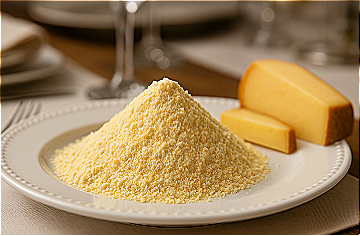
• Cheese powder is a food ingredient obtained by dehydrating natural cheeses, typically aged (e.g., Cheddar, Parmesan/Grana, Gouda) or fresh (e.g., mozzarella, cream cheeses).
• Drying removes water, concentrating aroma, fat, and protein and stabilizing the product.
• Granular-to-fine appearance, ivory to pale yellow color, with the flavor profile of the base cheese.
• Used as a flavoring, seasoning, or functional ingredient in dry or instant preparations.
Indicative nutritional values (per 100 g)
• Energy: 480–520 kcal
• Protein: 25–30 g
• Total fat: 30–35 g — SFA (saturated fatty acids; excess may raise LDL) 18–22 g; MUFA (monounsaturated; generally favorable) 8–10 g; PUFA (polyunsaturated; includes n-6/n-3) 1–2 g
• Carbohydrates: 10–15 g (residual lactose or added maltodextrins)
• Sugars: 3–6 g
• Sodium: 800–1800 mg (depends on cheese type)
• Calcium: 700–900 mg; Phosphorus: 500–600 mg; Vitamin A: 250–350 µg; Riboflavin (B2): 0.3–0.5 mg
Key constituents
• Milk proteins (casein, α-lactalbumin, β-lactoglobulin) with high biological value (BV ~80–85).
• Milk fat dominated by saturated fractions, with meaningful monounsaturated (oleic) and polyunsaturated (linoleic) components.
• Minerals (calcium, phosphorus, zinc) and fat-soluble vitamins (A, D, E, K).
• Natural flavor compounds from lipolysis and proteolysis of the source cheese.
• Optional anti-caking/stabilizing agents (e.g., maltodextrins, mineral salts) to improve flow and shelf stability.
Production process
• Selected cheese → melting or milling → emulsification with optional processing aids → dehydration (spray drying or drum drying) → cooling and sieving → packaging under controlled conditions.
• Target final moisture ≤ 4%.
• Some products are blended with vegetable fats or flavorings (“cheese-flavored powder preparations”).
Physical properties
• Appearance: homogeneous powder, ivory to light yellow.
• Moisture: < 4%; bulk density: 450–550 g/L.
• Water dispersibility varies (higher with maltodextrins).
• Aroma intensity depends on the base cheese and drying method.
Sensory and technological properties
• Delivers aroma, saltiness, and color to food matrices.
• Enhances palatability and protein content of snacks, sauces, and ready meals.
• Melts and disperses readily in fat- or starch-rich systems.
• Good microbiological stability thanks to low water content.
• Suitable for cooking, extrusion, and blending.
Food applications
• Food industry:
– Savory snacks, popcorn, chips, dry seasoning blends.
– Instant preparations (pasta, soups, sauces, mashed potatoes).
– Dehydrated or frozen ready meals.
– Fillings, bakery doughs, breadsticks, crackers, and other baked goods.
• Foodservice: ready sauces, fondues, toppings, flavor boosts.
• Nutrition products: in protein/energy formulations for calcium and dairy protein.
Nutrition and health
• Retains the nutritional qualities of the source cheese in concentrated form.
• Excellent source of complete proteins and bioavailable calcium.
• High saturated fat and sodium should be considered in low-fat/low-sodium diets.
• Supplies fat-soluble vitamins and essential minerals.
• In moderate portions, supports a balanced diet and muscle maintenance.
Serving note: 10–20 g per portion as seasoning/ingredient (≈ 1–2 tablespoons).
Allergens and intolerances
• Contains milk and milk derivatives (mandatory allergen per EU 1169/2011).
• May contain lactose (up to ~5–6 g/100 g, formulation-dependent).
• Not suitable for individuals with milk-protein allergy or lactose intolerance (unless lactose-reduced versions).
• In mixed powders, potential presence of soy, gluten, or egg as carriers/co-ingredients (must be declared).
• Naturally gluten-free when derived solely from milk/cheese.
Quality and specifications (typical values)
• Moisture ≤ 4%
• Total fat 30–35%
• Protein ≥ 25%
• Salt 2–4%
• pH: 5.2–5.6
• Microbiology: Salmonella absent/25 g; Listeria monocytogenes absent/25 g; total count < 10⁴ CFU/g
• Permitted additives (EU examples): silicon dioxide (E551), calcium phosphate (E341), E472e (mono-/diacetyl tartaric acid esters of mono-/diglycerides)
Storage and shelf-life
• Store cool and dry (T ≤ 25 °C, RH < 65%).
• Reseal tightly after opening to prevent moisture uptake.
• Typical shelf-life: 12–24 months (unopened); 1–3 months after opening.
• Sensitive to light, heat, and oxygen → risk of rancidity and aroma loss.
Safety and regulatory
• Manufactured under GMP/HACCP (good manufacturing practices / hazard analysis and critical control points) and EU hygiene regulations (e.g., Reg. EC 852/2004, 853/2004).
• Mandatory labeling: cheese origin/type, full ingredient list, allergens, nutrition table, storage, and date coding.
• Monitoring for contaminants and microbiology per dairy standards.
Labeling
• Name: “cheese powder” or “powdered [cheese type]” (e.g., “Cheddar cheese powder”).
• Declare additives used, milk allergen, cheese origin, and fat content.
• For blends: specify “cheese-flavored powder preparation”.
Troubleshooting
• Caking/clumping → moisture ingress → store in dry conditions; use airtight packs or anti-caking agents.
• Rancid off-notes → lipid oxidation → limit heat/light/oxygen exposure.
• Color fading → oxidation or aged stock → check BBD and packaging.
• Poor dispersibility → low emulsification or overly aged cheese base → adjust particle size or include carriers.
Sustainability and supply chain
• Footprint depends on milk origin and cheese type; potential to valorize dairy by-products (rework, unsold cheeses).
• In-plant: wastewater treatment with BOD/COD reduction, heat recovery for dryers, recyclable packaging.
• Demand planning and rework policies help reduce food waste.
Main INCI functions (cosmetics)
• Hydrolyzed Milk Protein / Lactis Powder — emollient, nourishing, and hair/skin-conditioning functions.
• Used in rich creams, shampoos, and masks for dry or damaged hair/skin, within dermal safety limits.
Conclusion
Cheese powder is a versatile, shelf-stable ingredient that concentrates the flavor and nutrition of its source cheese. It provides high-quality proteins, calcium, and a strong savory profile, making it valuable in industry, foodservice, and functional formulations. Quality hinges on the base cheese, drying method, and storage conditions.
Mini-glossary
• SFA — Saturated fatty acids; excessive intake may raise LDL-cholesterol.
• MUFA — Monounsaturated fatty acids; generally favorable for lipid profile.
• PUFA — Polyunsaturated fatty acids; include n-6 and n-3 families with varied health roles.
• MAP — Modified atmosphere packaging; gas mixes that extend shelf-life and preserve quality.
• BV — Biological value; index of protein quality based on amino-acid profile.
• GMP/HACCP — Good manufacturing practices / hazard analysis and critical control points; hygiene and safety systems.
• BOD/COD — Biochemical / chemical oxygen demand; indicators of organic load in effluents.
• aw — Water activity; fraction of free water available for microbial growth.
References__________________________________________________________________________
Laithier C, Coulon JB, Vuitton DA, Lortal S, Loukiadis E. Bénéfices et risques pour la santé de la consommation de fromage. Health benefits and risks of cheese consumption. Rev Prat. 2025 Sep;75(7):779-786.
Abstract. The positive influence of cheese consumption on the intestinal microbiota and the immune system has received solid scientific support over the last 20 years, from cohort studies concerning protection against the clinical manifestations of atopic allergy and its mechanisms. Some of the benefits of eating cheese go against conventional wisdom. In fact, recent studies show that cheese, as part of a healthy diet and lifestyle, is neutral or even protective against cardiovascular diseases; it does not increase either the risk of obesity, high blood pressure or type 2 diabetes. Complementary research is needed to shed light on the role of cheese in the development of neuro-psychiatric illnesses and cancer. Without losing sight of the infectious risks, which are rare in France but can be a serious cause for concern, cheeses appear to offer several health benefits, notably because of their microbial biodiversity, which is particularly rich in raw milk cheeses. However, further work is needed to clarify the specific benefits of these cheeses.
Tilocca B, Soggiu A, Iavarone F, Greco V, Putignani L, Ristori MV, Macari G, Spina AA, Morittu VM, Ceniti C, Piras C, Bonizzi L, Britti D, Urbani A, Figeys D, Roncada P. The Functional Characteristics of Goat Cheese Microbiota from a One-Health Perspective. Int J Mol Sci. 2022 Nov 16;23(22):14131. doi: 10.3390/ijms232214131.
Abstract. Goat cheese is an important element of the Mediterranean diet, appreciated for its health-promoting features and unique taste. A pivotal role in the development of these characteristics is attributed to the microbiota and its continuous remodeling over space and time. Nevertheless, no thorough study of the cheese-associated microbiota using two metaomics approaches has previously been conducted. Here, we employed 16S rRNA gene sequencing and metaproteomics to explore the microbiota of a typical raw goat milk cheese at various ripening timepoints and depths of the cheese wheel. The 16S rRNA gene-sequencing and metaproteomics results described a stable microbiota ecology across the selected ripening timepoints, providing evidence for the microbiologically driven fermentation of goat milk products. The important features of the microbiota harbored on the surface and in the core of the cheese mass were highlighted in both compositional and functional terms. We observed the rind microbiota struggling to maintain the biosafety of the cheese through competition mechanisms and/or by preventing the colonization of the cheese by pathobionts of animal or environmental origin. The core microbiota was focused on other biochemical processes, supporting its role in the development of both the health benefits and the pleasant gustatory nuances of goat cheese.
Farsi DN, Mathur H, Beresford T, Cotter PD. Cottage cheese, a relatively underexplored cultured dairy product with potential health benefits? Crit Rev Food Sci Nutr. 2025;65(32):7953-7963. doi: 10.1080/10408398.2025.2487682.
Abstract. Cottage cheese (CC) is a member of the "fresh cheese" family of cheeses and is widely consumed due to its culinary versatility and some perceived health benefits. However, the evidence of direct health effects of CC is not well established. This review describes the production and nutritional characteristics of CC, before exploring the evidence of health effects from human intervention, in vitro, and in vivo models. Despite widespread consumption and advocated health benefits, there is a dearth of evidence pertaining to the health effects of CC from high-quality human randomized controlled trials. To date, a limited number of human intervention models with CC have explored nutrient bioavailability, metabolic health, and appetite regulation, in small, niche study populations. Findings with in vitro and in vivo models suggest that CC may be an efficacious vehicle for bioactive compounds. In conclusion, CC is a cultured dairy product that could impose a myriad of benefits across health outcomes including cardiometabolic, gastrointestinal, body composition, appetite regulation, and nutrient status. However, there is a need for high-quality human randomized controlled trials to develop a substantiated evidence base relating to the full potential of CC in human health.
Milani C, Longhi G, Alessandri G, Fontana F, Viglioli M, Tarracchini C, Mancabelli L, Lugli GA, Petraro S, Argentini C, Anzalone R, Viappiani A, Carli E, Vacondio F, van Sinderen D, Turroni F, Mor M, Ventura M. Functional modulation of the human gut microbiome by bacteria vehicled by cheese. Appl Environ Microbiol. 2025 Mar 19;91(3):e0018025. doi: 10.1128/aem.00180-25.
Abstract. Since cheese is one of the most commonly and globally consumed fermented foods, scientific investigations in recent decades have focused on determining the impact of this dairy product on human health and well-being. However, the modulatory effect exerted by the autochthonous cheese microbial community on the taxonomic composition and associated functional potential of the gut microbiota of human is still far from being fully dissected or understood. Here, through the use of an in vitro human gut-simulating cultivation model in combination with multi-omics approaches, we have shown that minor rather than dominant bacterial players of the cheese microbiota are responsible for gut microbiota modulation of cheese consumers. These include taxa from the genera Enterococcus, Bacillus, Clostridium, and Hafnia. Indeed, they contribute to expand the functional potential of the intestinal microbial ecosystem by introducing genes responsible for the production of metabolites with relevant biological activity, including genes involved in the synthesis of vitamins, short-chain fatty acids, and amino acids. Furthermore, tracing of cheese microbiota-associated bacterial strains in fecal samples from cheese consumers provided evidence of horizontal transmission events, enabling the detection of particular bacterial strains transferred from cheese to humans. Moreover, transcriptomic and metabolomic analyses of a horizontally transmitted (cheese-to-consumer) bacterial strain, i.e., Hafnia paralvei T10, cultivated in a human gut environment-simulating medium, confirmed the concept that cheese-derived bacteria may expand the functional arsenal of the consumer's gut microbiota. This highlights the functional and biologically relevant contributions of food microbes acquired through cheese consumption on the human health.IMPORTANCEDiet is universally recognized as the primary factor influencing and modulating the human intestinal microbiota both taxonomically and functionally. In this context, cheese, being a fermented food with its own microbiota, serves not only as a source of nourishment for humans, but also as a source of nutrients for the consumer's gut microbiota. Additionally, it may act as a vehicle for autochthonous food-associated microorganisms which undergo transfer from cheese to the consumer, potentially influencing host gut health. The current study highlights not only that cheese microbiota-associated bacteria can be traced in the human gut microbiota, but also that they may expand the functional repertoire of the human gut microbiota, with potentially significant implications for human health.
Kuhfeld RF, Eshpari H, Atamer Z, Dallas DC. A comprehensive database of cheese-derived bitter peptides and correlation to their physical properties. Crit Rev Food Sci Nutr. 2024;64(27):10105-10119. doi: 10.1080/10408398.2023.2220792.
Abstract. Bitterness is a common flavor attribute of aged cheese associated with the peptide fraction, but excessive levels are a defect leading to consumer rejection. Bitterness in cheese has been primarily associated with peptides that arise from the breakdown of casein. The last review of bitter peptides was published in 1992. This updated review compiled information about the bitter peptides published up to 2022. Our comprehensive search of the literature compiled 226 peptides associated with bitterness and cheese protein origins into a database (Supplemental Materials). The influences of a peptide's physical properties, such as molecular weight, average hydrophobicity, peptide length, number of prolines and the presence of hydrophobic amino acids in the peptide's terminus, were assessed for correlation with bitterness threshold values this assessment found that, among variables considered, higher molecular weight had the strongest correlation with higher bitterness among known peptides. Heatmaps of bitter peptides and their bitterness threshold values highlight β-casein as the primary source of known bitter peptides in cheese. This comprehensive database of cheese protein-derived bitter peptides and this discovery of the correlation of a peptide's physical properties to bitterness will aid future researchers in the identification and discovery of contributors to cheese bitterness.
Nájera AI, Nieto S, Barron LJR, Albisu M. A Review of the Preservation of Hard and Semi-Hard Cheeses: Quality and Safety. Int J Environ Res Public Health. 2021 Sep 17;18(18):9789. doi: 10.3390/ijerph18189789.
Abstract. Cheese is a dairy product with potential health benefits. Cheese consumption has increased due to the significant diversity of varieties, versatility of product presentation, and changes in consumers' lifestyles. Spoilage of hard and semi-hard cheeses can be promoted by their maturation period and/or by their long shelf-life. Therefore, preservation studies play a fundamental role in maintaining and/or increasing their shelf-life, and are of significant importance for the dairy sector. The aim of this review is to discuss the most effective methods to ensure the safety and sensory quality of ripened cheeses. We review traditional methods, such as freezing, and modern and innovative technologies, such as high hydrostatic pressures, chemical and natural vegetable origin preservatives, vacuum and modified atmosphere packaging, edible coatings and films, and other technologies applied at the end of storage and marketing stages, including light pulses and irradiation. For each technology, the main advantages and limitations for industrial application in the dairy sector are discussed. Each type of cheese requires a specific preservation treatment and optimal application conditions to ensure cheese quality and safety during storage. The environmental impact of the preservation technologies and their contribution to the sustainability of the food chain are discussed.
Gaglio R, Todaro M, Settanni L. Improvement of Raw Milk Cheese Hygiene through the Selection of Starter and Non-Starter Lactic Acid Bacteria: The Successful Case of PDO Pecorino Siciliano Cheese. Int J Environ Res Public Health. 2021 Feb 13;18(4):1834. doi: 10.3390/ijerph18041834.
Abstract. This review article focuses on the technological aspects and microbiological critical points of pressed-cooked cheeses processed from raw ewe's milk without the inoculation of starter cultures, in particular "Pecorino" cheese typology produced in Italy. After showing the composition of the biofilms adhering to the surface of the traditional dairy equipment (mainly wooden vat used to collect milk) and the microbiological characteristics of PDO Pecorino Siciliano cheese manufactured throughout Sicily, this cheese is taken as a case study to develop a strategy to improve its hygienic and safety characteristics. Basically, the natural lactic acid bacterial populations of fresh and ripened cheeses were characterized to select an autochthonous starter and non-starter cultures to stabilize the microbial community of PDO Pecorino Siciliano cheese. These bacteria were applied at a small scale level to prove their in situ efficacy, and finally introduced within the consortium for protection and promotion of this cheese to disseminate their performances to all dairy factories. The innovation in PDO Pecorino Siciliano cheese production was proven to be respectful of the traditional protocol, the final cheeses preserved their typicality, and the general cheese safety was improved. An overview of the future research prospects is also reported.




