



E407a — Processed Eucheuma Seaweed (PES)
(from red seaweeds—primarily Kappaphycus alvarezii and Eucheuma denticulatum; a gel-forming/thickening hydrocolloid that is “less refined” than carrageenan E407)
Description
• Hydrocolloid obtained from dried red seaweeds treated under alkaline conditions without removing cellulose or part of the native mineral salts; therefore it contains a mixture of carrageenans (mainly kappa from Kappaphycus and iota from Eucheuma), cellulose, and salts.
• Core functions: gelling, thickening, and stabilizing suspensions and emulsions (thermo-reversible gels modulated by K⁺/Ca²⁺ and by proteins).
• Cost-effective alternative to E407 (refined carrageenan) where greater process tolerance and robust functionality at low use levels are desired.
Indicative nutrition values (per 100 g powder; technological use at low dosages)
• Energy: 120–200 kcal (polysaccharides largely non-digestible)
• Carbohydrate (as polysaccharides): 50–75 g
• Dietary fiber (cellulose + soluble fraction): 20–40 g
• Protein: ≤3 g • Fat: ≤1 g • Ash: 15–35% (K, Ca, Na, Mg) • Sodium: variable (typically 200–1,000 mg)
• Note: at typical use levels (≤1%) the contribution to the finished food is negligible.
Key constituents
• Carrageenans: kappa (rigid, K⁺-strengthened gels) and iota (elastic, Ca²⁺-strengthened gels) with traces of lambda (non-gelling thickener).
• Cellulose and native insolubles (responsible for turbidity/opalescence).
• Mineral salts (K⁺, Ca²⁺, Mg²⁺, Na⁺) and trace elements; controlled residual moisture.
Production process
• Harvesting/aquaculture, washing, and drying of seaweed.
• Alkaline treatment to tune the kappa/iota profile → washing, neutralization, drying.
• Milling and sieving to particle size; no extraction/precipitation step that removes cellulose (key difference vs E407).
• Quality control and packing under GMP/HACCP.
Physical properties
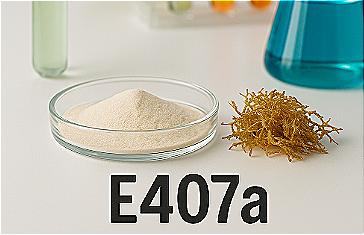
• Appearance: powder from off-white/ivory to beige/light brown.
• Dispersibility/solubilization: disperses in cold water; hydrates and solubilizes with heating (~70–90 °C).
• pH (1% solution): ~7.0–8.5 (grade-dependent).
• Gels: thermo-reversible; kappa → rigid/brittle gels (reinforced by K⁺, synergy with locust bean gum), iota → soft/elastic gels (reinforced by Ca²⁺).
• Stability: acid hydrolysis at pH <4 at high temperature; good salt tolerance.
Sensory and technological properties
• Efficient thickening and gelation at low solids; controls syneresis in gels/creams.
• Stabilizes particulates (e.g., cocoa in milk) and emulsions; compatible with dairy proteins.
• Synergies: strong with locust bean gum (LBG) for tougher kappa gels; combinations with xanthan for texture and thermal tolerance.
• Turbidity higher than E407 due to cellulose—useful when body/opalescence is desired.
Food applications
• Dairy & beverages: chocolate milk, protein/plant drinks, desserts/creams, milk gels (0.05–0.35%).
• Cooked meats/RTE: water binding/thermal gels (0.2–0.8%; with KCl/CaCl₂ or in brines).
• Aqueous/sugar gels: elastic or rigid gels (0.2–1.0% depending on ions/solids).
• Sauces & dressings: body/stability (0.1–0.4%).
• Pet food (canned/wet): structure and anti-syneresis.
Nutrition & health
E407a behaves as a technological fiber with low caloric availability; at use levels, nutritional contribution is minimal. It is not poligeenan (acid-degraded, low-MW carrageenan, not permitted in foods). Generally well tolerated; in very sensitive individuals, high intake may lead to bloating or softer stools. In dairy systems it can increase perceived satiety by raising viscosity.
From a safety standpoint, E407a is authorized for intended uses up to QS (quantum satis) in permitted categories, subject to purity specifications and good manufacturing practice.
A 2024 study warns about the risk of developing cancer with high intakes of emulsifiers, (including E440, Pectin, E471 mono- and diglycerides of fatty acids, carrageenan, E407, sodium carbonate E500) (1).
Quality and specifications (typical topics)
• Identity/purity: carrageenan content (kappa/iota), insoluble matter (cellulose) within range, metals within limits, grit/foreign bodies absent.
• Functional: viscosity at 1.5% (defined T/pH/ions), gel strength (method and ions stated), syneresis.
• Physicochemical: moisture, aw, slurry pH, color (CIELAB), total/insoluble ash.
• Microbiology: low counts; pathogens absent/25 g.
• Contaminants: pesticides/PAHs/metals within limits; ethylene oxide not permitted.
Storage and shelf-life
• Store dry, dark, in moisture-barrier packaging; avoid odors/CO₂ uptake.
• Typical shelf-life 24–36 months unopened; reseal and use desiccant after opening.
Safety and regulatory
• Additive E407a (processed Eucheuma seaweed), authorized in the EU at QS according to category/product and GMP; specifications cover composition (carrageenan/cellulose/salts), metals, and contaminants.
• In many jurisdictions, carrageenans/PES have an ADI “not specified” under intended uses.
• Label per additive rules; maintain technical dossier and traceability under GMP/HACCP.
Labeling
• Name in Italian lists: “E407a — alga Eucheuma trasformata”; in English lists: “processed Eucheuma seaweed”.
• Declare allergens only if present from the recipe; include conditions of use where required.
Troubleshooting
• Weak gel → insufficient/incorrect ions, low solids, unsuitable grade → add K⁺ (kappa) or Ca²⁺ (iota), raise %, or blend with LBG.
• Poor hydration/lumps → inadequate dispersion → premix with sugar/solids, apply strong shear cold, then heat to 80–90 °C.
• Syneresis → loose network → increase ions, add LBG/xanthan, raise solids.
• Acid hydrolysis (viscosity loss) → pH <4 at high T → raise process pH or reduce time/temperature; use buffers.
• Excess turbidity → high insoluble fraction → switch to E407 or a more filtered/refined PES grade.
Sustainability and supply chain
• Red seaweed aquaculture requires low land/fertilizer inputs and fixes CO₂; supports coastal economies.
• Focus areas: sustainable harvesting, species/biomass control, process-water/brine management to BOD/COD targets, and recyclable packaging.
• Prefer suppliers with geographic traceability and responsible aquaculture practices.
INCI functions (cosmetics)
• Carrageenan / Chondrus Crispus (Carrageenan) Extract / Eucheuma Seaweed Extract: viscosity-increasing, film-forming, stabilizing/emulsifying for gels, lotions, and toothpastes; usage per cosmetic regulations and tolerability assessments.
Conclusion
E407a (PES) delivers reliable gelation and stabilization at competitive cost with robust process tolerance, at the expense of higher turbidity than refined E407. Optimal performance depends on ions, pH/temperature, synergy with LBG, and correct dispersion/hydration.
Mini-glossary
• QS (quantum satis): Use “as needed” to achieve the technological effect under good practice.
• LBG: Locust bean gum — galactomannan synergistic with kappa carrageenan for stronger, lower-syneresis gels.
• Syneresis: Serum weeping from a gel due to network contraction/instability.
• Thermo-reversible: Gel that melts and re-gels upon temperature cycling.
• Poligeenan: Acid-degraded, low-molecular-weight carrageenan not permitted in foods.
• GMP/HACCP: Good manufacturing practice / hazard analysis and critical control points — Preventive hygiene and process-control systems.
• BOD/COD: Biochemical/chemical oxygen demand — Wastewater load metrics guiding treatment and discharge.

