



Red yeast rice powder
(powder from Oryza sativa fermented with Monascus spp.; also known as red fermented rice / RYR)
Description
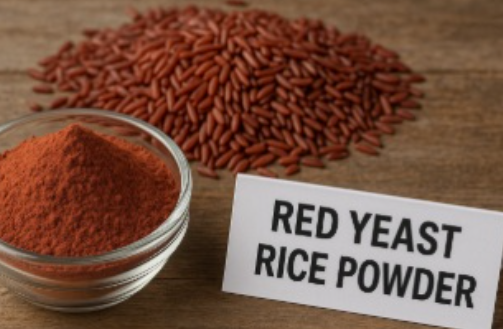
• Traditional fermented rice colored deep red by Monascus molds; supplied as fine-to-medium powders for culinary color/flavor and as standardized dietary-ingredient grades.
• Hallmarks: crimson azaphilone pigments, mild umami/cereal notes, and—depending on strain/process—variable monacolins (e.g., monacolin K, chemically identical to lovastatin).
• Two broad styles: culinary RYR (focus on color/aroma; monacolins at trace levels) and standardized RYR (monacolins assayed/controlled; stringent citrinin controls).
Indicative nutrition values (typical ranges; per 100 g powder)
• Energy: 320–380 kcal
• Carbohydrate: 60–75 g (sugars ≤3 g) • Dietary fiber: 3–8 g
• Protein: 8–14 g
• Fat: 2–6 g — SFA (saturated fatty acids; advisable to keep low overall) 0.5–1.5 g; MUFA (monounsaturated) 0.5–1.5 g; PUFA (polyunsaturated) 1–3 g
• Sodium: naturally low (unless salted)
• Micronutrients: residual minerals (K, Mg), pigments (monascin/ankaflavin), trace GABA (process-dependent).
Key constituents
• Monacolins: notably monacolin K (lovastatin) plus related lactone/acid forms (J, L, X); levels vary by strain, substrate, and fermentation control.
• Azaphilone pigments: monascorubrin, rubropunctatin, monascin, ankaflavin (color; antioxidant potential).
• Rice matrix: starches, proteins, lipids (seed-derived pufa predominance), phytosterols; minor GABA.
• Contaminants to control: citrinin (mycotoxin), heavy metals, residual solvents (if used), and overall microbiological hygiene.
Production process
• Substrate prep: soak/steam polished or glutinous rice → cool to inoculation temperature.
• Inoculation & solid-state fermentation: seed with selected Monascus spp. (e.g., M. purpureus, M. pilosus). Control temperature, humidity, aeration, and time to reach target pigment/monacolin profile while suppressing citrinin formation (strain and process selection are critical).
• Drying & milling: gentle drying to low aw, de-agglomeration and particle-size setting; optional standardization (blend-to-spec monacolin range).
• Quality steps: HPLC assay of monacolins, citrinin testing against legal/house limits, microbiology, color value; packing under GMP/HACCP.
Physical properties
• Appearance: red to crimson powder; hue depends on pigment ratio.
• Solubility/dispersion: insoluble particles; disperse in water or fats when pre-slurried. Monacolins are lipophilic lactones (hydrolyze to acids).
• Odor/taste: cereal/umami, lightly fermented.
• Stability: pigments and monacolins are light/oxygen/heat-sensitive; protect from UV, moisture, and high temperature.
Sensory and technological properties
• Natural colorant: imparts red–ruby shades to marinades, cured meats, tofu/fermented pastes, noodles, pastries.
• Flavor: mild umami rounding; fermented nuance; supports salty/fatty notes.
• Functionality: particulate color; no gelling; disperses better when pre-hydrated or fat-slurried.
Food applications
• Culinary: fermented bean curd, char siu–style glazes, red pastries/noodles (typ. 0.2–2.0%).
• Ferments/sauces: traditional rice wines/sauces; colored pastes.
• Dietary-ingredient uses: standardized RYR in tablets/capsules where permitted; color/flavor in functional foods as allowed.
Nutrition & health
Red yeast rice may contain monacolin K, which inhibits HMG-CoA reductase similarly to prescription statins. Preparations delivering meaningful monacolin intakes can lower LDL-cholesterol but also carry statin-like risks (e.g., myopathy, liver enzyme elevations, drug interactions). Critically, monacolin content varies widely among products; some contain trace/none, others substantial amounts, and historical market issues include illicit lovastatin addition.
Regulatory stances differ by country: many jurisdictions restrict health claims, impose warning statements and conditions of use for monacolin-containing RYR, and treat products with added/enhanced lovastatin as unapproved drugs rather than supplements. Citrinin is a separate safety concern and is legally limited in RYR supplements (typical maximum level: 100 μg/kg).
Populations who are pregnant/lactating, have liver/kidney disease, take CYP3A4-interacting drugs (e.g., certain statins, macrolides, azoles, grapefruit), or have statin intolerance should avoid self-use and seek medical advice.
Portion note:
• Culinary coloring/flavoring: typically 0.2–2.0% of dry mix or 0.5–5 g per kg of food, adjusted to hue/taste.
• Standardized supplements: follow local limits and label warnings; do not exceed labeled daily monacolin allowance; consult a healthcare professional before use.
Quality and specifications (typical topics)
• Monacolins: HPLC (monacolin K lactone/acid; total monacolins) within target; manage batch variability via process/blending.
• Citrinin: non-detect or ≤100 μg/kg in supplements; validated method and batch release criteria.
• Color: spectrophotometric color value; pigment profile (monascorubrin/rubropunctatin).
• Microbiology: low APC; pathogens absent/25 g; yeast/mould controlled.
• Physicochemical: moisture (≤10%), aw (≤0.6), ash, particle size (D50), bulk density.
• Contaminants: heavy metals within limits; residual solvents (if any) per ICH; peroxide/acid value trending for lipid stability.
Storage and shelf-life
• Store cool, dark, and dry in oxygen/light-barrier packaging; include desiccant where appropriate.
• Avoid heat and UV to limit pigment fading and monacolin degradation.
• Typical shelf-life: 18–24 months unopened; confirm with stability studies.
Safety and regulatory
• Culinary RYR may be marketed as a food/ingredient for color/flavor where allowed.
• RYR with monacolin claims is often regulated with conditions of use, warnings, and upper-level controls; products with added/enhanced lovastatin are treated as drugs in several markets.
• Manufacturers should comply with GMP/HACCP, verify citrinin compliance, and ensure transparent labeling in line with local law.
Labeling
• Name: “red yeast rice powder” / “rice fermented with Monascus”.
• Declare standardization (e.g., monacolin K content) where permitted, daily serving, and any mandatory warnings; for culinary grades, state intended use as color/flavor and relevant allergen/cross-contact policies.
Troubleshooting
• Dull/brown color → pigment oxidation/overheating → lower process temperature/hold time; improve O₂/light barrier.
• Monacolin out of spec → fermentation drift/strain instability → tighten inoculum/controls; blend batches to spec.
• Citrinin detected → unsuitable strain or stress conditions → switch to non-citrinin-producing strains; optimize moisture/aeration; reject batch if needed.
• Caking/poor flow → moisture pickup → stronger barrier film, permitted anti-caking, add desiccant.
• Off-odors → lipid oxidation → reduce headspace O₂; consider compatible natural antioxidants.
Sustainability and supply chain
• Solid-state fermentation on rice enables efficient use of cereal substrates; manage wastewater to BOD/COD targets.
• Prefer renewable energy for drying; use recyclable/lightweight packaging; audit suppliers for traceability and residue programs under GMP/HACCP.
INCI functions (cosmetics)
• Monascus/Rice Ferment / Oryza Sativa (Rice) Ferment Extract: skin-conditioning and coloring roles in topical products (verify local cosmetic colorant status; assess photostability/irritancy).
Conclusion
Red yeast rice powder is a dual-purpose ingredient—a natural red color/flavor for culinary use and a regulated dietary ingredient when standardized for monacolins. Success depends on strain/process control, rigorous citrinin management, protection from light/oxygen/heat, and strict regulatory compliance for labeling and daily-intake conditions.
Mini-glossary
• Monacolin K (lovastatin): Statin-class HMG-CoA reductase inhibitor occurring in some RYR; can lower LDL but carries statin-like risks.
• HMG-CoA reductase: Enzyme controlling a key step in cholesterol synthesis; pharmacological target of statins/monacolin K.
• Citrinin (CIT): Mycotoxin that can form in some Monascus ferments; capped at low levels in supplements.
• SFA: Saturated fatty acids — High intakes may raise LDL-cholesterol; desirable to keep low overall.
• MUFA: Monounsaturated fatty acids — Generally favorable when replacing saturates.
• PUFA: Polyunsaturated fatty acids — Beneficial when balanced and protected from oxidation.
• GMP/HACCP: Good manufacturing practice / hazard analysis and critical control points — Preventive hygiene/process-control systems.
• BOD/COD: Biochemical/chemical oxygen demand — Wastewater metrics guiding treatment and discharge.
Studies
The colour of the rice grain is determined by the pigmentation of certain phytochemicals. In the rice ( Oryza sativa ), most of the varieties have white grains, but some have brown, red or black grains. The colour of red rice is due to the deposition and oxidative polymerization of proanthocyanidins in the pericarp, while the colour of black rice is due to the deposition of anthocyanins (1).
Red or pigmented rice (Oryza longistaminata and Oryza sativa var Selvatica) is a perennial species of wild rice originating in Africa and containing anthocyanins and proanthocyanidins concentrated in the bran layer.
It also contains flavonoids derived from vitamin E, gamma oryzanol, proanthocyanidins and anthocyanins.
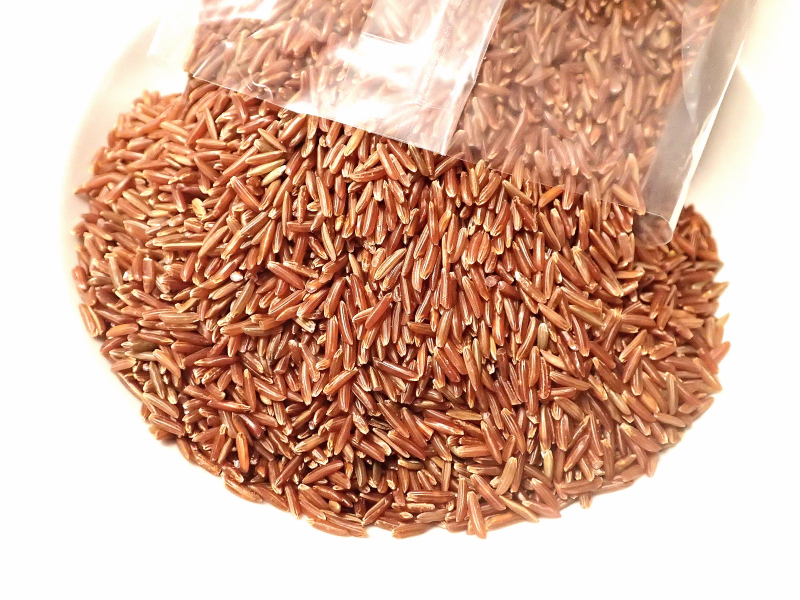
Very resistant to pests and diseases, until recently it was considered a weed and was frequently removed.
Rice is a grass and one of the most common and oldest foods. Just think that its history dates back 7,000 years.
It is harvested from September to October from a small plant called Oryza, which is fed by flooded soil.
The genus Oryza has many species, here some of the best known:
- Oryza sativa, white rice grown all over the world
- Oryza glaberrima, cultivated in Africa
- Oryza officinalis, cultivated in Vietnam
- Oryza australiensis, cultivated in Australia
- Oryza rhizomatis
- etc.
Italy is the first European producer with crops in the provinces of Vercelli, Novara, Pavia, Biella, Milan, Lodi and others.
The rice is composed of the grain and its husk and husk wrapper.
Once harvested, it is not edible and must be worked to remove the husk and other parts.
After the processing that is called dehusking you get the
- brown rice, edible
Wholemeal rice, with a subsequent refining process, is used to produce the
- refined rice, edible
The varieties of rice are numerous, over 100,000 and each has different taste and cooking times.
In general, rice contains more than 100 bioactive substances mainly in its bran layer including phytic acid, isovitexin, gamma-oryzanol, phytosterols, octacosanol, squalene, gamma-aminobutyric acid, tocopherol and derived from tocotrienol (2), antioxidants.
It does not contain beta carotene (provitamin A) and has a very low iron and zinc content (3).
In rice bran there are bioactive phytochemicals that exert protective actions against cancer that involve the metabolism of the host and the intestinal microbiome. A diet based on rice bran has shown positive effects in reducing the risk of colon cancer (4).
Allergies: Be careful, rice contains a certain amount of lactose, a component that can give intolerance.
The most common types of rice used are :
- Arborio : large grains, the most common in Italy
- Ribe : elongated grains.
- Thaibonnet : medium, elongated and fine grains
- Rome : large grains
- Basmati : thin and elongated grains. Grown in Pakistan and India
- Carnaroli : large grains
- Vialone nano : large, round grains
- Original or Balilla : small round grains
- Jasmine : fine grains of Asian origin
- Red : red, small and narrow grains
- Wild : Zizania palustris
- Baldo : large, shiny grains
- Ganges : from India
- Footboard : releases a lot of starch
- Venus : from China and the Po Valley
- Patna : from Thailand. Long and narrow grains
- Sant'Andrea : Thick and long grains. Releases a lot of starch
Rice viruses and pests: Pseudomonas aeruginosa, Rice yellow mottle virus, Magnaporthe oryzae , Rice Tungro Bacilliform Virus , Lissorhoptrus oryzophilus Kuschel, Oebalus pugnax, Xanthomonas oryzae

