Vitamine
(micronutrienti organici essenziali, liposolubili: A, D, E, K; idrosolubili: C e gruppo B)
Descrizione
• Le vitamine sono micronutrienti essenziali richiesti in piccole quantità per funzioni enzimatiche, ormonali e antiossidanti; l’organismo umano non le sintetizza a sufficienza e devono essere assunte con la dieta o tramite fortificazione/integratori.
• Forme multiple (“vitameri”) condividono attività biologica (es. retinolo/retinili per A; tocoferoli/tocotrienoli per E; filochinone/menaquinoni per K; niacina come acido nicotinico/niacinamide).
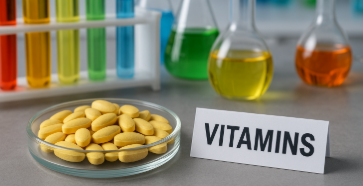
• In alimenti e integratori sono fornite come polveri cristalline, dispersioni o premix microincapsulati per migliorarne stabilità e biodisponibilità.
Valori nutrizionali indicativi (riferimenti tipici UE per adulti; soglie NRV/PRI; esempi non esaustivi)
• Vitamina A (RAE): 700–900 μg/d; UL 3.000 μg RAE/d (retinolo).
• Vitamina D (D₂/D₃): 10–20 μg/d (400–800 UI/d); UL 100 μg/d.
• Vitamina E (α-TE): 12–15 mg/d; UL 300 mg/d (α-tocoferolo).
• Vitamina K: 70–120 μg/d (nessun UL stabilito per K1).
• Vitamina C: 80–100 mg/d; UL 1.000–2.000 mg/d (tolleranza individuale).
• B1 1,1–1,3 mg; B2 1,1–1,6 mg; B3 14–18 mg NE; B5 5 mg; B6 1,3–1,7 mg (UL 12–25 mg); B7 (biotina) 30–50 μg; B9 (folato/DFE) 400 μg (UL 1.000 μg folato sintetico); B12 2–4 μg.
• Nei prodotti fortificati, i claim “fonte di” e “ad alto contenuto di” richiedono rispettivamente ≥15% e ≥30% del NRV per porzione/100 g.
Principali sostanze contenute
• Liposolubili:
– Vitamina A (retinolo, retinyl acetate/palmitate; provitamine β-carotene e carotenoidi).
– Vitamina D (D₃ colecalciferolo da 7-deidrocolesterolo; D₂ ergocalciferolo).
– Vitamina E (α/β/γ/δ-tocoferoli; tocotrienoli; forme estere tocopheryl acetate).
– Vitamina K (K₁ filochinone; K₂ menaquinoni MK-4…MK-7).
• Idrosolubili:
– Vitamina C (acido L-ascorbico; sali ascorbati; derivati stabilizzati per alimenti/cosmesi).
– Complesso B: B1 tiamina, B2 riboflavina, B3 niacina (acido nicotinico/niacinamide), B5 D-pantotenato, B6 piridossina/P-5-P, B7 biotina, B9 folato (acido folico/5-MTHF), B12 ciano-/metil-/adenocobalamina.
Processo di produzione
• Sintesi chimica: retinolo/esteri A; all-rac-α-tocoferile acetato; acido nicotinico/niacinamide; acido folico; retinyl derivati; vitamina A/D/E incapsulate.
• Fermentazione/bioconversione: riboflavina (B2) da Bacillus/Ashbya; vitamina C via processi moderni a biotrasformazione; K₂ (MK-7) da Bacillus; B12 da microrganismi selezionati.
• Estrazione: tocoferoli misti da distillati di oli vegetali; K₁ da matrici vegetali; provitamina A (β-carotene) da alghe o fermentazione.
• Origine D₃: fotoconversione di 7-deidrocolesterolo da lanolina (pecora) o da licheni per gradi “vegan”.
• Finitura: premix con carrier (maltodestrina, amidi modificati), micronizzazione, microincapsulazione (amido gommoso, gelatina, liposomi), antiossidanti e antiagglomeranti; standardizzazione di titolo.
Proprietà fisiche
• Stato fisico: polveri cristalline (A, D, E esteri; acido ascorbico; B varie), oli viscosi (alcuni tocoferoli).
• Solubilità: liposolubili solubili in grassi/solventi organici, idrosolubili in acqua (alcune richiedono sale o derivati per dispersione).
• Stabilità: sensibili a luce, ossigeno, calore e pH (C, B1, B6, folati particolarmente labili; B2 fotosensibile; A/D/E/K sensibili a ossidazione, protette da antiossidanti).
• Colore/odore: riboflavina giallo intenso; β-carotene arancio; la maggior parte inodore.
Impieghi alimentari
• Fortificazione: farine/cereali breakfast (B-complex, ferro + acido folico), bevande (C, B, D), lattiero e plant-based (A, D, B12), margarine/oli (A, D, E).
• Tecnologici: antiossidante (C/E) per protezione di colore/aromi; colorante naturale (riboflavina, β-carotene).
• Premix per bakery, nutrizione clinica/sportiva, prodotti infant (secondo standard stringenti).
Nutrizione e salute
• Le vitamine si assumono naturalmente da cibi, frutta e verdura e solo un medico può stabilire la eventuale carenza e somministrazione di vitamine. Evitare il fai da te.
Le vitamine sostengono metabolismo energetico (B1, B2, B3, B5, B6, biotina), difese antiossidanti (C, E), visione e differenziazione cellulare (A), omeostasi del calcio e salute ossea (D, K), ematopoiesi (B9, B12), funzione immunitaria (A, C, D, B6, folati).
• Deficit: da lievi (stanchezza, gengive fragili, pelle secca) a severi (rachitismo/osteomalacia per D, anemia megaloblastica per B12/folati, xeroftalmia per A). Popolazioni a rischio: diete restrittive, gravidanza/allattamento, anziani, malassorbimento, alcolismo, vegan (B12).
• Eccessi: rischio soprattutto per liposolubili (A, D, E, K) e per alte dosi di alcune idrosolubili (B6 neuropatie, niacina flushing/epatotossicità). Rispettare i UL e le dosi professionali.
• Biodisponibilità: migliora con matrice e cofattori (es. carotenoidi con lipidi alimentari; acido ascorbico ↑ assorbimento ferro non-eme; folati instabili al calore).
• Interazioni: farmaci antiepilettici/anticoagulanti con folati/K; metformina e B12; alcol riduce B1.
• Qualità di vita: nei fortificati correttamente formulati, il raggiungimento del 15–30% NRV per porzione sostiene adeguatezza senza eccedere i limiti.
Qualità e specifiche (temi tipici)
• Titolazione/potenza (assay, IU/μg/mg), overage definito per compensare perdite in processo/shelf-life.
• Impurezze e solventi residui nei limiti; metalli pesanti conformi; perossidi (forme oleose) bassi.
• Stabilità: studi accelerati e real-time; compatibilità con pH, acqua libera, luce; validazione fotostabilità (B2).
• Microbiologia: bassa carica; assenza patogeni; per premix umidi considerare aw.
• Forma: cristallinità, granulometria, dispersibilità; capsule/compresse: durezza, friabilità, disgregazione.
Conservazione e shelf-life
• Conservare al buio, in atmosfera inerte/ridotto O₂, asciutto e fresco; contenitori ambra/barriera ben chiusi.
• Evitare calore, umidità e contatto con metalli catalitici; rispettare TMC e richiudere con essiccante.
• Le forme incapsulate mantengono meglio la potenza in alimenti acidi, lattiero e bevande.
Sicurezza e regolatorio
• Fortificazione/claim secondo normativa UE: uso di vitamine autorizzate, fonti ammesse, limiti massimi nazionali dove previsti; claim ammessi solo con condizioni d’uso (es. “fonte di”, “ad alto contenuto di”).
• Integratori: etichetta con DOSI, %NRV, avvertenze; attenzione a UL e popolazioni specifiche (gravidanza: A retinolo).
• Produzione in GMP/HACCP; tracciabilità e SDS disponibili.
Etichettatura
• Nome della vitamina e forma chimica (es. “vitamina D₃ colecalciferolo”, “niacinamide”, “retinyl palmitate”), titolo e %NRV per porzione.
• Indicazioni di conservazione, TMC, lotto; nei fortificati evidenziare la presenza in elenco ingredienti e nella tabella nutrizionale.
• Claim funzionali/di salute solo se autorizzati e rispettando le condizioni.
Troubleshooting
• Perdita di potenza (C, folati, B1) → eccesso di calore/ossigeno/pH sfavorevole → usare derivati stabilizzati, incapsulazione, abbassare T/tempo.
• Scolorimento/odore (E, A) → ossidazione → aggiungere antiossidanti compatibili, ridurre O₂, usare packaging barriera.
• Interazioni di processo (riboflavina fotochimica, niacina causa flushing in bevande) → regolare dose e profili di luce/pH.
• Precipitazione in bevande → scegliere sali/derivati più solubili o sistemi emulsionali (liposolubili).
• Non conformità claim → potenza reale < dichiarato a fine shelf-life → aumentare overage e rifare studi di stabilità.
Sostenibilità e filiera
• Preferire fermentazione/biocatalisi quando possibile (riboflavina, C, K₂), uso di solventi verdi, energia da fonti rinnovabili.
• Valorizzare sottoprodotti (tocoferoli da distillati di oli); gestione reflui verso target BOD/COD; packaging riciclabile.
• Tracciabilità materie prime (es. D₃ da lanolina vs licheni), audit fornitori, programmi residui/impurezze in GMP/HACCP.
Principali funzioni INCI (cosmesi)
• Ascorbic Acid / Sodium/Magnesium Ascorbyl Phosphate / Ascorbyl Tetraisopalmitate — antiossidante, brightening, supporto collagene.
• Tocopherol / Tocopheryl Acetate — antiossidante lipidico, protezione ossidativa.
• Retinol / Retinyl Palmitate/Acetate — rinnovamento epidermico, trattamento fotoaging (uso controllato).
• Niacinamide — barriera cutanea, uniformante tono.
• Panthenol — idratazione, lenitivo.
• Biotin / Folic Acid / Pyridoxine HCl / Thiamine / Riboflavin / Cyanocobalamin — conditioning, supporto metabolismo cutaneo/capillare (claim cosmetici non terapeutici).
Conclusione
Le vitamine sono strumenti chiave per salute pubblica e tecnologia alimentare: efficaci se formulate e dosate correttamente, protette da fattori di degrado e integrate in matrici compatibili. La riuscita dipende da selezione della forma, stabilità (incapsulazione, packaging), biodisponibilità e rigoroso controllo qualità dall’origine al prodotto finito.
Mini-glossario
• NRV: valore nutritivo di riferimento usato in etichetta (UE).
• PRI/RDA: fabbisogno medio raccomandato / razione giornaliera raccomandata.
• UL: livello massimo tollerabile di assunzione giornaliera.
• RAE: retinol activity equivalents per vitamina A (converte retinolo/carotenoidi).
• DFE: dietary folate equivalents per confrontare folati naturali e acido folico.
• NE: niacin equivalents (da niacina e triptofano).
• IU: unità internazionali (storiche per A, D, E).
• GMP/HACCP: sistemi igienico-preventivi e di controllo processo.
• BOD/COD: indicatori del carico inquinante dei reflui utili alla gestione/depurazione.
Bibliografia__________________________________________________________________________
Dattola A, Silvestri M, Bennardo L, Passante M, Scali E, Patruno C, Nisticò SP. Role of Vitamins in Skin Health: a Systematic Review. Curr Nutr Rep. 2020 Sep;9(3):226-235. doi: 10.1007/s13668-020-00322-4.
Abstract. Purpose of review: Skin is the main defense organ of the human body against external insults (ultraviolet radiations, infections by pathogenic microorganisms, and mechanical and chemical stress). The integrity and functions of the skin barrier are supported by an adequate supply of micronutrients, such as several vitamins. The purpose of this review was to analyze all vitamin-related skin problems. Recent findings: The World Health Organization has estimated that more than 2 billion people worldwide experience deficiencies in the intake of essential vitamins and minerals; the percentage of adults all over the world using daily vitamin supplements, for treatment or prevention of chronic disease, has increased very rapidly in recent years. In this review, 65 studies have been selected in order to examine the role of the main vitamins and their derivatives involved in maintaining the well-being of the skin and their use as prophylactic and therapeutic agents in the management of skin disorders.
Cagetti MG, Wolf TG, Tennert C, Camoni N, Lingström P, Campus G. The Role of Vitamins in Oral Health. A Systematic Review and Meta-Analysis. Int J Environ Res Public Health. 2020 Feb 3;17(3):938. doi: 10.3390/ijerph17030938.
Abstract. The association between vitamins and oral health have recently been discussed, yielding increased attention from medical and dental perspectives. The present review aimed to systematically evaluate and appraise the most recently scientific papers investigating the role of vitamins in the prevention and treatment of the main oral diseases as hard dental pathological processes and gum/periodontal disease. Randomized controlled trials, cross-sectional studies, cohort studies, comparative studies, validation studies and evaluation studies, following the Preferred Reporting Items for Systematic Reviews and Meta-Analyses (PRISMA) guidelines, reporting associations between vitamins and oral diseases or the use of vitamins to prevent or treat oral diseases in patients of any age were included. PubMed, Embase and Scopus were searched to November 2019 using an ad hoc prepared search string. All the papers meeting the inclusion criteria were subjected to a quality assessment. The search identified 1597 papers; 741 were selected after removing duplicates. A total of 334 articles were excluded after title and abstract evaluation; 407 were assessed and 73 papers were full-text assessed; other 14 papers were discharged after full text evaluation, leaving finally 58 papers included. In general, there is weak evidence supporting the association between vitamins and both gingival/periodontal disease and hard dental pathological processes.
Semba RD. The discovery of the vitamins. Int J Vitam Nutr Res. 2012 Oct;82(5):310-5. doi: 10.1024/0300-9831/a000124.
Abstract. The discovery of the vitamins was a major scientific achievement in our understanding of health and disease. In 1912, Casimir Funk originally coined the term "vitamine". The major period of discovery began in the early nineteenth century and ended at the mid-twentieth century. The puzzle of each vitamin was solved through the work and contributions of epidemiologists, physicians, physiologists, and chemists. Rather than a mythical story of crowning scientific breakthroughs, the reality was a slow, stepwise progress that included setbacks, contradictions, refutations, and some chicanery. Research on the vitamins that are related to major deficiency syndromes began when the germ theory of disease was dominant and dogma held that only four nutritional factors were essential: proteins, carbohydrates, fats, and minerals. Clinicians soon recognized scurvy, beriberi, rickets, pellagra, and xerophthalmia as specific vitamin deficiencies, rather than diseases due to infections or toxins. Experimental physiology with animal models played a fundamental role in nutrition research and greatly shortened the period of human suffering from vitamin deficiencies. Ultimately it was the chemists who isolated the various vitamins, deduced their chemical structure, and developed methods for synthesis of vitamins. Our understanding of the vitamins continues to evolve from the initial period of discovery.
Pullar JM, Carr AC, Vissers MCM. The Roles of Vitamin C in Skin Health. Nutrients. 2017 Aug 12;9(8):866. doi: 10.3390/nu9080866
Abstract. The primary function of the skin is to act as a barrier against insults from the environment, and its unique structure reflects this. The skin is composed of two layers: the epidermal outer layer is highly cellular and provides the barrier function, and the inner dermal layer ensures strength and elasticity and gives nutritional support to the epidermis. Normal skin contains high concentrations of vitamin C, which supports important and well-known functions, stimulating collagen synthesis and assisting in antioxidant protection against UV-induced photodamage. This knowledge is often used as a rationale for the addition of vitamin C to topical applications, but the efficacy of such treatment, as opposed to optimising dietary vitamin C intake, is poorly understood. This review discusses the potential roles for vitamin C in skin health and summarises the in vitro and in vivo research to date. We compare the efficacy of nutritional intake of vitamin C versus topical application, identify the areas where lack of evidence limits our understanding of the potential benefits of vitamin C on skin health, and suggest which skin properties are most likely to benefit from improved nutritional vitamin C intake.
Jiang M, Li G, Yang K, Tao L. Role of vitamins in the development and treatment of osteoporosis (Review). Int J Mol Med. 2025 Jul;56(1):109. doi: 10.3892/ijmm.2025.5550. Epub 2025 May 16.
Abstract. Osteoporosis has escalated into a pressing public health challenge amidst global demographic aging. Conventional diagnostic approaches and therapeutic interventions demonstrate growing limitations in both risk stratification and epidemiological control. In this context, serological monitoring and targeted nutrient supplementation emerge as promising preventive strategies. Vitamins, fundamental regulators of cellular homeostasis, demonstrate particular significance in bone remodeling processes. The present comprehensive review elucidates the pathophysiological mechanisms through which specific vitamins differentially modulate osteoblastic activity and osteoclastic regulation, summarizing contemporary evidence from the molecular to clinical research levels. While vitamin A exhibits dual effects, other vitamins predominantly show positive impacts on bone homeostasis. Oxidative stress and inflammation are key pathological changes associated with osteoporosis. Vitamins play a protective role by enhancing the expression of antioxidant enzymes, activating antioxidant pathways and inhibiting the secretion of inflammatory cytokines, thereby mitigating these conditions. Serum vitamin concentrations exhibit significant correlations with bone mineral density alterations and osteoporosis progression, providing predictive biomarkers for fracture risk assessment. However, serum vitamin profiles exhibit marked heterogeneity across osteoporosis risk strata, necessitating population‑specific therapeutic protocols. Precision‑adjusted supplementation strategies effectively attenuate pathological bone resorption while preserving physiological remodeling homeostasis. The present review systematically delineates the therapeutic potential of vitamins in osteoporotic management, underscoring the necessity for evidence‑based precision nutrient protocols tailored to at‑risk populations to prevent disease progression.
Amerikanou C, Gioxari A, Kleftaki SA, Valsamidou E, Zeaki A, Kaliora AC. Mental Health Component Scale Is Positively Associated with Riboflavin Intake in People with Central Obesity. Nutrients. 2023 Oct 21;15(20):4464. doi: 10.3390/nu15204464.
Abstract. Micronutrient deficiencies are a well-established fact in obesity. However, few studies exist on the relationship between micronutrient intake and mental health. In this study, we investigated the associations between daily intakes of vitamins and minerals and scoring items that measure mental health in people living with central obesity. One hundred males and females with central obesity and metabolic abnormalities were included in the study. Demographic, clinical, anthropometric, and biochemical data were collected. Mental health statuses were assessed with validated questionnaires, and daily micronutrient intakes were assessed with food diaries and Nutritionist ProTM software v7.9. The mental component score (MCS-12) positively correlated with vitamin A (Rho = 0.249, p = 0.038), vitamin C (Rho = 0.293, p = 0.014), riboflavin (Rho = 0.264, p = 0.026), and folate (Rho = 0.238, p = 0.046). Rosenberg Self-Esteem Scale (RSES) correlated with sodium (Rho = 0.269, p = 0.026), and the Center for Epidemiologic Studies Depression Scale Revised (CESD-R) correlated with chromium (Rho = 0.313, p = 0.009). In the regression analysis, after potential confounders were adjusted for, only riboflavin was positively associated with the MCS-12 log (beta ± SD = 0.047 ± 0.023, p = 0.044). Our study provides evidence of the link between dietary riboflavin and mental health in people with obesity, and it highlights the importance of monitoring both nutritional status and mental health when managing obesity.
Chai Y, Chen C, Yin X, Wang X, Yu W, Pan H, Qin R, Yang X, Wang Q. Effects of water-soluble vitamins on glycemic control and insulin resistance in adult type 2 diabetes: an umbrella review of meta-analyses. Asia Pac J Clin Nutr. 2025 Feb;34(1):118-130. doi: 10.6133/apjcn.202502_34(1).0012.
Abstract. Background and objectives: Growing evidence has explored the effects of water-soluble vitamins supplementation on glycemic control and insulin resistance in diabetic patients; however, the results of previous meta-analyses are inconsistent. To address this, we conducted an umbrella review to synthesize the evidence on these effects. Methods and study design: A systematic literature search in Web of science, PubMed, and Cochrane Database of Systematic Reviews was performed from 2012 to November 2022. he quality of the meta-analyses was assessed using AMSTAR-2 and GRADE. Results: Fourteen systematic reviews and meta-analyses met the inclusion criteria, examining the effects of five water-soluble vitamins (B-1, B-3, biotin, B-9, and C) on glycemic control and insulin resistance. The findings suggest that vitamin C supplementation can improve glycemic control in type 2 diabetes, as indicated by reduced FBG and HbA1c, with more significant effects observed for durations longer than 30 days. Conclusions: Insulin resistance is improved by folic acid supplementations. More well-designed individual randomized controlled trials are needed in the future, as well as meta-analysis of higher quality.
Wróblewska J, Długosz A, Wróblewski M, Nuszkiewicz J, Wróblewska W, Woźniak A. Sex Differences in Vitamin Metabolism and Their Role in Oxidative Stress Regulation and Cardiometabolic Health. Nutrients. 2025 Aug 20;17(16):2697. doi: 10.3390/nu17162697.
Abstract. Vitamins A, D, E, K, B2, B12, and C play a key role in regulating metabolism and oxidative stress, significantly impacting cardiometabolic health. This review uniquely integrates mechanistic and epidemiological data to examine sex-specific differences in the bioavailability, metabolism, and physiological effects of these vitamins. By linking hormonal and genetic factors with oxidative stress modulation, lipid metabolism, and endothelial function, we outline how individualized vitamin intake strategies may help prevent cardiovascular and metabolic disorders. The paper also identifies natural dietary sources and optimal intake recommendations for each vitamin, emphasizing the importance of tailoring supplementation to sex-related needs. This sex-focused perspective provides a basis for developing personalized nutrition approaches to optimize cardiometabolic outcomes.




