



Pea fibers
(from seeds and/or seed coats of Pisum sativum L.; family Fabaceae )
Description
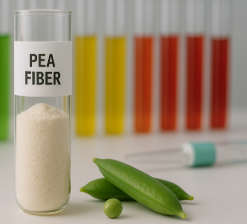
• Dietary-fiber ingredient obtained from pea cell-wall fractions (cellulose, hemicelluloses, pectins). Available as hull fiber (more insoluble) or cotyledon fiber (more balanced insoluble/soluble).
• Supplied as powders with tailored particle size (standard, micronized) and as functional fibers (partly solubilized/enzymatically treated) for specific food uses.
• Core functions: water/oil binding, bulking (partial sugar/fat replacement), texture stabilization, and syneresis reduction.
Indicative nutrition values (per 100 g powder; typical ranges)
• Energy: 120–220 kcal (depends on residual starch/protein)
• Available carbohydrate: 5–25 g (sugars ≤2 g)
• Dietary fiber: 60–90 g (mostly insoluble)
• Protein: 5–15 g
• Fat: 0.5–3 g — SFA (saturated fatty acids; advisable to keep low), MUFA (monounsaturated) and PUFA (polyunsaturated) are negligible
• Sodium: usually <100 mg
• Ash/Moisture: ash 2–7%; moisture 4–10%
Key constituents
• Fibrous matrix: cellulose, hemicelluloses (arabinoxylans), pectins, lignin; often some resistant starch.
• Minor components: residual proteins, minerals (K, Ca, Mg), and bound polyphenols.
• To monitor: coarse particles (grittiness), heavy metals within limits, pesticide residues ≤ MRL.
Production process
• Cleaning & dehulling: removal of foreign matter, separation of hulls/cotyledons.
• Fractionation: dry route (milling + air classification) to concentrate fiber, or wet route removing starch/protein so fiber remains as a purified residue.
• Washing & stabilization: reduce free starch/oligosaccharides; optional heat step for microbiological safety.
• Drying & milling: set particle size; optional micronization and/or mild enzymatic hydrolysis to tune functionality.
• Packaging: moisture/oxygen-barrier sacks; made under GMP/HACCP.
Sensory and technological properties
• Water/oil binding: high WHC (e.g., 4–12 g water/g) and useful OHC for meats/analogues and bakery.
• Viscosity & body: increases body in sauces, fillings, creams; micronized grades improve mouthfeel and lower grittiness.
• Stability: limits syneresis and supports cook yield and freeze–thaw stability.
• Color/flavor: cream to beige/greenish; neutral to slightly green/legume note at high inclusion.
Food applications
• Bakery: breads, flatbreads, cookies, muffins → more fiber, higher water uptake, yield and structure (2–6%).
• Meat & plant-based analogues: less cook loss, improved juiciness and bite (1–4%; higher in vegan systems).
• Dairy/plant desserts: ice cream, yoghurts, creams → body and syneresis control.
• Sauces, soups, fillings: clean-label thickener/stabilizer alternative.
• Beverages: micronized/“soluble-style” grades (0.5–2%) for suspended fiber with low grittiness.
• Extruded snacks/bars: fiber boost and bulking while managing shelf-life hardening.
Nutrition & health (extended and discursive)
Pea fiber is rich in insoluble fractions (cellulose/hemicelluloses) with a variable soluble pectic portion. Insoluble fiber supports bowel regularity and fecal mass, while soluble components add viscosity and can moderate post-prandial glycaemia. When used to replace part of sugars or fats, it helps lower energy density, enhances satiety, and improves structural integrity of foods.
A rapid intake increase may cause gas/bloating from colonic fermentation—ramp up gradually and maintain good hydration. In FODMAP-sensitive individuals, residual fructans are usually low in hull-derived fibers, but tolerance is individual.
Fat is very low and saturates minimal; overall lipid impact depends on the recipe. Pea fiber is naturally gluten-free (verify cross-contact for claims). Finished foods can qualify for “source of fiber”/“high in fiber” claims when legal thresholds are met.
Portion note: Typical inclusions are 1–3% (beverages/sauces) and 2–6% (bakery/meat/analogues). As a kitchen ingredient, start with 5–10 g per serving and adjust to tolerance.
Quality and specifications (typical topics)
• Fiber content (IDF/SDF; AOAC), particle size (D50, % >212 μm), WHC/OHC, slurry pH.
• Microbiology: pathogens absent/25 g; APC/yeasts/moulds within spec.
• Residues/contaminants: pesticides ≤ MRL; metals within limits; mycotoxins uncommon but monitored.
• Physicochemical: moisture, ash, color (CIELAB), odor/taste; grittiness panel score.
• Functional: freeze–thaw stability, syneresis in dairy/plant models, rheology at low/high shear.
Storage and shelf-life
• Store cool, dry, and dark (<25 °C; RH <65%) in sealed barrier bags; avoid odor pickup.
• Shelf-life: typically 18–24 months unopened; reseal with desiccant after opening.
• Risks: caking with humidity, slight “green” note oxidation, flowability loss.
Safety and regulatory
• Widely accepted as a food ingredient (not an additive). Manufactured under GMP/HACCP with lot traceability.
• Allergens: pea is not a major priority allergen in many regions, but legume cross-reactivity can occur; manage cross-contact.
• Fiber claims on finished foods: “source of fiber” (≥3 g/100 g or 1.5 g/100 kcal) and “high fiber” (≥6 g/100 g or 3 g/100 kcal), per local rules.
• Gluten-free claims require verification (<20 ppm).
Labeling
• Name: “pea fiber” / “pea dietary fiber”; indicate micronized/insoluble/soluble style if relevant.
• Ingredients list and origin where required; recommended use level for B2B; declare any allergen cross-contact policies.
Troubleshooting
• Grittiness/rough mouthfeel → particles too coarse → choose micronized grade, allow hydration/rest, sieve if needed.
• Excess thickness/viscosity → over-dosage or very fine grade → reduce dose, blend with less-viscous fibers or compatible starches/proteins.
• Syneresis in fillings/yoghurts → WHC too low or sub-optimal pH/ions → increase dose, choose higher-WHC grade, tune Ca²⁺/pH.
• Perceptible green notes → grade quality or oxidation → select more neutral grade, manage O₂, add natural flavours/maskers.
• Low cook yield (meat/analogues) → weak network → increase functional fiber %, pair with proteins/hydrocolloids.
Sustainability and supply chain
• Peas have low GHG and water footprints and support soils via biological nitrogen fixation.
• Co-products (starch/protein) are valorised; plants should target BOD/COD goals with heat/water recovery.
• Prefer recyclable/lightweight packaging; supplier audits and residue (MRL) programs under GMP/HACCP.
INCI functions (cosmetics)
• Pisum Sativum (Pea) Fiber: absorbent/opacifier, texture enhancer, mild exfoliant when granular; adds body and slip to aqueous gels. Usage/claims subject to cosmetic regulations.
Conclusion
Pea fiber is a clean-label, versatile tool to raise fiber content, improve yield, juiciness, and stability across many food categories. Success depends on selecting the right grade and particle size, correct dose and hydration, and integrating it with the product’s matrix.
Mini-glossary
• SFA: Saturated fatty acids — high intakes can raise LDL-cholesterol; desirable to keep low overall.
• MUFA: Monounsaturated fatty acids — generally favourable when replacing saturates.
• PUFA: Polyunsaturated fatty acids — include n-6/n-3 families; beneficial when balanced and protected from oxidation.
• IDF/SDF: Insoluble/soluble dietary fiber — insoluble supports transit and fecal mass; soluble adds viscosity and can moderate glycaemia.
• WHC/OHC: Water/oil-holding capacity — grams of water/oil retained per gram of fiber.
• FODMAP: Fermentable carbohydrates that may cause GI symptoms in sensitive people; hull-based pea fibers are typically low.
• MRL: Maximum residue limits for pesticides on foods.
• GMP/HACCP: Good manufacturing practice / hazard analysis and critical control points — preventive hygiene and process-control systems.
• BOD/COD: Biochemical/chemical oxygen demand — wastewater load metrics guiding treatment and discharge.
Studies
In a controlled diet, daily consumption of whole and fractionated yellow pea meal at doses equivalent to half a cup of yellow peas reduced insulin resistance in hypercholesterolaemic, while whole pea meal reduced android adiposity in women (1).
Purified peptides extracted from Pisum sativum have demonstrated a broad spectrum of antibacterial activity that can be used as a selective agent against infections and bacteria (2).
This study informs us that as the skin ages, impairment of extracellular matrix protein synthesis and increased action of degradative enzymes manifest as atrophy, wrinkles, and laxity. There is growing evidence for the functional role of exogenous peptides in many areas, including in offsetting the effects of skin aging. Here, using an artificial intelligence approach, RTE62G, a natural and unmodified peptide with extracellular matrix stimulatory properties, was identified. The predicted anti-aging properties of RTE62G peptide were then validated through in vitro, ex vivo, and proof-of-concept clinical trials (3).

