



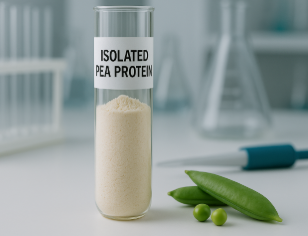
Isolated pea protein
(from seeds of Pisum sativum L.; family Fabaceae )
Description
• Highly purified plant protein ingredient obtained from yellow peas using wet fractionation, delivering a typical 80–90% protein (dry basis) with neutral-to-beany flavour depending on refinement.
• Offered as spray-dried powders (native or instantised/lecithinated) and sometimes as textured pea protein (TPP) for meat analogues.
• Functional profile includes emulsification, foaming, gelation, water/oil binding, and viscosity build; solubility follows a U-shaped pH-solubility curve with a minimum near the isoelectric point (~pH 4.5).
Indicative nutrition values (typical ranges; per 100 g powder unless stated)
• Energy: 360–420 kcal
• Protein: 80–90 g (complete EAA pattern; limiting sulphur amino acids)
• Carbohydrate: 1–8 g (of which sugars ≤1–2 g)
• Fibre: 2–8 g (dietary fibre, mostly insoluble; process-dependent)
• Fat: 1–9 g — SFA (saturated fatty acids — advisable to keep low overall), MUFA and PUFA minor
• Sodium: 200–900 mg (process-dependent; sodium-reduced grades available)
• Minerals (typical): potassium 100–1200 mg, iron 5–30 mg (bioavailability varies), calcium 50–200 mg
• Amino acids (per 100 g protein): leucine ~7.5–8.5 g; lysine ~6.5–7.5 g; methionine+cysteine ~1.4–2.0 g; BCAA total ~16–20 g
Key constituents
• Storage proteins: legumin (11S) and vicilin (7S) globulins; minor convicilin—determine gel and emulsifying behaviour.
• Residual carbohydrates: small amounts of starch, oligosaccharides (raffinose/stachyose, FODMAP relevance at high doses).
• Lipids & phospholipids: low level; contribute to flavour/oxidation if not well refined.
• Antinutritional factors (residual): phytate, trypsin inhibitors, lectins—typically reduced by processing.
• Process aids: instantised grades may contain lecithin (sunflower) for dispersion; sodium or calcium salts may be present from pH adjustment.
Production process
• Milling & flouring: cleaned dehulled peas → pea flour.
• Protein solubilisation: suspend in water; adjust to alkaline pH (~8–9) to solubilise proteins and separate starch/fibre (screening/centrifugation).
• Recovery: isoelectric precipitation near pH 4.5 (or membrane concentration) → protein curd.
• Neutralisation & washing: adjust pH to ~7; wash to reduce salts/oligosaccharides.
• Heat treatment: pasteurise to reduce micro/inhibitors (balance against functionality).
• Drying & finishing: spray-dry; optional lecithination for instant dispersion; sieve/blend to spec.
• Texturing (optional): extrusion to produce TPP/TVP particulates or mince-like strands.
Sensory and technological properties
• Flavour: neutral to mild beany/green; off-notes reduced with aroma stripping, de-oiling, and selective refining.
• Solubility: lowest at ~pH 4.5; improves at pH <3.5 (acid beverages) and pH >7 (bases/soups). Salt and shear can enhance dispersion.
• Emulsification & foaming: strong interfacial activity; stabilises oil-in-water systems; foams best at pH away from pI.
• Gelation/texture: heat-induced gelation (~75–95 °C) yields elastic/firm gels; synergistic with starches, fibres, carrageenan, and CMC.
• Water/oil holding: high WHC/OHC supports juiciness in meat analogues and moisture retention in bakery.
• Thermal/processing: partial denaturation improves functionality; excessive heat reduces solubility and PDCAAS/DIAAS slightly.
Food applications
• Beverages & shakes: RTD and powders (typically 5–10% protein in drink; instantised grades for dispersibility).
• Dairy alternatives: yoghurts, puddings, ice-cream bases (with hydrocolloids for stability).
• Meat analogues: burgers, nuggets, sausages with PPI + binders; TPP for fibrous bite.
• Bakery & snacks: protein-enriched breads, cookies, extruded snacks, high-protein bars (beware hardening over shelf-life).
• Culinary: soups, sauces, emulsified dressings as an emulsifier/stabiliser.
• Nutrition: sport and medical nutrition where plant protein and low allergenicity are desired.
Nutrition & health
Pea protein isolate provides a high-quality amino acid profile with robust lysine and leucine content; the sulphur amino acids (methionine+cysteine) are relatively lower and can be complemented with rice protein or cereal proteins in blended formulas. Human protein-quality metrics are favourable (adult PDCAAS commonly near 0.8–1.0; DIAAS varies by process and age group).
Digestibility is generally high, and residual antinutrients (phytate, trypsin inhibitors) are reduced by soaking/alkaline extraction/heat; nevertheless, very high doses may cause GI discomfort in sensitive individuals due to FODMAP oligosaccharides.
Fat is low overall, keeping SFA low with only minor MUFA/PUFA; this supports lipid-conscious formulations. Sodium can be elevated in some isolates because of neutralisation salts—sodium-reduced or ion-exchanged grades mitigate this.
From an allergy standpoint, pea is not a major priority allergen in many jurisdictions, but legume cross-reactivity (e.g., with peanut/lupin) can occur in susceptible individuals. Iron levels are often labelled as a benefit, though non-heme bioavailability depends on formulation and meal context (vitamin C, phytate level).
For athletes and older adults, 20–40 g per serving typically supplies 2–3 g leucine, hitting the usual mTOR activation threshold comparable to dairy proteins when dosed appropriately.
Portion note: Common serving sizes are 25–35 g powder in beverages/shakes; in solid foods, inclusion is recipe-specific (often 5–20% of formula for enrichment; higher in meat analogues with binders and fats).
Quality and specifications (typical topics)
• Protein: ≥80–90% d.b. (Kjeldahl/Dumas; N×6.25). PDI/solubility index per spec (native vs instantised).
• Moisture: ≤8% (typical); ash within grade limits; pH ~6.5–7.5 (1:10 slurry).
• Microbiology: pathogens absent/25 g; APC/yeasts/moulds in spec; Cronobacter absence for infant uses.
• Contaminants: heavy metals within limits; pesticide residues ≤ MRL; mycotoxins not typical for peas but monitored.
• Antinutrients: phytate, trypsin inhibitors monitored where relevant; lectins reduced by heat.
• Functional tests: NSI/PDI, emulsifying/foaming capacity, gel strength, particle size, bulk density, and dispersibility.
• Sensory: beany/green notes, astringency, grittiness; peroxide and volatiles for oxidation control.
Storage and shelf-life
• Store cool, dry, and dark (<25 °C; RH <65%) in sealed, oxygen/light-barrier bags; avoid odour pickup.
• Shelf-life: typically 18–24 months unopened; after opening, use promptly and reseal with desiccant.
• Risks: flavour oxidation, moisture caking, loss of instantisation, and gradual hardening in high-protein bars.
Safety and regulatory
• Generally recognised as safe (GRAS, product-specific) in the US and widely accepted globally as a food ingredient; not a novel food in many jurisdictions when produced traditionally.
• Allergen labelling: pea is usually not a listed priority allergen; however, declare legume source and manage cross-contact.
• Gluten-free by nature; verify against <20 ppm threshold for claims.
• Produced under GMP/HACCP; for infant foods, meet stricter microbiological and contaminant criteria.
Labeling
• Name of the ingredient: “pea protein isolate” (and “instantised” or “lecithinated” if applicable); disclose sunflower lecithin if used.
• Nutrition facts with protein per serving; amino acid profile optional but useful in sports nutrition.
• Claims: “vegan”, “gluten-free”, “non-GMO” as substantiated; protein-quality claims must follow local rules (e.g., PDCAAS/DIAAS usage).
Troubleshooting
• Chalky/gritty mouthfeel → particle size too coarse or poor dispersion → use instantised grade, increase shear/hydration time, reduce solids, or add small hydrocolloids.
• Beany/green off-notes → oxidation or native volatiles → select low-beany grades, add flavour maskers, include ascorbate/RO deodorisation, manage oxygen.
• Precipitation in acid beverages → pH near pI or heat-denatured proteins → formulate at pH ≤3.5, use stabilisers, or apply enzymatic hydrolysis/modified isolates.
• Weak gel/emulsion → low ionic strength or wrong pH/thermal profile → adjust salt/pH, raise protein %, or blend with starches/fibres.
• Bar hardening over shelf-life → Maillard/crosslinking and moisture migration → adjust polyol/glycerol system, add humectants, lower water activity, consider hydrolysed pea protein fraction.
Sustainability and supply chain
• Low GHG and water footprint versus animal proteins; peas enrich soils via biological nitrogen fixation.
• By-products (starch, fibre) valorised in foods/feeds; manage factory effluents toward BOD/COD targets; implement heat/water recovery.
• Prefer EU/NA supply chains with traceability, agronomic data, and pesticide stewardship; audit under GMP/HACCP.
INCI functions (cosmetics)
• Pisum Sativum (Pea) Protein / Hydrolyzed Pea Protein: film-forming, conditioning (skin/hair), and humectant properties; supports hair strength/feel at low %. Usage and claims subject to cosmetic regulations.
Conclusion
Pea protein isolate is a versatile, allergen-lean plant protein with solid functionality across beverages, dairy alternatives, meat analogues, bakery, and nutrition. Success depends on matching grade (native vs instantised vs textured) to application, controlling pH/ionic strength/thermal profile, and managing flavour and particle size for the target sensory experience.
Mini-glossary
• SFA: Saturated fatty acids — excessive intake may raise LDL; pea protein is naturally low.
• MUFA / PUFA: Monounsaturated / polyunsaturated fatty acids — minor in isolates; more relevant to added fats in recipes.
• PDCAAS: Protein digestibility-corrected amino acid score — legacy protein-quality metric (capped at 1.0).
• DIAAS: Digestible indispensable amino acid score — newer protein-quality metric based on ileal digestibility.
• EAA: Essential amino acids — must be supplied by diet; balance matters for quality.
• BCAA: Branched-chain amino acids (leucine, isoleucine, valine) — key for muscle protein synthesis.
• PDI/NSI: Protein dispersibility/solubility indices — indicate ease of dispersion in water.
• TPP/TVP: Textured pea/vegetable protein — extruded, fibrous forms for meat analogues.
• FODMAP: Fermentable oligo-, di-, mono-saccharides and polyols — can cause GI symptoms in sensitive individuals.
• GMP/HACCP: Good manufacturing practice / hazard analysis and critical control points — preventive hygiene/process-control systems.
• BOD/COD: Biochemical/chemical oxygen demand — wastewater impact metrics guiding treatment.
Studies
In a controlled diet, daily consumption of whole and fractionated yellow pea meal at doses equivalent to half a cup of yellow peas reduced insulin resistance in hypercholesterolaemic, while whole pea meal reduced android adiposity in women (1).
Purified peptides extracted from Pisum sativum have demonstrated a broad spectrum of antibacterial activity that can be used as a selective agent against infections and bacteria (2).
This study informs us that as the skin ages, impairment of extracellular matrix protein synthesis and increased action of degradative enzymes manifest as atrophy, wrinkles, and laxity. There is growing evidence for the functional role of exogenous peptides in many areas, including in offsetting the effects of skin aging. Here, using an artificial intelligence approach, RTE62G, a natural and unmodified peptide with extracellular matrix stimulatory properties, was identified. The predicted anti-aging properties of RTE62G peptide were then validated through in vitro, ex vivo, and proof-of-concept clinical trials (3).

