



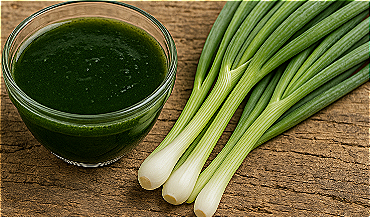
Green onion extract
(from leaves and tender pseudostems of Allium fistulosum L., and/or young Allium cepa ; family Amaryllidaceae )
Description
• Concentrated flavour ingredient obtained by extracting chopped green onion with food-grade solvents (water, hydroalcoholic systems, glycerol) and optionally concentrating or spray-drying to a powder; may also be produced as a clarified liquid.
• Delivers clean scallion/green-onion notes without particulates; available as single-strength liquids, concentrates, or powder on carriers (e.g., maltodextrin).
• Typical targets (liquids): °Brix 0.2–4.0 depending on style; pH ~5.3–6.2 (low-acid → validated heat treatment required); clarity from clear to lightly hazy per filtration grade.
Indicative nutrition values (composition varies by solvent/strength; examples below)
• Liquid, unsalted, single-strength (per 100 ml): energy 0–5 kcal; carbohydrate 0–1.0 g (sugars ≤0.5 g); protein 0–0.3 g; fat ~0 g — SFA (saturated fatty acids; advisable to keep low overall) minimal; MUFA/PUFA negligible; sodium <20 mg; potassium 10–60 mg.
• Spray-dried powder on carrier (per 100 g): energy 200–380 kcal (carrier-driven); carbohydrate 45–95 g (sugars 2–10 g); fibre 1–5 g; protein 2–10 g; fat 0–2 g (SFA minimal); sodium formulation-dependent (often low unless salted).
Key constituents
• S-alk(en)yl-L-cysteine sulfoxides (ACSOs): methiin, isoalliin (onion precursors).
• Thiosulfinates/disulfides (formed after cutting by alliinase): e.g., dipropyl disulfide family driving onion aroma; decline with heat and oxygen.
• Fructans (FOS): short-chain inulin-type oligosaccharides (reduced in clarified liquids; higher in whole-juice or powder styles).
• Phenolics/flavonoids: quercetin/kaempferol derivatives (low in clarified liquids), traces of chlorogenic acids.
• Minerals/organic acids: potassium prominent; traces of malate/citrate.
• To control: excessive reactive sulfur (harshness), pesticide residues ≤ MRL, heavy metals, elevated 5-HMF (over-heating).
Production process
• Raw material: fresh, sound green onions; trim roots/damaged tissue; optional blanch to soften pungency.
• Extraction: maceration or short infusion in potable water (or hydroalcoholic/glycerol), with tight time/temperature/oxygen control.
• Clarification: coarse filtration → fining/centrifugation (optional) → polishing filtration; deaeration to limit oxidation and aroma loss.
• Standardisation: adjust °Brix/pH; optional aroma capture/return.
• Concentration (where applicable): mild vacuum evaporation.
• Drying (powder styles): spray-drying on carriers (e.g., maltodextrin), set water activity and particle size; anti-caking as permitted.
• Thermal processing & packing: HTST + aseptic fill for liquids or retort for jars; barrier packs (light/O₂) with reduced headspace (nitrogen).
Sensory and technological properties
• Aroma/flavour: fresh green-onion leaf; heat develops sweet, lightly caramelised onion notes.
• Functionality: contributes savoury top-notes and mild sulfur cues; participates in Maillard under heat; slight reducing capacity.
• Solubility: liquids disperse readily; powders reconstitute in water; emulsions may need stabilisers in high-fat systems.
• Stability: sulfur volatiles are oxygen/heat-labile → gradual flavour fade; clarified styles remain clear if well filtered.
Food applications
• Soups, broths, sauces, gravies, dressings (clean onion note without particulates).
• Marinades/glazes, pickling brines; rice/noodle/vegetable seasonings.
• Plant-based meats and meat systems (binder brines, emulsions) for top-note onion flavour.
• Snack seasonings, culinary concentrates/cubes, ready meals.
• Dry blends (powder extract) where consistent dispersion and shelf stability are needed.
Nutrition & health
Green onion extract contributes flavour with minimal energy and negligible fat in liquid styles; powder nutrition is largely defined by the carrier. Fibre and many micronutrients present in whole scallions are reduced by clarification, so whole vegetables or purées provide more dietary fibre and phytochemicals.
The extract carries onion sulfur precursors and some thiosulfinates, which underpin flavour and show antimicrobial activity in model systems. In real foods their levels are modest and decline with heating and storage.
People sensitive to FODMAPs should note that fructans can persist—usually low in clarified liquids but tolerance is individual. Sodium is not inherent; keeping added salt modest enables low-sodium formulations.
Portion note: Typical usage 0.05–0.5% (w/w or v/v) in finished foods for liquids; 0.1–1.0% for powder extracts, titrated by sensory trials and extract strength.
Quality and specifications (typical topics)
• Identity/composition: solids (°Brix or dry matter), pH, titratable acidity; pyruvate test (pungency index); volatile sulfur profile (if instrumented).
• Appearance: clarity/turbidity (NTU), colour (APHA/CIELAB), absence of sediments.
• Chemistry: low 5-HMF; peroxide value (if any lipid phase) minimal; ethanol/residual solvent within legal limits for hydroalcoholic extracts.
• Residues/contaminants: pesticides ≤ MRL; heavy metals within limits; sulphites declared if used/≥10 mg/kg.
• Microbiology: pathogens absent/25 g; APC/yeasts/moulds per spec; water activity controlled for powders.
• Functional: heat-step flavour retention, light/O₂ stress, salt/acid compatibility; bulk density and particle size (powders); carrier % and anti-caking level.
Storage and shelf-life
• Store cool, dark, and dry; avoid temperature cycling.
• Liquids (aseptic ambient): typically 9–12 months; after opening refrigerate 0–4 °C, use within 3–7 days.
• Powders: barrier packaging (moisture/oxygen/light); 12–24 months typical; keep tightly sealed.
• Main risks: flavour fade (loss of sulfur volatiles), slight yellowing, haze/sediment if filtration was mild; caking in powders if humidity rises.
Safety and regulatory
• Designations: “green onion extract”, “spring onion extract”, or botanical “Allium fistulosum extract,” with solvent/carrier disclosure as required.
• Category: culinary flavouring/vegetable extract; liquids at pH >4.6 are low-acid and require validated thermal schedules under GMP/HACCP.
• Allergen/intolerance: Allium sensitivity is uncommon but reported; note FODMAP considerations.
• Claims: flavouring use; nutrition/health claims generally not applicable unless fortified or compositionally qualified; residual solvent limits apply where ethanol is used.
Labeling
• Name of ingredient, botanical source, solvent/carrier (e.g., water; ethanol; glycerol; maltodextrin), and any antioxidants/acids.
• Declare added salt if present; origin/lot/date marking; storage instructions.
• Optional “no added salt/no added sugar” where applicable.
Troubleshooting
• Harsh/metallic sulfur notes: over-extraction or metal contact → shorten extraction time/temperature, avoid Cu/Fe, consider chelators where permitted.
• Weak flavour: excessive heat/oxygen → shorten thermal holds, deaerate, use aroma capture/return.
• Browning/yellowing: non-enzymatic reactions → lower heat load, protect from light/O₂.
• Haze/sediment: insufficient clarification → tighten filtration/centrifugation; cold stabilise before filling.
• Caking (powders): high humidity → improve barrier pack, add permitted anti-caking, include desiccant.
Sustainability and supply chain
• Raw material: valorise field trim/off-grade sizes; seasonal contracts to cut waste.
• By-products: spent solids to compost, feed, or bioenergy.
• Operations: heat/air recovery, CIP water reuse, wastewater treatment toward BOD/COD targets; recyclable/lightweight packaging.
• Systems: supplier audits, traceability, pesticide-residue programs under GMP/HACCP.
Conclusion
Green onion extract is a clean-label flavour tool that provides bright scallion notes with excellent processability in liquid and dry systems. Success depends on fresh raw material, oxygen/heat management, clarification/drying quality, and protective packaging, matched to the target intensity and application.
INCI functions (cosmetics)
• Allium Fistulosum (Green Onion) Extract: skin-conditioning; antioxidant claim potential linked to phenolics; characteristic odour to be managed in formulation; usage and claims subject to local cosmetic regulations.
Mini-glossary
• SFA: Saturated fatty acids — high intakes can raise LDL-cholesterol; desirable to keep low overall.
• MUFA: Monounsaturated fatty acids — favourable when replacing saturates.
• PUFA: Polyunsaturated fatty acids — include n-6/n-3 families; beneficial when balanced and protected from oxidation.
• ACSOs: S-alk(en)yl-L-cysteine sulfoxides, the non-volatile onion precursors that generate flavour volatiles via alliinase.
• FODMAP: Fermentable carbohydrates that can trigger GI symptoms in sensitive people (onion fructans are FODMAPs).
• 5-HMF: 5-hydroxymethylfurfural, a marker of excessive heat/sugar degradation.
• MRL: Maximum residue limits for pesticides on foods.
• GMP/HACCP: Good manufacturing practice / hazard analysis and critical control points — preventive hygiene/process-control systems.
• BOD/COD: Biochemical/chemical oxygen demand — wastewater impact metrics guiding treatment and discharge limits.

