



Dried onion (Allium cepa)
Description
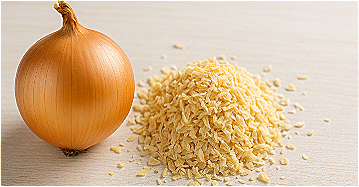
Dehydrated ingredient made from peeled, trimmed fresh onions that are sliced/diced and dried; available as flakes, minced/granulated, and powder, including toasted or caramelized variants.
Sensory profile: sweet–sulfurous aroma with umami and roasted notes (if toasted); color white–cream to straw yellow.
Positioning: clean-label flavor base for seasonings, soups/sauces, snacks, and ready meals; convenient alternative to fresh onion.
Caloric value (per 100 g dry product)
~320–360 kcal; carbohydrates ~70–85 g (including sugars and fructans), fiber ~8–15 g, protein ~8–12 g, fat <1.5 g, sodium low. Typical use levels are modest (≈0.2–5% of recipe).
Key constituents
Sulfur precursors: cysteine sulfoxides (e.g., isoalliin). With alliinase, they form volatile sulfides and the lachrymatory factor (syn-propanethial-S-oxide).
Thermal sulfur compounds: thiosulfinates, sulfides, thiols; pyrazines and Maillard notes in toasted types.
Carbohydrates: fructans (FOS, FODMAP), glucose/fructose, sucrose.
Phenolics/flavonoids: quercetin (higher in darker varieties).
Minerals: notably potassium, manganese; moisture typically ≤5–7% in spec.
Production process
Raw prep: sorting, peeling, trimming, slicing/dicing.
Drying: low-temperature hot air with controlled airflow; optional light toasting/caramelization for “roasted/sweet” profiles.
Milling: calibrated into flakes/granules/powder; cooled/cryogenic milling may be used to retain volatiles.
Decontamination: steam treatment or irradiation where permitted; possible anticaking agents (silicon dioxide, tricalcium phosphate) must be declared.
QC: moisture/a_w, particle size (mesh), color (L, a, b*)**, micro load, residues.
Sensory and technological properties
Rehydration: fast water uptake; 1 g dry yields ~5–8 g rehydrated; fresh equivalence ~7–9:1 by weight.
Flavoring power: high and standardizable; powder disperses uniformly in dry blends.
Process stability: good at low a_w; extended heat reduces sharp sulfur notes and boosts sweet/roasted tones.
Color development: prone to Maillard browning in matrices rich in reducing sugars + amino acids (manage pH/time/temp).
Food applications
Seasonings/rubs: for snacks, meats/plant-based, dry sauces.
Soups, sauces, ready meals: clean-label base (flakes/granules provide piece identity).
Bakery/savory: onion breads, crackers, grissini (monitor Maillard and color).
Cured/plant-based meats: powder adds umami and natural sweetness; can aid binding with proteins/fibers.
Snacks & extrusion: post-cook seasoning; compatible with plant milks and creamy sauces.
Nutrition and health
Source of fiber (partly fructans) and flavonoids (e.g., quercetin).
FODMAP: fructans may cause bloating in sensitive consumers → control dose or use natural onion-type flavors designed low-FODMAP where needed.
Sodium: naturally low (watch blended seasonings for added salt).
Fat profile
Total fat is negligible; first occurrence: SFA — saturated fatty acids (best kept moderate overall); MUFA — monounsaturated fatty acids (often neutral/beneficial); PUFA — polyunsaturated fatty acids (beneficial when balanced). For dried onion, lipid impact is trivial.
Quality and specifications (typical topics)
Moisture ≤5–7%, low a_w, mesh to application (e.g., 40–80 mesh for powder).
Microbiology: pathogens absent/25 g; controlled TAMC/yeasts/molds (steam-treated options available).
Residues/contaminants: pesticides/metals within limits; sulfites if used must be declared.
Sensory: no mold/musty notes, clean aroma; uniform color without scorching.
Storage and shelf life
Store cool, dry, dark, in airtight, moisture-barrier packs; avoid odors and humidity (caking).
Typical shelf life 18–24 months unopened; once opened, reseal and use within a few weeks.
Allergens and safety
Not a major allergen, though Alliaceae sensitivities exist.
Declare sulfites where present as preservers/anti-browning agents.
Gluten-free by nature; manage cross-contact in facilities.
INCI functions in cosmetics (where applicable)
INCI: Allium Cepa Bulb Powder / Allium Cepa Bulb Extract.
Roles: antioxidant/skin-conditioning; consider odor and potential sensitization in leave-on formats.
Troubleshooting
Caking/lumps: upgrade moisture barrier, use anticaking (e.g., SiO₂) or agglomerated powder.
“Raw” note in sauces: toast lightly in fat before adding water, or choose toasted grade.
Excess browning in bakery: reduce time/temperature, adjust pH, or swap powder for granules.
Burn specks on snacks: lower frying temp, improve seasoning distribution, select finer mesh.
Sustainability and supply chain
Dehydration reduces food waste and transport mass/volume, valorizing seasonal surpluses.
In-plant: improve drying energy efficiency/heat recovery, manage effluents toward BOD/COD targets, use recyclable packaging, and maintain robust GMP/HACCP and traceability.
Labelling
Name: “dried onion” with form (flakes/granules/powder) and any treatment (toasted, steam-treated).
Additives: declare anticaking agents or sulfites where present; organic origin when applicable.
Allergens: none specific, but sulfites >10 mg/kg (as SO₂) must be labeled.
Conclusion
Dried onion delivers concentrated flavor, ease of use, and stable performance across seasonings to shelf-stable meals. Selecting the right cut, toast level, and mesh, together with careful moisture and heat management, ensures sensory consistency, safety, and a clean label.
Mini-glossary
FODMAP: Fermentable carbohydrates that may cause bloating (here mainly fructans).
FOS (fructo-oligosaccharides): Short-chain fructans with prebiotic effects; useful yet problematic for low-FODMAP diets.
a_w (water activity): Measure of “free” water; lower values improve stability and safety of dry goods.
Mesh: Particle-size index (sieve rating); higher number = finer particles.
L, a, b*:** CIELAB color coordinates: L* (lightness), a* (green↔red), b* (blue↔yellow).
TAMC: Total aerobic mesophilic count; general hygiene indicator (with yeasts/molds and pathogen absence).
GMP/HACCP: Good manufacturing practice / hazard analysis and critical control points—preventive food-safety systems with defined CCPs.
BOD/COD: Biochemical/chemical oxygen demand—wastewater impact metrics guiding treatment.
SiO₂ (silicon dioxide): Anticaking agent used in powders; must be declared if present.
SO₂ / sulfites: Preservers/anti-browning agents; mandatory labeling above regulatory thresholds.
SFA — saturated fatty acids; MUFA — monounsaturated fatty acids; PUFA — polyunsaturated fatty acids. (Fat is negligible in dried onion.)
Studies
Onions have antibacterial properties and can help reduce the risk of certain chronic diseases. Quercetin, found in onions, has been linked to preventing age-related diseases such as diabetes, cancer, and neurodegenerative diseases.
Animal studies have shown the effectiveness of onion as an anticoagulant.
Human studies have found the usefulness of onion combined with other vegetables to prevent cardiovascular problems.
As an anti-inflammatory, a component of the onion, Onionin A found in the bulb, has been shown to perform an action to counteract inflammatory blood activity (1).
There would also appear to be an action to improve the balance of blood sugar.

It is recommended, along with garlic, shallots and chives to prevent prostate cancer (2).
The best known red onions in Italy are the red head of Tropea and Certaldo.
Red onion studies
References________________________________________________________________________
(1) Fujiwara Y, Horlad H, Shiraishi D, Tsuboki J, Kudo R, Ikeda T, Nohara T, Takeya M, Komohara Y. O
(1) Fujiwara Y, Horlad H, Shiraishi D, Tsuboki J, Kudo R, Ikeda T, Nohara T, Takeya M, Komohara Y. Onionin A, a sulfur-containing compound isolated from onions, impairs tumor development and lung metastasis by inhibiting the protumoral and immunosuppressive functions of myeloid cells. Mol Nutr Food Res. 2016 Nov;60(11):2467-2480. doi: 10.1002/mnfr.201500995.
(2) Colli JL, Amling CL. Chemoprevention of prostate cancer: what can be recommended to patients? Curr Urol Rep. 2009 May;10(3):165-71. Review.
Abstract. Prostate cancer is third to lung and colon cancer as the cause of cancer-related deaths in American men. It is estimated that there will have been more than 28,000 deaths and 186,000 new cases in 2008 that will impose a significant burden on national health care costs. Chemoprevention aims to reduce both incidence and mortality through the use of agents to prevent, reverse, or delay the carcinogenic process. This study provides clinicians with information on some chemoprevention agents that have been considered to reduce prostate cancer risks, including 5-alpha-reductase inhibitors; statins (a class of compounds used to reduce cholesterol); NSAIDs; selenium; vitamins E and D; lycopene; allium vegetables (garlic, scallions, onions, chives, and leeks); soy/isoflavones; and green tea polyphenols. The evidence to support prostate cancer risk reduction benefits for each chemoprevention agent based on a review of the literature is provided.
Tsuboki J, Fujiwara Y, Horlad H, Shiraishi D, Nohara T, Tayama S, Motohara T, Saito Y, Ikeda T, Takaishi K, Tashiro H, Yonemoto Y, Katabuchi H, Takeya M, Komohara Y. Onionin A inhibits ovarian cancer progression by suppressing cancer cell proliferation and the protumour function of macrophages. Sci Rep. 2016 Jul 12;6:29588. doi: 10.1038/srep29588.
Abstract. It is well known that tumour-associated macrophages (TAMs) play an important role in tumour development by modulating the tumour microenvironment, and targeting of protumour activation or the M2 polarization of TAMs is expected to be an effective therapy for cancer patients. We previously demonstrated that onionin A (ONA), a natural low molecular weight compound isolated from onions, has an inhibitory effect on M2 macrophage polarization. In the present study, we investigated whether ONA had a therapeutic anti-ovarian cancer effect using in vitro and in vivo studies. We found that ONA reduced the extent of ovarian cancer cell proliferation induced by co-culture with human macrophages. In addition, we also found that ONA directly suppressed cancer cell proliferation. A combinatorial effect with ONA and anti-cancer drugs was also observed. The activation of signal transducer and activator of transcription 3 (STAT3), which is involved in cell proliferation and chemo-resistance, was significantly abrogated by ONA in ovarian cancer cells. Furthermore, the administration of ONA suppressed cancer progression and prolonged the survival time in a murine ovarian cancer model under single and combined treatment conditions. Thus, ONA is considered useful for the additional treatment of patients with ovarian cancer owing to its suppression of the protumour activation of TAMs and direct cytotoxicity against cancer cells.
Li Q, Wang Y, Mai Y, Li H, Wang Z, Xu J, He X. Health Benefits of the Flavonoids from Onion: Constituents and Their Pronounced Antioxidant and Anti-neuroinflammatory Capacities. J Agric Food Chem. 2020 Jan 22;68(3):799-807. doi: 10.1021/acs.jafc.9b07418.
Abstract. Onion is the most widely cultivated vegetable around the world. In this study, the isolation, concentration, quantification, and bioactivity evaluation of the phenolics in onion peels were investigated. Thirty-four phenolics, including 17 flavonoids and 17 nonflavonoid phenolics, were purified and identified. Among them, there were 2 new unusual epoxyflavanones and a new phenolic constituent, as well as 13 unreported constituents from the genus Allium. The total flavonoids were concentrated, and finally obtained 90.25% of flavonoid content extract. Fifteen main flavonoids were quantified using an ultra-performance liquid chromatography-photodiode array (UPLC-PDA), and quercetin (36.94%) and quercetin 4'-O-β-d-glucopyranoside (15.81%) were the richest contents of flavonoids. The antioxidant and anti-neuroinflammatory capacities were evaluated, and the bioactive results indicated that the flavonoids in onion exhibited pronounced activities. The study suggested that the flavonoids in onion peels could be used in functional food.
Yoo Y, Kim S, Lee W, Kim J, Son B, Lee KJ, Shin H. The prebiotic potential of dietary onion extracts: shaping gut microbial structures and promoting beneficial metabolites. mSystems. 2025 Jan 21;10(1):e0118924. doi: 10.1128/msystems.01189-24.
Abstract. Onions are well-known vegetables that offer various health benefits. This study explores the impact of onion extracts on gut microbiome using an in vitro fecal incubation model and metabolome analysis. Fecal samples were collected from 19 healthy donors and incubated in the presence or absence of onion extracts for 24 h. To reduce inter-individual variability in the gut microbiome, we employed enterotyping based on baseline fecal microbiota: 14 subjects with a Bacteroides-dominant type (enterotype B) and 5 subjects with Prevotella-dominant type (enterotype P). Alpha diversity was significantly reduced in the onion-treated group compared to the non-treated control group in both Bacteroides- and Prevotella-dominant types. However, significant structural differences in bacterial communities were observed based on weighted UniFrac distance. Notably, short-chain fatty acid (SCFA)-producing bacteria, such as Bifidobacterium_388775, Feacalibacterium, and Fusicatenibacter, were overrepresented in response to onion extracts in enterotype B. Furthermore, genes related to butyrate production were significantly overrepresented in the onion-treated group within enterotype B. Consistent with the enriched taxa and the predicted metabolic pathways, SCFAs and their related metabolites were significantly enriched in the onion-treated group. Additionally, tryptophan metabolism-derived metabolites, including indolelactate (ILA) and indolepropionate (IPA), were elevated by 4- and 32-fold, respectively, in the onion-treated group compared to the control group. In vitro growth assays showed an increase in lactobacilli strains in the presence of onion extracts. These results provide evidence that onion extracts could serve as promising prebiotics by altering gut microbial structure and promoting the production of beneficiary metabolites, including SCFAs and indole derivatives, and enhancing the growth of probiotics.IMPORTANCEThis study is significant as it provides compelling evidence that onion extracts have the potential to serve as effective prebiotics. Utilizing an in vitro fecal incubation model and enterotyping to reduce inter-individual variability, the research demonstrates how onion extracts can alter gut microbial structure and promote the production of beneficial metabolites, including SCFAs and indole derivatives like ILA and IPA. Additionally, onion extract treatment enhances the growth of beneficial probiotics. The findings underscore the potential of onion extracts to improve gut health by enriching specific beneficial bacteria and metabolic pathways, thereby supporting the development of functional foods aimed at improving gut microbiota composition and metabolic health.
Dorrigiv M, Zareiyan A, Hosseinzadeh H. Onion (Allium cepa) and its Main Constituents as Antidotes or Protective Agents against Natural or Chemical Toxicities: A Comprehensive Review. Iran J Pharm Res. 2021 Winter;20(1):3-26. doi: 10.22037/ijpr.2020.112773.13940.
Abstract. Onion (Allium cepa) is a member of the family Amaryllidaceae and one of the most widely cultivated species of the genus Allium. Onion has plentiful chemical compounds such as allicin, quercetin, fisetin, other sulphurous compounds: diallyl disulphide and diallyl trisulphide. Onion and its main components in specific doses have shown a lot of benefits including free-radical scavenging and antioxidant properties, anticholesterolemic, anti-heavy metals toxicity, antihyperuricemia, antimicrobial, anti-gastric ulcer, and anticancer. This study summarizes numerous in-vitro and animal studies on the protective effects of onion against natural and chemical toxicities. Onion and its main components can ameliorate the toxicity of chemical agents in kidney, liver, brain, blood, heart, reproductive system, embryo, pancreas through reducing lipid peroxidation, antioxidant effect, radical-scavenging, anti-inflammatory, chelating agent, cytoprotective activities, increasing protein synthesis in damaged tissues, suppressing apoptosis, as well as modulation of PKC-

