



Chickpea (garbanzo) flour (Cicer arietinum)
Description
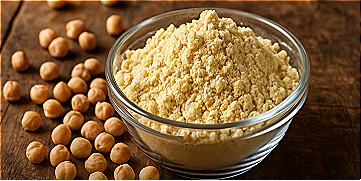
Legume flour milled from whole or dehulled chickpeas, typically to a fine/medium-fine granulation; also known as besan/gram flour.
Sensory profile: nutty–lightly toasted flavor with subtle earthy notes; color ranges from pale yellow to light amber.
Functional traits: high water absorption, strong binding and body, foaming/emulsifying capacity (protein + saponins), and good starch gelation on cooking.
Caloric value (per 100 g, powder)
~360–390 kcal; protein 20–23 g; carbohydrates 55–62 g (of which fiber 9–12 g); fat 5–7 g; sodium low (↑ if salted).
Sulphur amino acids (methionine/cysteine) are limiting → complement with cereals to balance the profile.
Key constituents
Proteins: storage fractions 7S vicilin, 11S legumin, convicilin.
Complex carbohydrates: starch (↑ RS3 — resistant starch after cook–cool), soluble/insoluble fibers.
Lipids: modest total fat, mainly PUFA (polyunsaturated fatty acids; e.g., linoleic n-6, potentially beneficial when balanced; more oxidation-prone) and MUFA (monounsaturated fatty acids; e.g., oleic n-9, often neutral/beneficial), with low SFA (saturated fatty acids; best kept moderate overall).
Phytochemicals: saponins, phytosterols, polyphenols; phytates (mineral chelators, reduced by processing).
Minerals/vitamins: folate, manganese, magnesium, phosphorus, potassium, iron (bioavailability ↑ with vitamin C/fermentation).
Production process
Cleaning and selection → optional dehulling → optional light roasting/thermal stabilisation (to soften “beany” notes and inactivate enzymes) → milling (roller/stone/pin) → sieving to target particle size → barrier packaging.
Typical QC: moisture (e.g., ≤12–13%), protein (N×6.25), ash, granulation (d50/d90), color (L, b)**, fresh aroma; microbiology (pathogens absent/25 g), metals/pesticides within limits.
Sensory and technological properties
High water uptake → viscosity/body in batters, sauces, and fillings.
Foaming/emulsifying (an aquafaba-like effect) supports egg-free mayo and whipped desserts.
Thermal starch gel provides structure; retrogradation on cooling ↑ RS3 and firmness.
Protein coagulation synergises with acids/salts; Maillard browning in dry-heat processing.
Food applications
Traditional: socca/farinata, pakora/bhaji, panelle, laddu, sev.
Gluten-free & plant-based: legume pasta/gnocchi, burgers and fritters (binder), vegan omelettes/frittatas (with water/plant milk), white sauces/veloutés as a thickener.
Hybrid baking: 10–30% blends with cereal flours for protein, color, and aroma.
Snacks & coatings: crisp batters, crackers, breadsticks, protein bars.
Nutrition and health
High fiber (satiety, transit, glycaemic control) and good protein quality yet incomplete → pair with grains.
Glycaemic index (GI) low–moderate; cook–cool cycles ↑ RS3 and can further lower GI.
Antinutrients (phytates, tannins, trypsin inhibitors) are reduced by soaking, fermentation, sprouting, roasting, or thermal treatment.
Possible FODMAP (oligosaccharides): in sensitive individuals, portion control and adequate hydration help.
Fat profile
Moderate total fat; predominantly PUFA (potentially beneficial when balanced; more oxidation-prone) and MUFA (often neutral/beneficial), with low SFA. TFA (trans fatty acids) negligible; MCT (medium-chain triglycerides) not significant.
Quality and specifications (typical topics)
Identity/purity: moisture ≤12–13%, free of pests/foreign matter, fresh, non-rancid aroma.
Composition: protein (e.g., ≥20%), ash within spec, stable color and granulation for the target recipe.
Functionality: water absorption, viscosity (Brookfield), emulsion/foam stability, binding power.
Microbiology: pathogens absent, yeasts/molds low; mycotoxins/metals/pesticides compliant.
Packaging: barrier to moisture/oxygen/light (limit lipid oxidation).
Storage and shelf life
Store cool, dry, away from light/odors, in an airtight container; avoid humidity (caking).
Shelf life: typically 6–12 months (best quality when fresh/recently milled); after opening reseal and use within weeks.
Allergens and safety
Naturally gluten-free, but cross-contact possible in mixed mills → seek certified gluten-free if required.
Legume allergies: uncommon but occur; possible cross-reactivity with peanut, lentil, pea, soy.
Avoid raw consumption (astringent taste and antinutrients): prefer cooked/toasted uses.
INCI functions in cosmetics (where applicable)
INCI: Cicer Arietinum Seed Flour / Seed Powder / Extract / Protein.
Roles: absorbent, mild exfoliant, light skin-conditioning; used in powder cleansers, masks, scrubs (ensure safety/claim substantiation).
Troubleshooting
Pronounced “beany” note: lightly roast the flour (110–130 °C, 10–20 min) or choose heat-treated grades.
Lumps in batters/sauces: pre-mix with oil/sugar or sift; add liquids gradually while whisking.
Crumbling in gluten-free bakes: increase hydration, add hydrocolloids (e.g., xanthan/psyllium) or emulsifiers; brief autolyse helps.
Bitter aftertaste: check for rancidity (oxidised fats); use barrier packs and stock rotation.
Sustainability and supply chain
Nitrogen-fixing legume: lowers synthetic fertiliser needs and improves rotations; GHG footprint far below animal proteins.
In-plant: improve water/energy efficiency, manage effluents toward BOD/COD targets, use recyclable packaging; ensure traceability and GMP/HACCP.
Labelling
Names: “chickpea (garbanzo) flour”, “besan/gram flour” (where customary). State country of origin, lot, particle size (if relevant), and any roasting/thermal treatment.
Nutrition claims (“source of protein/fiber”) and gluten-free only if compliant; list ingredients/allergens in blends.
Conclusion
Chickpea flour is a versatile, nutrient-dense ingredient that delivers protein, fiber, and useful functionality (binding, foaming, emulsifying) across batters, bakes, gluten-free cooking, and plant-based formulations. The right raw-material quality, granulation, thermal treatment, and hydration are key to clean flavor, stable textures, and consistent performance.
Mini-glossary
RS3 — resistant starch (retrograded): Less-digestible starch formed on cooling; can moderate glycaemic response.
GI — glycaemic index: Measure of post-meal glucose impact; lowered by fiber, cooling, and protein/fat pairing.
FODMAP — fermentable oligo-, di-, mono-saccharides and polyols: May cause bloating; manage via portioning and rinsing/processing.
PUFA — polyunsaturated fatty acids: Potentially beneficial when balanced; more oxidation-prone.
MUFA — monounsaturated fatty acids: Often neutral/beneficial for lipid profiles.
SFA — saturated fatty acids: Best kept moderate overall.
TFA — trans fatty acids: Negligible in legume flours.
MCT — medium-chain triglycerides: Not significant in chickpea flour.
GMP/HACCP — good manufacturing practice / hazard analysis and critical control points: Preventive food-safety systems with validated CCPs.
BOD/COD — biochemical/chemical oxygen demand: Effluent metrics guiding wastewater treatment and environmental impact.

