



Coconut vinegar
Description
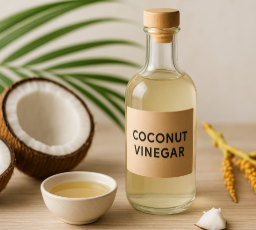
Fermented condiment made from coconut sap (toddy/neera) or coconut water, first converted into coconut wine (alcoholic fermentation) and then into vinegar (acetic fermentation).
Sensory profile: bright, clean acidity with fruity and sometimes lightly sweet notes; color ranges from opalescent to pale amber; may contain a natural “mother” (cellulosic pellicle).
Caloric value (per 100 ml)
About 10–25 kcal; carbohydrates ≤1–3 g (fermentation residues); fat and protein negligible; sodium low unless added by recipe.
Titratable acidity typically ≥4% as acetic acid, often 4–6%; pH ~2.4–3.5.
Key constituents
Organic acids: predominantly acetic acid; traces of lactic, malic, and citric acids.
Minerals (from sap): mainly potassium, plus magnesium, phosphorus, manganese (modest per serving).
Trace phytochemicals and amino acids; cellulosic polysaccharide forming the vinegar mother.
Residual alcohol: typically <0.5% vol when compliant.
Production process
Raw material collection: coconut palm sap (tapping inflorescences) or coconut water.
Alcoholic fermentation: yeasts (e.g., Saccharomyces) convert sugars → ethanol.
Acetic fermentation: acetic acid bacteria (e.g., Acetobacter/Komagataeibacter) oxidize ethanol → acetic acid; mother forms.
Clarification/filtration (partial or unfiltered), optional maturation, pasteurisation for shelf-stable lines, and bottling (glass/HDPE barrier).
Typical QC: % acidity, pH, residual alcohol, °Brix, color/turbidity, microbiology (pathogens absent), methanol (trace compliant), heavy metals.
Sensory and technological properties
Acidifier with a gentler fruity note than wine vinegar; high water solubility.
Provides preservative effect (lowers pH and contributes to aw reduction); helps stabilise light emulsions and sauces.
Volatiles are sensitive to prolonged boiling → consider a finish addition for top-note freshness.
Food applications
Traditional cuisines: Philippine (e.g., adobo, sawsawan), Indonesian and South Asian uses.
Modern uses: vinaigrettes, marinades for meat/fish/veg, quick pickles, lighter BBQ sauces, hot sauces, shrubs and non-alcoholic drinks.
Baking/plant-based: pH correction with baking soda; adds tang in vegan cheeses and dressings.
Nutrition and health
Low calorie at culinary doses; low sodium unless salted.
Acetic acid may assist post-prandial glycaemic modulation when part of a balanced meal; avoid overuse to protect dental enamel and mucosae.
Potassium is present but modest per tablespoon; in CKD contexts, consider total dietary intake.
Fat profile
Total fat negligible; therefore PUFA/MUFA/SFA breakdown is not nutritionally significant here. TFA absent; MCT not relevant.
Quality and specifications (typical topics)
Declared acidity (≥4%), pH within spec, low residual alcohol, no abnormal haze (haze is acceptable if unfiltered), consistent color.
Microbiology: pathogens absent; for raw/unpasteurised styles, a controlled mother may be present.
Contaminants: metals and methanol within limits; sulfites only if added (mandatory declaration above threshold).
Packaging integrity: closure torque/seal checks; corrosion testing for metal caps/liners.
Storage and shelf life
Store cool, dark, well sealed; avoid heat and light.
Shelf life: typically 18–24 months (pasteurised, unopened); once opened, ≤4 °C and use within 3–6 months.
Sediment/mother may form over time—not a defect in unfiltered products.
Allergens and safety
Naturally gluten-free; coconut is not a major allergen in the EU (check non-EU rules).
Label “contains sulfites” if used as preservatives.
Due to acidity, avoid undiluted contact with skin/mucosae; people with GERD should assess personal tolerance.
INCI functions in cosmetics
Possible INCI: Cocos Nucifera (Coconut) Vinegar, Acetum, Cocos Nucifera (Coconut) Fruit Extract (in acidic blends).
Roles: astringent, pH adjuster, light skin-conditioning; used in scalp tonics and acid rinses (respect pH limits and perform safety/claim assessments).
Troubleshooting
Solvent/acetone off-note: stressed alcoholic fermentation or contamination → improve yeast selection, temperature/oxygen control, and strip early volatiles.
Low/unstable acidity: nutrient-limited acetic bacteria or low oxygen → enhance aeration and nutrient supply (nitrogen, minerals).
Unwanted haze/flocs in filtered SKUs: re-fermentation → pasteurise/fine-filter, sanitise the line.
Flat flavour: insufficient esters/maturation → extend aging or blend with a more aromatic lot.
Cap corrosion: acidic vapour ingress → switch to acid-resistant liners/caps.
Sustainability and supply chain
Sap tapping adds value to the coconut palm; support GAP and fair trade with tappers.
Low-energy (fermentative) processing with by-product reuse; manage acidic effluents toward BOD/COD targets; operate under GMP/HACCP; prefer recyclable packaging.
Labelling
Specify origin (“from coconut sap” vs “from coconut water”), % acidity, filtered/unfiltered, pasteurised/raw status.
List additives (e.g., sulfites), any flavours, and allergens; include country of origin and full traceability.
Conclusion
Coconut vinegar is a natural acidifier with a fruity, clean profile that suits marinades, sauces, and quick pickling. Careful control of the two-stage fermentation, acidity, and packaging ensures safety, stability, and sensory consistency, making it a strong alternative to other vinegars across culinary applications.
Mini-glossary
PUFA — polyunsaturated fatty acids: Potentially beneficial when balanced; not relevant here due to negligible fat.
MUFA — monounsaturated fatty acids: Often neutral/beneficial; not relevant here.
SFA — saturated fatty acids: Best kept moderate overall; irrelevant in coconut vinegar.
TFA — trans fatty acids: Absent in non-hydrogenated vinegars.
MCT — medium-chain triglycerides: Not significant in coconut vinegar.
GMP/HACCP — good manufacturing practice / hazard analysis and critical control points: Preventive hygiene systems with validated CCPs.
BOD/COD — biochemical/chemical oxygen demand: Wastewater impact metrics for effluent management.
TTA — total titratable acidity: Laboratory % acetic acid; the primary vinegar specification.
aw — water activity: A stability parameter; effectively reduced by acidity in vinegars.
Studies
There are two groups of coconut trees: tall and dwarf. The tall variety gives fruits between 6 and 10 years, while the dwarf variety between 4 and 5 years. The coconut is quite caloric, 354 calories in 10 grams of pulp.
Content (1):
- Ascorbic acid
- Caffeic acid
- Vitamin B3, nicotinic acid or niacin
- Vitamin B5, pantothenic acid
- Vitamin B7, biotin
- Vitamin B2, riboflavin
- Vitamin B9, folic acid
- traces of vitamin B1 thiamine
- traces of vitamin B6 pyridoxine
- selenium
- sugars
- L-Arginine
- Lauric acid
- Myristic acid
- Palmitic acid
The kernel contains about 70% oil that is used in cosmetics and nutrition.
What it is used for and where
Medical
The ethanol extract at 1.5% of the coconut husk has shown an antibacterial action against dental biofilm and can be used as an irrigation solution to overcome bacterial resistance with synthetic agents (2).
Some components of green dwarf coconut water, mainly caffeic acid and ascorbic acid, have demonstrated antioxidant and hepatoprotective activity and reduce DNA damage, thus reducing oxidative stress induced by ethanol metabolism in steatosis and alcoholic steatohepatitis (3).
Coconut water has been used as an intravenous solution in surgery (4).
This study believes that the fiber extract from the lemon peel acts, in certain amounts, on the central nervous system. The resulting anxiolytic and antidepressant effect is related by interaction with the serotonergic system (5).
Cosmetics
Coconut is used as a topical skin care treatment and for repairing the natural function of the skin barrier (6) due to the emollient and anti-infective properties of phenolic acids, vitamins and flavonoids.
Emollients have the characteristic of enhancing the skin barrier through a source of exogenous lipids that adhere to the skin, improving barrier properties by filling gaps in intercorneocyte clusters to improve hydration while protecting against inflammation. Emollients are described as degreasing or refreshing additives that improve the lipid content of the upper layers of the skin by preventing degreasing and drying of the skin. The problem with emollients is that many have a strong lipophilic character and are identified as occlusive ingredients; they are oily and fatty materials that remain on the skin surface and reduce transepidermal water loss. In cosmetics, emollients and moisturisers are often considered synonymous with humectants and occlusives.
Safety
Coconut and its derived products were initially classified as unhealthy due to the significant presence of fatty acids believed to be saturated, but scientific research has recently shown that there are in fact medium-chain fatty acids (7). In particular, lauric acid, as a primary fatty acid behaves as a medium and long chain fatty acid (8).
The most relevant studies have been selected to explore this in more depth:

