

Ciao, Visitatore!


  Oggetti Tiiips Categorie
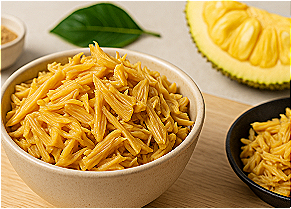
Jackfruit sfilacciato
"Descrizione"
di Al222 (23254 pt)
04-nov-2025 19:07

Jackfruit sfilacciato (Artocarpus heterophyllus)

Descrizione

  • Jackfruit giovane/verde sfilacciato in fibre lunghe tipo carne; in genere sbollentato/cotto, leggermente in salamoia e confezionato al naturale (acqua/salamoia) oppure condito (olio, acidi, spezie).

  • Profilo sensoriale: base neutro–vegetale con sfilacciatura evidente, ottima capacità di assorbire salse e morso tenero/succoso; colore panna–beige.
Valore calorico (per 100 g)

  • Semplice, sgocciolato (senza salsa): ~25–45 kcal; carboidrati 5–9 g; fibre 2–4 g; proteine 1–2 g; grassi ≤0,5 g; sodio variabile (da salamoia).

  • In salse/condimenti: kcal, zuccheri e sodio crescono con °Brix e ricetta.

Principali sostanze contenute

  • Carboidrati e fibre: pectine/emicellulose (corpo, legame acqua); nella polpa acerba prevale amido che dopo cottura/raffreddamento può formare RS3 — amido resistente da retrogradazione.

  • Fitocomposti: carotenoidi (β-carotene, luteina) e polifenoli (flavonoidi) a livelli dipendenti dal processo.

  • Minerali/vitamine: soprattutto potassio; residui di vitamina C e alcune vitamine del gruppo B.

Processo di produzione

  • Preparazione materia prima: scelta di frutti immaturi, pulitura, rimozione buccia e torsolo, sbollentatura/precottura per ammorbidire.

  • Sfilacciatura: tramite sfibratori meccanici o manuale fino alla geometria desiderata; opzionale cloruro di calcio per fermezza.

  • Formulazione: confezionamento al naturale (acqua/salamoia) oppure condito (sale, acidi organici, spezie; opzionale olio).

  • Stabilizzazione: sterilizzazione a retorta (lunga conservazione a temperatura ambiente) oppure refrigerato in MAP — modified atmosphere packaging/sottovuoto; alcune linee impiegano HPP — high pressure processing.

  • Controlli tipici: peso sgocciolato, pH (linee acidificate ≤4,6), Aw — attività dell’acqua, umidità, NaCl, texture (TPA), colore (L*a*b*), microbiologia post-processo, assenza di corpi estranei.

Proprietà sensoriali e tecnologiche

  • Struttura fibrosa con strands tipo pulled e alta capacità di assorbire salse.

  • Elevato legame acquasuccosità e resa; il gusto mite è altamente adattabile a marinate, rub e spezie.

  • Asciugatura superficiale/rosolatura dopo sgocciolamento migliora browning e morso in cottura.

Impieghi alimentari

  • Secondi “pulled-style”: panini/bun, tacos, wrap, topping pizza, grain bowl.

  • Basi culinarie: curry, stufati, ragù, ripieni per bao/gyros, meal kit e ready meal.

  • Swap “better-for-you”: bulk vegetale a bassa densità energetica in sostituzione parziale di carni/ripieni calorici.

Nutrizione e salute

  • Bassa densità energetica nelle versioni al naturale; le fibre favoriscono sazietà e modulazione glicemica.

  • Indice glicemico più contenuto dopo cottura–raffreddamento (↑ RS3).

  • Sodio variabile: preferire low-salt o risciacquare prima dell’uso.

  • Potassio naturalmente presente: considerare in piani CKD.

Profilo dei grassi

  • Grassi totali molto bassi; la frazione residua contiene soprattutto PUFA — grassi polinsaturi (potenzialmente benefici se bilanciati, più ossidabili) e MUFA — grassi monoinsaturi (spesso neutri/favorevoli), con SFA — grassi saturi minimi (da moderare nella dieta complessiva). TFA — acidi grassi trans trascurabili; MCT — trigliceridi a media catena non significativi.

Qualità e specifiche (temi tipici)

  • Geometria dello sfilaccio (lunghezza/larghezza) e uniformità, assenza di torsolo/buccia.

  • Chimico–fisiche: pH, Aw, umidità, NaCl, °Brix (se in salsa), fermezza (TPA).

  • Microbiologia: sterilità commerciale per i retort o shelf-life validata per i refrigerati (MAP/HPP); patogeni assenti/25 g.

  • Packaging: barriera all’umidità, integrità del vuoto, chiara indicazione del peso sgocciolato.

Conservazione e shelf-life

  • Ambiente (retorta): tipicamente 18–36 mesi sigillato; dopo apertura ≤4 °C e consumo in 2–3 giorni.

  • Refrigerato (sottovuoto/MAP): 0–4 °C, 30–90 giorni a seconda del processo; più breve senza HPP.

  • Congelato: –18 °C per 6–12 mesi; attesa sinèresi allo scongelamento (legare con salsa).

Allergeni e sicurezza

  • Naturalmente senza glutine e senza soia, salvo condimenti con salsa di soia, ingredienti a base frumento, senape, sedano, ecc.

  • Possibile sindrome lattice–frutta in soggetti allergici al lattice.

  • Per linee acidificate, mantenere controllo pH e CCP convalidati sotto GMP/HACCP.

Funzioni INCI in cosmesi (ove applicabile)

  • INCI: Artocarpus Heterophyllus Fruit Extract.

  • Ruoli: antioxidant, skin-conditioning, masking (uso limitato con idonea valutazione sicurezza/claim).

Troubleshooting

  • Texture molle: sovracottura o Aw elevata → accorciare trattamento termico, usare agente di fermezza (CaCl₂), migliorare sgocciolamento.

  • Purge acquoso in pack: legame insufficiente → aumentare solidi (°Brix) della salsa, aggiungere fibre agrumate/amidi, ottimizzare sottovuoto.

  • Sapore blando: aumentare acidi/sale/umami, marinare più a lungo, rosolare per attivare Maillard.

  • Insaporimento irregolare: estendere tumbling/tempo di marinata, ridurre larghezza sfilaccio, usare tumble sottovuoto.

  • Shelf-life breve a freddo: maggiore acidificazione, valutare HPP, ottimizzare gas MAP e approccio hurdle.

Sostenibilità e filiera

  • Alberi di jackfruit ad alta resa per ettaro e resilienti al clima; lo sfilacciato sostiene menù plant-forward con impronta GHG inferiore rispetto alla carne.

  • Operare sotto GMP/HACCP; gestire i reflui verso target BOD/COD; usare pack riciclabili e mantenere tracciabilità.

Etichettatura

  • Esempi: “jackfruit sfilacciato in salamoia”, “jackfruit sfilacciato condito”. Dichiarare ingredienti, peso sgocciolato e valori nutrizionali; evidenziare eventuali allergeni provenienti dai condimenti.

  • Possibili claim (vegano, a basso contenuto di grassi, fonte di fibre) solo se conformi.

Conclusione

Il jackfruit sfilacciato offre una texture convincente tipo pulled, una piattaforma di gusto neutra e un apporto calorico contenuto, ideale per veicolare salse e spezie. Mediante la regolazione di geometria, idratazione/Aw, equilibrio acido–sale e metodo di stabilizzazione (retorta, MAP, HPP), è possibile ottenere prodotti succosi, costanti e sicuri per retail e foodservice.

Mini-glossario

  • GI — indice glicemico: misura la risposta glicemica; si riduce con fibre/grassi e con raffreddamento (↑ RS3).

  • RS3 — amido resistente da retrogradazione: frazione meno digeribile formata dopo raffreddamento; aiuta la modulazione glicemica.

  • PUFA — grassi polinsaturi: potenzialmente benefici se bilanciati; più suscettibili a ossidazione.

  • MUFA — grassi monoinsaturi: spesso neutri/favorevoli e relativamente stabili.

  • SFA — grassi saturi: da moderare nella dieta complessiva; quota minima qui.

  • TFA — acidi grassi trans: trascurabili nei prodotti non idrogenati.

  • MCT — trigliceridi a media catena: non significativi nel jackfruit.

  • MAP — modified atmosphere packaging: atmosfera modificata che estende la shelf-life refrigerata.

  • HPP — high pressure processing: pastorizzazione a freddo per estendere la shelf-life dei refrigerati.

  • Aw — attività dell’acqua: parametro che governa la stabilità microbiologica.

  • GMP/HACCP — good manufacturing practice / hazard analysis and critical control points: sistemi igienico–preventivi con CCP convalidati.

  • BOD/COD — domanda biochimica/chimica di ossigeno: indicatori dell’impatto dei reflui e dell’efficienza di trattamento.

Bibliografia__________________________________________________________________________

Gupta A, Marquess AR, Pandey AK, Bishayee A. Jackfruit (Artocarpus heterophyllus Lam.) in health and disease: a critical review. Crit Rev Food Sci Nutr. 2023;63(23):6344-6378. doi: 10.1080/10408398.2022.2031094. 

Abstract. Artocarpus heterophyllus Lam. (Family Moraceae), is a tropical tree, native to India and common in Asia, Africa, and several regions in South America. The fruit is commonly known as jackfruit which is one of the largest edible fruits in the world. Jackfruits comprises a wide range of nutrients, including minerals, carbohydrates, volatile compounds, proteins, and vitamins. The fruit, bark, leaves, and roots are endowed with therapeutic attributes and are utilized in the many traditional medicinal systems for the management of various ailments. Fruit and seeds are commonly used to prepare various food items, including sauce, ice creams, jams, jellies, and marmalades. Due to unique texture, jackfruit is becoming a popular meat substitute. Based on preclinical studies, jackfruit exhibits antimicrobial, antioxidant, anti-melanin, antidiabetic, anti-inflammatory, immunomodulatory, antiviral, anthelmintic, wound-healing, and antineoplastic activities. Clinical studies reveal that the leaves possess antidiabetic action in healthy and insulin-independent diabetic individuals. Despite numerous health benefits, regrettably, jackfruit has not been properly utilized in a marketable scale in areas where it is produced. This review delivers an updated, comprehensive, and critical evaluation on the nutritional value, phytochemical profiling, pharmacological attributes and underlying mechanisms of action to explore the full potential of jackfruit in health and disease.

Ranasinghe RASN, Maduwanthi SDT, Marapana RAUJ. Nutritional and Health Benefits of Jackfruit (Artocarpus heterophyllus Lam.): A Review. Int J Food Sci. 2019 Jan 6;2019:4327183. doi: 10.1155/2019/4327183. 

Abstract. Artocarpus heterophyllus Lam., which is commonly known as jackfruit is a tropical climacteric fruit, belonging to Moraceae family, is native to Western Ghats of India and common in Asia, Africa, and some regions in South America. It is known to be the largest edible fruit in the world. Jackfruit is rich in nutrients including carbohydrates, proteins, vitamins, minerals, and phytochemicals. Both the seeds and the flesh of jackfruit are consumed as curries and boiled forms, while the flesh in fully ripen stage can be eaten directly as a fruit. Several countries have developed different food products such as jam, jellies, marmalades, and ice creams using pureed jackfruit. The several parts of jack tree including fruits, leaves, and barks have been extensively used in traditional medicine due to its anticarcinogenic, antimicrobial, antifungal, anti-inflammatory, wound healing, and hypoglycemic effects. Despite all these benefits, unfortunately, the fruit is underutilized in commercial scale processing in regions where it is grown. The aim of this review is to disseminate the knowledge on nutritional and health benefits of jackfruit, in order to promote utilization of jackfruit for commercial scale food production.

Li Y, Chen Y, Li C, Wu G, He Y, Tan L, Zhu K. Polysaccharide from Artocarpus heterophyllus Lam. (Jackfruit) Pulp Ameliorates Dextran Sodium Sulfate-Induced Enteritis in Rats. Int J Mol Sci. 2024 Jan 29;25(3):1661. doi: 10.3390/ijms25031661. 

Abstract. A polysaccharide from Artocarpus heterophyllus Lam. (jackfruit) pulp (JFP-Ps) is known for its excellent bioactivities. However, its impact on small intestinal barrier function is still largely unexplored. The study aimed to examine the protection effect of JFP-Ps against dextran sodium sulfate-induced enteritis and its underlying mechanism. This research revealed that JFP-Ps mitigated small intestinal tissue damage by reducing the expression of pro-inflammatory cytokines and promoting the expression of the anti-inflammatory cytokine interleukin-10 in the small intestine. JFP-Ps diminished oxidative stress by bolstering the activity of antioxidant enzymes and reducing the concentration of malondialdehyde in the small intestine. In addition, JFP-Ps may restore the mechanical barrier and inhibit intestinal structure damage by augmenting the expression of short-chain fatty acids (SCFAs) receptors (GPR41/43) and up-regulating the expression of tight junction proteins (occludin). In conclusion, JFP-Ps may positively influence intestinal health by relieving oxidative stress in the small intestine, improving mechanical barrier function, activating the SCFA-GPR41/GPR43 axis, and inhibiting TLR4/MAPK pathway activation. The results augment our comprehension of the bioactivities of JFP-Ps, corroborating its great potential as a functional food.

Cheng M, He J, Gu Y, Wu G, Tan L, Li C, Xu F, Zhu K. Changes in Phenolic Compounds and Antioxidant Capacity of Artocarpus heterophyllus Lam. (Jackfruit) Pulp during In Vitro Gastrointestinal Digestion. Antioxidants (Basel). 2023 Dec 23;13(1):37. doi: 10.3390/antiox13010037. 

Abstract. An in vitro gastrointestinal digestion model was applied to investigate the effect of digestion on the phenolic compounds and antioxidant capacity of Artocarpus heterophyllus Lam. (jackfruit) pulp. The total phenol content (TPC) was determined using Folin-Ciocalteu method, and the antioxidant activities were evaluated by DPPH and ABTS assays. Phenolic compounds were analyzed using ultra-performance liquid chromatography coupled with electrospray ionization, followed by quadrupole time-of-flight mass spectrometry (UPLC-ESI-Q-TOF-MS/MS). The results showed that TPC was significantly higher after gastric digestion. Thirty phenolic compounds (hydroxybenzoic acids and derivatives, hydroxycinnamic acids and derivatives, and flavonoids) were identified. The antioxidant activities of the digested samples varied with the TPC, and there was a correlation between antioxidant activity and TPC. The present study implies that gastrointestinal digestion may improve TPC and increase the amount of free phenolic compounds, mainly related to changes in pH value and digestive enzymes.

Felli R, Yang TA, Abdullah WNW, Zzaman W. Effects of Incorporation of Jackfruit Rind Powder on Chemical and Functional Properties of Bread. Trop Life Sci Res. 2018 Mar;29(1):113-126. doi: 10.21315/tlsr2018.29.1.8.

Abstract. Nowadays, there is a rising interest towards consuming health beneficial food products. Bread-as one of the most popular food products-could be improved to 'healthy bread' by addition of ingredients high in protein, dietary fiber and low in calorie. Incorporating Jackfruit rind powder (JRP) as a by-product rich in dietary fiber in bread, could not only provide health beneficial bread products, but also lead to develop an environmental friendly technology by solving the problem of waste disposal of residues. In this study, addition of jackfruit rind powder (JRP) as a high dietary fiber and functional ingredient in bread was examined. The results showed that incorporation of JRP in bread improved functional properties of flour such as Oil Holding Capacity (OHC), Water Holding Capacity (WHC) and pasting properties. Addition of 5%, 10% and 15% of JRP in wheat flour caused significantly (p < 0.05) higher insoluble, soluble and total dietary fiber in flour and bread products. Results from proximate composition indicated that all breads substituted with JRP, contained significantly (p < 0.05) higher fiber, moisture and fat. Obtained results confirmed that the JRP has great potential in development of functional foods especially functional bread products.

Valuta