Ancho chili powder
Description
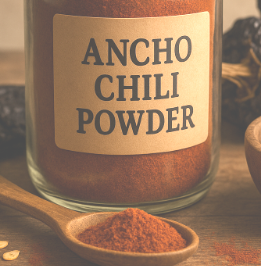
Chili powder made by milling the dried, ripe (red) pods of poblano peppers (Capsicum annuum, family Solanaceae), commercially known as ancho.
Sensory profile: brown-ruby color, sweet and fruity aroma (raisin, dried plum), toasty/cocoa hints with a light smoky edge; low pungency.
Heat (indicative): ~1,000–2,000 SHU (Scoville Heat Units), varying by cultivar, terroir, and placenta/seed content.
Caloric value (per 100 g)
Dry powder: ~280–320 kcal; carbohydrates ~50–60 g (of which fiber ~30–35 g), protein ~12–15 g, fat ~10–15 g.
Typical use (0.5–5 g): modest energy; nutritional interest is chiefly phytochemicals and fiber (on a dry basis).
Key constituents
Carotenoids: capsanthin, capsorubin, zeaxanthin, β-carotene (drive color).
Capsaicinoids: low (generally mild heat).
Polyphenols and volatiles (pyrazines, toasty notes); natural sugars and organic acids.
Trace minerals; a small intrinsic lipid fraction (from seeds/oleoresins).
Production process
Raw material: whole ancho pods, cleaned, typically destemmed and partly deseeded to reduce bitterness and heat variability.
Pre-treatments: optional light toasting to enhance aroma; sanitation (steam or approved ionizing processes) to reduce microbial load.
Milling: low-temperature grinding with sieving to target particle size; blending to standardize color (ASTA) and flavor.
Quality controls: moisture ≈8–12%, ASTA, foreign bodies, mycotoxins (e.g., aflatoxins), pesticides/metals, microbiology (low aw).
Sensory and technological properties
Warm, deep natural color with good yield at low dose.
Dispersibility: excellent in fatty matrices; in aqueous systems improve with pre-dispersion in oil or suitable emulsifiers.
Color/aroma stability: sensitive to light, oxygen, and prolonged heat → prefer barrier packs and late addition.
Pairing: synergy with acids (vinegar, citrus), umami (soy, miso), and fats (olive oil).
Culinary uses
Mexican/Southwestern: mole, enchiladas, red salsas, low-heat chili, and rubs for meats and vegetables.
Modern applications: sweet-smoky hummus/dips, marinades, roasted potatoes, eggs, legumes; base for blends (e.g., ancho-cocoa-coffee).
Nutrition and health
Typical servings are small yet provide carotenoids and polyphenols with potential antioxidant activity.
Sodium is intrinsically low; the final recipe determines salt intake.
Tolerance: mild heat; adjust dose for GERD or spice sensitivity.
Fat profile
Low–moderate total fat for a spice; composition trends to PUFA (polyunsaturated fatty acids, mainly linoleic; potentially supportive but more oxidizable) and MUFA (monounsaturated, e.g., oleic; often neutral/beneficial), with minimal SFA (saturated fatty acids; best moderated in the overall diet).
Quality and specifications (typical topics)
ASTA, moisture, particle size, ash, pungency/SHU (if declared).
Mycotoxins compliant; pesticides/metals within limits; PAH controlled if toasting is used.
Microbiology: pathogen-free; low total counts (low aw).
Uniformity of color/aroma and absence of foreign matter.
Storage and shelf life
Store dark, dry, cool (≈5–20 °C) in tight barrier containers; avoid light, air, and heat.
Typical shelf life 12–24 months (depending on ASTA, antioxidant protection, and packaging); reclose promptly after use.
Allergens and safety
Naturally gluten-free; not among major allergens. Possible cross-contact in facilities (verify supplier).
Capsaicin is irritant to skin/mucosae: use gloves for prolonged handling; keep away from children.
INCI functions in cosmetics
Possible names: Capsicum Annuum Fruit Powder, Capsicum Annuum Extract.
Roles: natural colorant (red-brown tones), mild secondary antioxidant, light skin-conditioning. Check skin staining and stability; use at low levels with compatibility testing.
Troubleshooting
Flat/stale flavor: raw material oxidized → choose fresh lots (adequate ASTA), improve packaging and storage.
Bitter/harsh notes: excessive seeds/placenta or over-toasting → increase deseeding, reduce time/temperature.
Uneven color: heterogeneous particle size or poor dispersion → sieve and pre-disperse in oil.
Lumping in dry mixes: elevated humidity → gentle drying, sieving, use permitted anti-caking aids.
Sustainability and supply chain
Proper drying at origin reduces mycotoxin risk; favor suppliers with solid traceability and responsible agronomic practices.
Process efficiency: by-product recovery, recyclable packaging, effluent management toward BOD/COD targets; audits under GMP/HACCP with CCP on sanitation, foreign bodies, and mycotoxin screening.
Conclusion
Ancho chili powder delivers gentle heat, fruity sweetness, and aromatic depth that elevate sauces, rubs, and low-pungency dishes. Careful raw-material selection, toasting/milling control, and proper dispersion ensure stability, uniformity, and sensory consistency in both professional and home applications.
Mini-glossary
SHU — Scoville heat units: Index of perceived pungency (higher = hotter).
ASTA — American Spice Trade Association (color units): Standard measure of coloring strength.
aw — Water activity: Availability of water for microbial growth; low in spices.
PUFA — Polyunsaturated fatty acids: Can support cardiometabolic health; more prone to oxidation.
MUFA — Monounsaturated fatty acids: Often neutral/beneficial for lipid profile.
SFA — Saturated fatty acids: Advisable to moderate in the overall diet.
GMP/HACCP — Good manufacturing practice / hazard analysis and critical control points: Preventive hygiene systems with validated CCPs.
CCP — Critical control point: Process step requiring strict control (e.g., sanitation, mycotoxins).
BOD/COD — Biochemical/chemical oxygen demand: Indicators of effluent impact on wastewater treatment.
References__________________________________________________________________________
Hernández, L. J., Montejo, N. C., Rangel, A. S., Torres, V. R., Rico, J. S. G. J. A., & Naveda, A. F. (2024). Agronomic and morphological evaluation of six genotypes and two hybrids of Poblano peppers in field conditions. Agro Productividad.
Abstract. Objective: to evaluate agronomic and morphological traits of six Poblano-type pepper genotypes, compared to a commercial hybrid and an experimental hybrid, in order to select genotypes with potential to continue with a plant breeding program. Design/ Methodology/ Approach: treatments and statistical model were arranged in randomized complete blocks, with eight treatments (six F2 genotypes, and two hybrids Carranza (commercial F1) and F402 (experimental F1). Treatments were analyzed with analysis of variance (p ≤ 0.05); then tested with Multiple Mean Comparison (Tukey, p ≤ 0.05) and Pearson Correlation Analysis. Results: no statistical differences were found in yield per plant (RPP), number of fruits per plant (NFP), average weight per fruit (PPF), plant height (AP), stem thickness (GT), leaf length (AL) and leaf width (AH). Regarding width at the base of the fruit (ABF) the hybrids were superior; in average width of the fruit the genotypes G4, G6 and the hybrids were better; in fruit length G2, G5 and G6 stood out; in calyx depth G1, G3 and G4; in length of the peduncle G4 was different from the others; and in thickness of the mesocarp (GM) the genotypes G2, G4, G6 and hybrids were superior. According to Pearson's correlation, the yield depended on NFP (0.66), MG (0.46), ABF (0.38), as it is shown by their coefficients.
Toledo-Aguilar, R., López-Sánchez, H., López, P. A., Guerrero-Rodríguez, J. D. D., Santacruz-Varela, A., & Huerta-de la Peña, A. (2016). Morphological diversity of native population’s poblano pepper. Revista mexicana de ciencias agrícolas, 7(5), 1005-1015.
Abstract. The genetic diversity in different types of pepper in Mexico has been little studied. The poblano pepper (Capsicum annuum L.) has great culinary importance as an ingredient in traditional dishes from Puebla; also constitutes a source of income for rural families in the region of the Sierra Nevada de Puebla; however, there is no study to determine the morphological diversity of native populations of this type of pepper found in this ecological niche. The aim of this study was to analyze the morphological diversity of native population’s poblano peppers de la Sierra Nevada de Puebla. By using descriptors were analyzed 41 populations of pepper poblano, four of ancho pepper, two of “Loco” pepper, one of “Miahuateco” and hybrid pepper ancho pepper “Doroteo” (Ahern Seeds®). An experimental design was used in three randomized complete block assessment in two locations. In the combined analysis of variance statistically significant difference in 60% of the variables found. With the selection of 30 morphological was performed variables principal component analysis, where populations of pepper poblano formed a group, away from the rest of populations evaluated and the hybrid. The cluster analysis was also performed, in which four subgroups were defined. The native populations that shaped each subgroup were not related to the geographical location of seed collection, suggesting the exchange of germplasm among farmers. In the native populations of pepper poblano morphological diversity found mainly in fruit variables, plant habit and earliness.
Santiago López, U., Ramírez Meraz, M., & Méndez Aguilar, R. (2018). HAP14F: hybrid of ancho poblano pepper for the Altiplano de México. Revista mexicana de ciencias agrícolas, 9(2), 481-485.
Abstract. In Mexico, the poblano pepper has great gastronomic, economic and social importance because it is a basic ingredient of traditional dishes. Obtaining low yields in the producing areas, mainly in the Altiplano de México, is due to the high use of creole seeds. To mitigate the aforementioned problem, INIFAP developed the HAP14F wide pepper poblano hybrid, which is an early cycle because it presents flowering and ripening at 39 and 118 days after transplantation (DDT), respectively. It produces fruits of intermediate green color in an immature state that turn a dark red color with a strong brilliance in a mature state. In open-pit evaluations, this hybrid had an average yield of 3.7 t ha-1 of dried or dehydrated chili and in green fruit it reached 23.1 t ha-1. For the aforementioned, HAP14F is considered a good alternative for the Altiplano de México.
Hernández Hernández, B. N., Tornero Campante, M. A., Sandoval Castro, E., Rodríguez Mendoza, M. D. L. N., Taboada Gaytán, O. R., & Peña Olvera, B. V. (2021). Growth, yield and quality of poblano chili pepper grown in hydroponics under greenhouse. Revista mexicana de ciencias agrícolas, 12(6), 1043-1056.
Abstract. The poblano chili pepper crop sown in soil in the Alto Atoyac in Puebla has been affected by the presence of diseases caused by fungi, bacteria and nematodes, generating losses in yield and reduction of the sowing area. The production under greenhouse and hydroponics is an alternative solution to this problem, since it allows the development of crops in a controlled environment using inert substrates, ensuring a greater percentage of production. The objective was to evaluate the growth, yield and fruit quality of two local varieties of poblano chili pepper (Tlacotepec and Tlalancaleca) and a commercial variety (San Luis), supplied nutritionally by three concentrations of the Steiner nutrient solution under greenhouse and hydroponics in order to know their agronomic and productive behavior. A 3x3 factorial treatment design in a completely randomized experimental design was considered. The variables evaluated were: plant height, stem thickness, number of leaves, number of bifurcations, number of flowers, yield and fruit quality. The results showed that the San Luis variety reached the highest yield and fruit quality. As for the three concentrations of nutrient solution, there was no significant effect on the yield and the agronomic behavior of creole varieties in the substrate, greenhouse and hydroponics system may be an option for the production of poblano chili pepper in the Alto Atoyac region




