



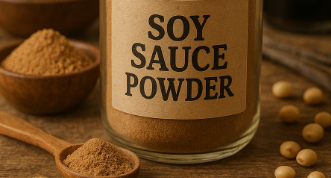
Salsa di soia in polvere (soy sauce powder)
Descrizione
Preparato disidratato ottenuto da salsa di soia (tradizionalmente fermentata) spray–essiccata su supporti carboidratici (es. maltodestrina, amidi modificati), talvolta con antiagglomeranti (es. silice) e sale.
Profilo sensoriale: umami intenso, note salate, tostate e leggermente caramellate; colore bruno.
Varianti: da shoyu (soia + frumento), da tamari (senza frumento/glutine), oppure da HVP (proteine vegetali idrolizzate) con profilo aromatico più deciso.
Valore calorico (per 100 g di prodotto)
~150–350 kcal/100 g (ampio range: dipende da quota sale e carrier).
Indicativo: carboidrati prevalenti (da maltodestrina/amidi), proteine residue basse, grassi trascurabili.
Sodio elevato (tipicamente 15–40% NaCl sul secco, secondo la formulazione): il contributo per porzione d’uso è la variabile nutrizionale più rilevante.
Principali sostanze contenute
Aminoacidi liberi (soprattutto glutammato), peptidi e 5’-nucleotidi (5’-IMP, 5’-GMP) responsabili della sinergia umami.
Zuccheri/oligosaccaridi da supporti (maltodestrina; DE variabile).
Acidi organici (lattico, acetico) e composti di Maillard volatili (note tostate).
Cloruro di sodio; eventuale MSG aggiunto (da dichiarare in etichetta, E621).
Marcatori tipici: azoto totale/ammino-azoto, NaCl%, umidità, aw, colore (L*a*b*).
Processo di produzione
Base liquida: salsa di soia fermentata (koji da Aspergillus oryzae/sojae su soia e frumento; fermentazione in moromi con lieviti e batteri lattici) → pressatura, filtrazione, pastorizzazione.
Alternativa: idrolisi acida/enzimatica di proteine vegetali (HVP), successiva neutralizzazione e standardizzazione.
Essiccazione: preparazione feed con carrier, spray-drying → setacciatura, eventuale antiagglomerante, confezionamento barriera.
Qualità sotto GMP/HACCP con CCP su carica microbica, 3-MCPD (se HVP), umidità/aw, sigillo.
Proprietà sensoriali e tecnologiche
Umami potente e rotondità del gusto; esalta note carnee e brodose.
Alta solubilità in acqua; possibile igroscopicità (tendenza al caking) secondo DE e sale.
Contribuisce a browning/Maillard in cottura; il sale favorisce ritenzione idrica in carni.
Impieghi alimentari
Condimenti secchi (rub, snack seasoning), zuppe/instant noodles, marinature e glasse (dry mix), salse e sughi, burger e ripieni plant-based, riso e stir-fry in formato “one-pot”.
Dosaggi tipici: 0,2–4% sul peso totale (da tarare su sale e impatto umami); per snack condire a 2–8% nel blend di spolvero.
Nutrizione e salute
Sodio elevato: valutare porzione e, se necessario, scegliere versioni a ridotto contenuto di sale.
Glutammato: naturalmente presente; aggiunte di MSG devono essere dichiarate.
Istamina: in prodotti ben controllati è bassa, ma la filiera fermentativa deve prevenire eccessi.
Glutine: presente nei prodotti da shoyu; le versioni tamari possono essere senza glutine (verificare etichetta).
Qualità e specifiche (temi tipici)
Umidità/ aw basse, flowability (indice di scorrevolezza), granulometria.
Azoto totale/ammino-azoto, NaCl%, pH (soluzione 10%).
Microbiologia: patogeni assenti/25 g, conte microbiologiche basse; spore non germinabili per aw ridotta.
Contaminanti: 3-MCPD entro limiti (nei prodotti da HVP/idrolisi), metalli/micotossine conformi.
Conservazione e shelf-life
Conservare asciutto, al riparo da umidità, calore e luce; richiudere bene (sacche con zip o secchi con guarnizione).
Shelf-life tipica 12–24 mesi; usare sacche barriera e essiccanti per ridurre il caking.
Allergeni e sicurezza
Contiene soia (allergene maggiore UE); può contenere frumento/glutine (shoyu).
In impianti misti possibili tracce (es. sesamo, latte): verificare dichiarazioni.
Rispettare GMP/HACCP; CCP su umidità, contaminanti (es. 3-MCPD), integrità confezione.
Funzioni INCI in cosmesi
Non si usa come tale. Materie correlate: Hydrolyzed Soy Protein, Soy Amino Acids, Glycine Soja (Soybean) Seed Extract (ruoli: skin conditioning, film forming).
Troubleshooting
Impaccamento (caking): umidità/UR elevate → migliorare pack barriera, aggiungere antiagglomerante, impiegare liner con essiccante.
Distribuzione non uniforme in rub o snack: granulometria inadeguata → uniformare particle size, usare carrier compatibile con il substrato.
Sapore troppo salato/piatto: dosaggio o sale eccessivo → ridurre livello, bilanciare con zuccheri, acidi o spezie.
Imbrunimento eccessivo in forno: quota zuccheri alta (DE elevato) → scegliere grado con DE inferiore, ridurre T/tempo.
Torbidità in soluzione: co-formulanti incompatibili → sciogliere in fase acquosa separata, filtrare, correggere pH.
Sostenibilità e filiera
Fermentazione tradizionale: impatti legati a acqua/energia; migliorabili con recupero calore, gestione reflui a target BOD/COD.
Upcycling: uso di carrier da amidi non OGM e pack riciclabili; tracciabilità completa e fornitori certificati.
Conclusione
La salsa di soia in polvere è un aromatizzante umami pratico e stabile che trasferisce il carattere della salsa di soia in formati dry. La scelta della base (shoyu/tamari/HVP), del carrier e del tenore di sale, insieme al controllo di umidità e granulometria, determina impatto sensoriale, processabilità e stabilità del prodotto finito.
Mini-glossario
aw — attività dell’acqua: quota di acqua “libera”; aw bassa migliora stabilità e inibisce i patogeni.
DE — dextrose equivalent: misura del grado di idrolisi della maltodestrina; DE ↑ → dolcezza/igroscopicità ↑.
MSG — monosodio glutammato (E621): esaltatore di sapidità; aggiunte vanno dichiarate.
HVP — hydrolyzed vegetable protein: proteine vegetali idrolizzate; possono richiedere controllo di 3-MCPD.
3-MCPD — 3-monoclor-1,2-propandiolo: contaminante di processo da monitorare/limitare in HVP e salse di soia.
GMP/HACCP — good manufacturing practice / hazard analysis and critical control points: sistemi igienico-preventivi con CCP definiti.
CCP — critical control point: fase in cui un controllo previene/riduce un pericolo (es. umidità, contaminanti, sigillo).
BOD/COD — domanda biochimica/chimica di ossigeno: indicatori dell’impatto dei reflui di processo.
Soia studi
Bibliografia_______________________________________________________________
Orts A, Revilla E, Rodriguez-Morgado B, Castaño A, Tejada M, Parrado J, García-Quintanilla A. Protease technology for obtaining a soy pulp extract enriched in bioactive compounds: isoflavones and peptides Heliyon. 2019 Jun 22;5(6):e01958. doi: 10.1016/j.heliyon.2019.e01958.
Abstract. This work presents a new bioprocess process for the extraction of bioactive components from soy pulp by-product (okara) using an enzymatic technology that was compared to a conventional water extraction. Okara is rich in fiber, fat, protein, and bioactive compounds such as isoflavones but its low solubility hampers the use in food and fertilizer industry. After the enzymatic attack with endoproteases half of the original insoluble proteins were converted into soluble peptides. Linked to this process occured the solubilization of isoflavones trapped in the insoluble protein matrix. We were able to extract up to 62.5% of the total isoflavones content, specially aglycones, the more bioactive isoflavone forms, whose values rose 9.12 times. This was probably due to the increased solubilization and interconversion from the original isoflavones. In conclusion, our process resulted in the formulation of a new functional product rich in aglycones and bioactive peptides with higher antioxidant potency than the original source. Therefore, we propose that the enzymatic extraction of okara bioactive compounds is an advantageous tool to replace conventional extraction.
González Cañete N, Durán Agüero S. Soya isoflavones and evidences on cardiovascular protection. Nutr Hosp. 2014 Jun 1;29(6):1271-82. doi: 10.3305/nh.2014.29.6.7047. Spanish.
Roccisano D, Henneberg M, Saniotis A. A possible cause of Alzheimer's dementia - industrial soy foods. Med Hypotheses. 2014 Mar;82(3):250-4. doi: 10.1016/j.mehy.2013.11.033. Epub 2013 Dec 7.
Seeley AD, Jacobs KA, Signorile JF. Acute Soy Supplementation Improves 20-km Time Trial Performance, Power, and Speed. Med Sci Sports Exerc. 2020 Jan;52(1):170-177. doi: 10.1249/MSS.0000000000002102.
Abstract. Introduction: Isoflavones, a chemical class of phytoestrogens found in soybeans and soy products, may have biological functions similar to estradiol. After binding with ERβ or perhaps independently of estrogen receptors, isoflavones may augment vascular endothelial relaxation, contributing to improved limb blood flow. Purpose: To determine if acute fermented soy extract supplementation influences 20-km time trial cycling performance and cardiac hemodynamics compared with a placebo. Methods: Subjects included 25 cyclists and triathletes (31 ± 8 yr, V˙O2peak: 55.1 ± 8.4 mL·kg·min). Each subject completed a V˙O2peak assessment, familiarization, and two 20-km time trials in randomized order after ingestion of a fermented soy extract supplement or placebo. The fermented soy extract consisted of 30 g powdered supplement in 16 fl. ounces of water. The placebo contained the same quantities of organic cocoa powder and water. Each trial consisted of 60 min of rest, 30 min at 55% Wpeak, and a self-paced 20-km time trial. Results: Soy supplementation elicited a faster time to 20-km completion (-0.22 ± 0.51 min; -13 s), lower average HR (-5 ± 7 bpm), and significantly greater power (7 ± 3 W) and speed (0.42 ± 0.16 km·h) during the last 5 km of the time trial compared with placebo. Analysis of the results by relative fitness level (<57 vs ≥ 57 mL⋅kg⋅min) indicated that those with a higher level of fitness reaped the largest performance improvement alongside a reduced HR (-5 ± 7 bpm). Conclusions: Ingestion of a fermented soy extract supplement improved sprint-distance performance through improvements in both power and speed. For those with great aerobic fitness, soy supplementation may help to decrease cardiac demand alongside performance improvement.
Sedaghat A, Shahbazian H, Rezazadeh A, Haidari F, Jahanshahi A, Mahmoud Latifi S, Shirbeigi E. The effect of soy nut on serum total antioxidant, endothelial function and cardiovascular risk factors in patients with type 2 diabetes. Diabetes Metab Syndr. 2019 Mar - Apr;13(2):1387-1391. doi: 10.1016/j.dsx.2019.01.057
Nachvak SM, Moradi S, Anjom-Shoae J, Rahmani J, Nasiri M, Maleki V, Sadeghi O. Soy, Soy Isoflavones, and Protein Intake in Relation to Mortality from All Causes, Cancers, and Cardiovascular Diseases: A Systematic Review and Dose-Response Meta-Analysis of Prospective Cohort Studies J Acad Nutr Diet. 2019 Jul 2. pii: S2212-2672(19)30362-4. doi: 10.1016/j.jand.2019.04.011
Woo HW, Kim MK, Lee YH, Shin DH, Shin MH, Choi BY. Habitual consumption of soy protein and isoflavones and risk of metabolic syndrome in adults ≥ 40 years old: a prospective analysis of the Korean Multi-Rural Communities Cohort Study (MRCohort). Eur J Nutr. 2019 Oct;58(7):2835-2850. doi: 10.1007/s00394-018-1833-8.
Abstract. Purpose: Although considerable attention has been paid to the potential benefits of soy protein and isoflavones for preventing metabolic syndrome (MetS) and its components, findings linking habitual consumption of these factors to MetS are limited. This study aimed to evaluate the association of MetS incidence with habitual intake of soy protein/isoflavones among Korean men and women aged ≥ 40 years old who did not have MetS at baseline (n = 5509; 2204 men and 3305 women). Methods: Dietary intake of soy protein/isoflavones at baseline and average consumption during follow-up were used. Results: A significant inverse association between dietary intake and incidence of MetS was found in women (incidence rate ratios, IRR = 0.60, 95% CI = 0.46-0.78, P for trend = 0.0094 for the highest quintile of average soy protein intake compared with the lowest quintile; IRR = 0.57, 95% CI = 0.44-0.74, P for trend = 0.0048 for the highest quintile of average isoflavones intake compared with the lowest quintile). A tendency towards an inverse association was also found in men, although it was not significant for the highest quintile (IRR = 0.80, 95% CI = 0.58-1.11, P for trend = 0.9759, comparing the lowest to the highest quintile of average soy protein intake; IRR = 0.73, 95% CI = 0.53-1.01, P for trend = 0.8956, comparing the lowest to the highest quintile of average isoflavones intake). In terms of individual abnormalities, a significant inverse association was found between soy protein and isoflavones and the incidence of low-high-density lipoprotein cholesterol in both men and women. Abdominal obesity and elevated blood pressure were inversely related to soy protein/isoflavones only in women, and an inverse association of elevated triglyceride appeared only in men. Conclusion: Our findings suggest that habitual intake of soy protein and isoflavones is inversely associated with the risk of MetS and its components. There is likely to be a reverse J-shaped association of average intake with MetS.

