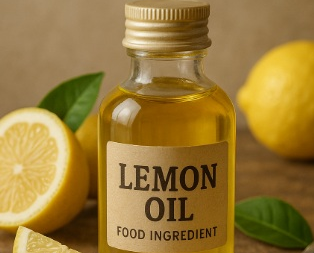
Lemon oil (food ingredient)
Description
Essential oil obtained primarily by cold pressing the peels of Citrus limon (L.) Osbeck, used as a natural flavor in foods and beverages.
Profile: fresh, citrusy–lemony and vibrant notes with light green facets; pale straw color; a mobile, highly volatile liquid.
Available as expressed oil, de-terpenated/folded grades (2×, 5×, 10×), and ready-to-use emulsions for beverages.
Caloric value (per 100 g)
Key constituents
Monoterpenes: d-limonene (major), β-pinene, γ-terpinene.
Oxygenated components (key to impact): citral (mixture of geranial/neral), linalool, α-terpineol, related citral derivatives.
Furocoumarins (trace, chiefly in expressed oils): bergapten, oxypeucedanin; very low/absent in FCF (furanocoumarin-free) or distilled grades.
Typical markers: GC–MS fingerprint, % limonene, % citral, optical rotation, refractive index, density, peroxides.
Production process
Raw material: fresh peels from the juice industry; mechanical rupture of oil vesicles.
Extraction: cold expression with water, then centrifugal separation of the oil phase.
Purification/standardization: filtration; optional de-terpenation/folding to enrich oxygenates and improve stability/solubility.
Beverage formulation: O/W emulsions using gum arabic/modified starches and, when needed, weighting agents (e.g., SAIB or esterified rosin).
Managed under GMP/HACCP with CCP on pesticide residues, metals, vehicle microbiology, adulteration checks, and seal integrity.
Sensory and technological properties
High aromatic intensity; folded grades deliver stronger citral impact and better process robustness.
Volatility/oxidation: sensitive to light, oxygen, and heat; limonene oxidation yields resinous/varnish-like off-notes.
Solubility: intrinsically lipophilic; for aqueous systems requires emulsification or hydroalcoholic pre-dilution; risk of oiling-out without correct HLB balance.
Food uses
Beverages (soft drinks, iced teas, hard seltzers) via emulsions or water-soluble flavor preparations.
Bakery, fillings/creams, ice creams/sorbets, confectionery, syrups, dessert sauces.
Savory: mayonnaise/dressings, fish/poultry marinades, condiments.
Indicative use levels (validate in trials): 5–60 ppm in RTD beverages, 20–300 ppm in bakery/confectionery; employ pre-dilutions for accurate dosing.
Nutrition and health
Used as a flavoring at very low levels; no health claims should be assigned without specific authorization.
Possible individual sensitivities to components (e.g., limonene, linalool, citral); not an EU major allergen in foods.
Furocoumarins are primarily a cosmetic phototoxicity concern; in foods levels are very low, especially with FCF grades.
Quality and specifications (typical topics)
Identity: coherent GC–MS profile (limonene-dominant with expected oxygenates).
Physical parameters: density, refractive index, positive optical rotation within range.
Purity: limits on peroxides, oxidation aldehydes, and adulterants (exogenous terpenes, phthalates, solvents).
Contaminants: pesticides compliant; metals low; furocoumarins controlled for intended use.
Stability: light/heat/oxygen challenge tests; no haze/sediment in finished emulsions.
Labeling: botanical source (Citrus limon), fold/FCF status, and any carriers/emulsifiers when present.
Storage and shelf-life
Store in amber glass or lacquered metal with nitrogen headspace, dark, at low temperature (preferably ≤10 °C).
Minimize oxygen in headspace; avoid permeable containers.
Typical shelf-life 12–24 months (grade/pack dependent); reclose promptly after use.
Allergens and safety
Does not contain EU major allergens in food use; watch for sensitivities to specific aromatics.
Phototoxicity: chiefly relevant to topical non-food uses; for foods, prefer FCF where appropriate.
Strict GMP/HACCP; key CCP: residues, oxidation control, emulsion stability, foreign-body prevention.
INCI functions in cosmetics
Typical entries: Citrus Limon (Lemon) Peel Oil, including FCF variants.
Roles: fragrance, masking, skin conditioning. For leave-on, respect limits and prefer FCF.
Troubleshooting
Oiling-out/ring in beverages: insufficient emulsification or wrong HLB → use stabilized emulsions (gum arabic/modified starch), consider weighting agents; control droplet size.
Resinous/varnish off-note: oxidized limonene → add suitable antioxidants (e.g., tocopherols, rosemary extract), upgrade pack and inert headspace.
Flavor fade: volatilization during baking/process → choose folded/encapsulated forms; dose post-heat where feasible.
Haze/instability in drinks: droplet coalescence → optimize emulsion, pH, ionic strength; ensure sufficient ethanol in hydroalcoholic bases.
Sustainability and supply chain
Upcycling of peels from the juice supply chain reduces waste.
Improve footprint via energy/solvent recovery, effluent control to BOD/COD targets, recyclable packaging, and cold logistics where needed.
Full traceability under GMP/HACCP; prioritize suppliers with low residues and robust quality certification.
Conclusion
Lemon oil is a potent, versatile natural flavor. Grade selection (expressed, folded, FCF), protection from light/oxygen/heat, and correct formulation (emulsions or pre-dilutions) determine stability, safety, and sensory consistency in application.
Mini-glossary
GC–MS — Gas chromatography–mass spectrometry: analytical fingerprint for volatile components.
FCF — Furanocoumarin-free: grade free of furocoumarins to minimize phototoxicity (important in cosmetics).
HLB — Hydrophilic–lipophilic balance: index guiding emulsifier selection for essential oils.
SAIB — Sucrose acetate isobutyrate: weighting agent for beverage emulsions.
Folding (2×/5×/10×) — Fractional concentration (terpene reduction, ↑ oxygenates) to improve stability and impact.
GMP/HACCP — Good manufacturing practice / Hazard analysis and critical control points: hygiene/preventive systems with defined CCP.
CCP — Critical control point: step where control prevents/reduces a hazard (e.g., residues, oxidation, sealing).
BOD/COD — Biochemical/chemical oxygen demand: indicators of wastewater impact.
References__________________________________________________________________________
Manjunath C, Mahurkar N. In vitro cytotoxicity of cardamom oil, lemon oil, and jasmine oil on human skin, gastric, and brain cancer cell line. J Cancer Res Ther. 2021 Jan-Mar;17(1):62-68. doi: 10.4103/jcrt.JCRT_915_17.
Abstract. Objective: The main objective of the study was to evaluate the cytotoxicity of selected essential oils on human skin, gastric, and brain cancer cell lines using microculture tetrazolium test. Materials and methods: Phytochemical analysis, as well as acute oral toxicity tests, was carried out in female albino mice with cardamom oil, lemon oil, and jasmine oil according to the Organization for Economic Co-operation and Development guidelines 425. Anticancer activities of the above test drugs were performed using human cancer cell lines. The studies were carried out at Skanda Life Sciences Pvt. Ltd., Bengaluru. Results: Phytochemical analysis has shown the presence of carbohydrates and flavonoids in cardamom oil. While lemon oil has shown the presence of carbohydrates, flavonoids, steroids, terpenoids, and tannins, jasmine oil has shown the presence of carbohydrates, alkaloids, flavonoids, steroids, terpenoids, and glycosides. Toxicity studies showed that cardamom oil, lemon oil, and jasmine oil were all found to be safe up to 2000 mg/kg body weight. Results have shown that lemon oil exhibited the strongest cytotoxicity toward three human cancer cell lines, namely skin cancer (A431), gastric cancer (MKN-45), and brain cancer (U-87 MG) cell lines, with higher IC50 values of 62.82 μg/ml, 220.9 μg/ml, and 440.1 μg/ml compared to standard. Jasmine oil exhibited the strongest cytotoxicity toward skin cancer and brain cancer cell lines, whereas cardamom oil has shown stronger cytotoxicity only toward skin cancer cell line but did not show any level of inhibition of growth of brain and gastric cancer cells. Conclusion: Our study reveals that lemon oil, jasmine oil, and cardamom oil possess potent antitumor activity compared to standard. At different concentrations, lemon oil has shown statistically significant (***P < 0.0001) anticancer activity toward all the three human cancer cell lines. While jasmine oil has shown statistically significant (***P < 0.0001) anticancer activity toward skin and brain cancer cell line, cardamom oil has also shown statistically significant (***P < 0.0001) anticancer activity but only toward skin cancer cell line.
Naganuma M, Hirose S, Nakayama Y, Nakajima K, Someya T. A study of the phototoxicity of lemon oil. Arch Dermatol Res. 1985;278(1):31-6. doi: 10.1007/BF00412492.
Abstract. Lemon oil contains furocoumarin derivatives and is known to cause phototoxicity. In this study, lemon oil was fractionated, and its phototoxic activity was measured by means of a biological assay. The substances producing phototoxicity were identified by high-performance liquid chromatography as being oxypeucedanin and bergapten. The phototoxic potency of oxypeucedanin was only one-quarter of that of bergapten. However, the amounts of these two phototoxic compounds present in lemon oils produced in different regions of the world varied by a factor of more than 20 (bergapten, 4-87 ppm; oxypeucedanin, 26-728 ppm), and their ratio was not constant. The two compounds accounted for essentially all of the phototoxic activity of all lemon-oil samples. Among various other citrus-essential oils investigated, lime oil and bitter-orange oil also contained large amounts of oxypeucedanin. Oxypeucedanin was found to elicit photopigmentation on colored-guinea-pig skin without preceding visible erythema.
Ibrahium SM, Wahba AA, Farghali AA, Abdel-Baki AS, Mohamed SAA, Al-Quraishy S, Hassan AO, Aboelhadid SM. Acaricidal Activity of Tea Tree and Lemon Oil Nanoemulsions against Rhipicephalus annulatus. Pathogens. 2022 Dec 9;11(12):1506. doi: 10.3390/pathogens11121506.
Abstract. Tick infestation is a serious problem in many countries since it has an impact on the health of animals used for food production and pets, and frequently affects humans. Therefore, the present study aimed to investigate the acaricidal effects of nanoemulsions of essential oils of Melaleuca alternifolia (tea tree, TT) and Citrus limon (lemon oil, CL) against the different stages (adult, eggs, and larvae) of deltamethrin-resistant Rhipicephalus annulatus ticks. Three forms of these oils were tested: pure oils, nanoemulsions, and a binary combination. Tea tree and lemon oil nanoemulsions were prepared, and their properties were assessed using a zeta droplet size measurement and a UV-Vis spectrophotometer. The results showed that TT and CL exhibited higher adulticidal effects in their pure forms than in their nanoemulsion forms, as demonstrated by the lower concentrations required to achieve LC50 (2.05 and 1.26%, vs. 12.8 and 11.4%, respectively) and LC90 (4.01% and 2.62%, vs. 20.8 and 19.9%, respectively). Significant larvicidal activity was induced by the TTCL combination, and LC50 was reached at a lower concentration (0.79%) than that required for the pure and nanoemulsion forms. The use of pure CL oil was found to have the most effective ovicidal effects. In conclusion, pure TT and CL have potent acaricidal effects against phenotypically resistant R. annulatus isolates. It is interesting that the activity levels of TT and CL EOs' binary and nanoemulsion forms were lower than those of their individual pure forms.
Komiya M, Takeuchi T, Harada E. Lemon oil vapor causes an anti-stress effect via modulating the 5-HT and DA activities in mice. Behav Brain Res. 2006 Sep 25;172(2):240-9. doi: 10.1016/j.bbr.2006.05.006.
Abstract. We examined the anti-stress action of the essential oils of lavender, rose, and lemon using an elevated plus-maze task (EPM), a forced swimming task (FST), and an open field task (OFT) in mice. Lemon oil had the strongest anti-stress effect in all three behavioral tasks. We further investigated a regulatory mechanism of the lemon oil by pre-treatments with agonists or antagonists to benzodiazepine, 5-HT, DA, and adrenaline receptors by the EPM and the FST. The anti-stress effect of lemon oil was significantly blocked by pre-treatment with frumazenil, benzodiazepine receptor antagonist, or apomorphine, a nonselective DA receptor agonist. In contrast, agonists or antagonists to the 5-HT receptor and the alpha-2 adrenaline receptor did not affect the anti-stress effect of lemon oil. Buspirone, DOI, and mianserine blocked the antidepressant-like effect of lemon oil in the FST, but WAY100,635 did not. These findings suggest that the antidepressant-like effect of lemon oil is closely related with the 5-HTnergic pathway, especially via 5-HT(1A) receptor. Moreover, the lemon oil significantly accelerated the metabolic turnover of DA in the hippocampus and of 5-HT in the prefrontal cortex and striatum. These results suggest that lemon oil possesses anxiolytic, antidepressant-like effects via the suppression of DA activity related to enhanced 5-HTnergic neurons.
Kreye G, Wasl M, Dietz A, Klaffel D, Groselji-Strele A, Eberhard K, Glechner A. Aromatherapy in Palliative Care: A Single-Institute Retrospective Analysis Evaluating the Effect of Lemon Oil Pads against Nausea and Vomiting in Advanced Cancer Patients. Cancers (Basel). 2022 Apr 24;14(9):2131. doi: 10.3390/cancers14092131.
Abstract. Aromatherapy is regularly used in the University Hospital Krems's palliative care unit. In a retrospective analysis, we investigated whether there were improvements in nausea and vomiting in patients with advanced cancers over a time span of 24 months. Data collection used the medical records of patients who were institutionally approved to receive routine aroma applications for alleviating nausea and vomiting. The efficacy of using lemon oil pads was tested with one-dimensional chi-squared tests. Sixty-six patients received 222 applications of lemon oil on cotton pads; no data were available for 17 applications. The adequate relief of nausea and vomiting was reported for 149 (73%) applications, whereas no symptom control was seen for 56 (27%) applications. For the 56 applications without symptom control, first- and second-line rescue medications were successful in 53 and 3 cases, respectively. The use of aromatherapy with lemon oil pads against nausea and vomiting was feasible for 73% of all applications. All patients who did not benefit from aromatherapy had effective symptom control with a rescue medication. Large randomized prospective trials are necessary to evaluate the benefit of the use of lemon oil pads against nausea and vomiting in patients with advanced cancer.
EFSA Panel on Additives and Products or Substances used in Animal Feed (FEEDAP); Bampidis V, Azimonti G, Bastos ML, Christensen H, Kouba M, Fašmon Durjava M, López-Alonso M, López Puente S, Marcon F, Mayo B, Pechová A, Petkova M, Ramos F, Sanz Y, Villa RE, Woutersen R, Brantom P, Chesson A, Westendorf J, Galobart J, Manini P, Pizzo F, Dusemund B. Safety and efficacy of feed additives consisting of expressed lemon oil and its fractions from Citrus limon (L.) Osbeck and of lime oil from Citrus aurantiifolia (Christm.) Swingle for use in all animal species (FEFANA asbl). EFSA J. 2021 Apr 30;19(4):e06548. doi: 10.2903/j.efsa.2021.6548. PMID: 33968248; PMCID: PMC8085978.




