



Glucose syrup solids, Corn syrup solids, Dehydrated corn syrup
Description
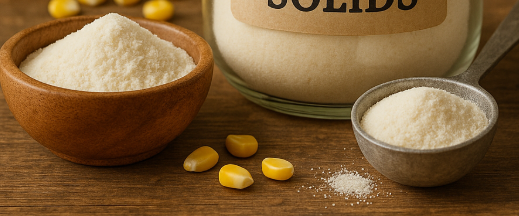
Dry, free-flowing powders obtained by dehydrating corn glucose syrup, used to deliver sweetness, body, bulking, and freeze–thaw stability.
Defined by dextrose equivalent (DE): glucose syrup solids typically DE ~20–95; products with DE <20 are commonly classified as maltodextrins.
Color white to off-white, neutral aroma/flavor; instant or regular solubility grades.
Caloric value (per 100 g)
~360–400 kcal/100 g (carbohydrate-based).
Typical macros (db): carbohydrate ~95–99 g, protein <0.5 g, fat <0.5 g, ash ~0.1–0.5 g; moisture ≤4–6%.
Key constituents
D-glucose (dextrose), maltose, and glucose oligomers (degree depends on DE).
Fructose: may be minimal in standard glucose syrup solids, but elevated when solids are derived from isomerized syrup (i.e., HFCS solids) or blended with crystalline fructose—verify label/spec.
Process markers: HMF (hydroxymethylfurfural) and color (ICUMSA) increase with heat load; aw is low in finished powder.
Production process
Corn starch → liquefaction (α-amylase) → saccharification (glucoamylase; optional isomerase for fructose-containing syrups) → refining (decolor/deionize) → concentration → spray-drying (with carriers if needed) → sieving and packing.
Managed under GMP/HACCP with CCP on enzyme inactivation, microbiology, moisture, and seal integrity.
Sensory and technological properties
Sweetness rises with DE; mouthfeel/body decrease as molecules get smaller.
Humectancy and freezing point depression improve with higher DE (useful in ice creams and frozen desserts).
Low hygroscopicity grades for coatings/tablets; high DE grades are more hygroscopic and brown more readily (Maillard/caramelization).
Food uses
Baked goods (crust color, moisture retention), confectionery (control crystallization/chew), ice cream/frozen desserts (body, anti-crystallization), beverages (sweetness and solids), meat/processed foods (bulking, surface browning), dry mixes, infant formulas (specific specs).
Typical use levels: 2–25% of formula solids, tuned to DE target and processing.
Nutrition and health
Added sugars source providing rapidly digestible carbohydrates; glycemic index (GI) generally high at higher DE.
Avoid excessive intake of sugar
- Fructose considerations: where fructose is present at high levels (e.g., HFCS solids or crystalline fructose blends), excessive intake of free fructose is debated in relation to energy overconsumption, weight gain, cardiometabolic risk, and type 2 diabetes; individuals with hereditary fructose intolerance (HFI) must avoid fructose-containing products.
- Dental caries risk similar to other sugars; encourage portion control and oral hygiene.
Quality and specifications (typical topics)
DE (e.g., 28, 42, 63, 90), moisture ≤4–6%, ash ≤0.5%, sulfated ash very low, bulk density, particle size/flowability, pH (10% soln.) ~4.0–6.5, color (ICUMSA), HMF.
Microbiology: low total counts; pathogens absent/25 g.
Contaminants: heavy metals, mycotoxins (from corn) within limits; residual enzymes inactivated.
Storage and shelf-life
Store cool, dry, sealed; avoid humidity (caking) and heat (browning).
Typical shelf-life 12–24 months in barrier packaging; reseal promptly after opening.
Allergens and safety
Derived from corn; gluten-free by process when made from pure maize starch on dedicated lines.
Possible soy/wheat/milk traces from shared facilities—label where applicable.
For infant/medical nutrition, use only grades meeting the applicable pharm/food-code specifications.
INCI functions in cosmetics
Related INCI names: Glucose, Maltodextrin, Hydrolyzed Starch (roles: humectant, viscosity-increasing, film-forming, masking).
Troubleshooting
Caking/clumping: high RH or warm storage → improve barrier pack, add desiccant, switch to coarser or low-hygroscopicity grade.
Excess browning in baking: DE too high or high heat → select lower DE grade, reduce time/temperature, adjust leavening.
Texture too soft in confections: too much high-DE syrup solids → reduce level or blend with maltodextrin (DE <20).
Ice crystals in frozen desserts: insufficient high-DE solids → increase level or blend DE grades for optimal freezing point depression.
Label conflict on fructose: confirm whether product is glucose syrup solids vs HFCS solids/crystalline fructose and label accordingly.
Sustainability and supply chain
Sourced from maize; impacts tied to agriculture, enzyme/energy use, and drying. Improve via energy recovery, water recycling, and effluent control to BOD/COD targets; use recyclable packaging and maintain full traceability under GMP/HACCP.
Conclusion
Glucose syrup solids are versatile bulking/sweetening carbohydrates whose behavior is governed by DE and process history. Proper selection (including fructose content where relevant), plus control of moisture and storage, delivers consistent texture, sweetness, and stability across applications.
Mini-glossary
DE — Dextrose equivalent: Percentage of reducing sugars as dextrose; higher DE → higher sweetness, lower viscosity, greater hygroscopicity.
HFCS — High-fructose corn syrup: Isomerized glucose syrup with elevated fructose; when dried (“HFCS solids”) or blended with crystalline fructose, fructose levels are high.
HMF — Hydroxymethylfurfural: Heat/acid degradation marker of sugars; rises with harsh processing/storage.
GI — Glycemic index: Relative rise in blood glucose; typically higher for high-DE syrup solids.
aw — Water activity: “Free” water; low aw in powders improves shelf stability.
GMP/HACCP — Good Manufacturing Practice / Hazard Analysis and Critical Control Points: Hygiene/preventive systems with defined CCP.
CCP — Critical control point: Processing step where control prevents/reduces a hazard (e.g., enzyme kill, moisture/seal).
BOD/COD — Biochemical/Chemical oxygen demand: Wastewater impact indicators for starch-processing plants.
Studies
Glucose syrup is a composite solution that combines various sugars such as glucose, maltose and various others. It is obtained from corn starch.
It is used as a sweetener in the food sector to be added to:
- Chocolate
- Dark sugar
- Candies
- Bakery products
- Ice creams
There is growing evidence that consumption of added sugars play a role in the recent increase of metabolic diseases: 1) The intake of derived caloric sweeteners has increased in conjunction with rising prevalence of obesity; 2) Epidemiologic data and experimental studies show a positive correlation between sugar, fructose or sweetened beverages consumption and component of the metabolic syndrome (1).
Studies in animals have documented that, compared with glucose, dietary fructose induces dyslipidemia and insulin resistance. To assess the relative effects of these dietary sugars during sustained consumption in humans, overweight and obese subjects consumed glucose- or fructose-sweetened beverages providing 25% of energy requirements for 10 weeks. Although both groups exhibited similar weight gain during the intervention, visceral adipose volume was significantly increased only in subjects consuming fructose. Fasting plasma triglyceride concentrations increased by approximately 10% during 10 weeks of glucose consumption but not after fructose consumption. In contrast, hepatic de novo lipogenesis (DNL) and the 23-hour postprandial triglyceride AUC were increased specifically during fructose consumption. Similarly, markers of altered lipid metabolism and lipoprotein remodeling, including fasting apoB, LDL, small dense LDL, oxidized LDL, and postprandial concentrations of remnant-like particle–triglyceride and –cholesterol significantly increased during fructose but not glucose consumption. In addition, fasting plasma glucose and insulin levels increased and insulin sensitivity decreased in subjects consuming fructose but not in those consuming glucose. These data suggest that dietary fructose specifically increases DNL, promotes dyslipidemia, decreases insulin sensitivity, and increases visceral adiposity in overweight/obese adults (2).
Chronic sugar-sweetened beverage (SSB) consumption is associated with obesity and type 2 diabetes mellitus (T2DM). Hyperglycaemia contributes to metabolic alterations observed in T2DM, such as reduced oxidative capacity and elevated glycolytic and lipogenic enzyme expressions in skeletal muscle tissue. We aimed to investigate the metabolic alterations induced by SSB supplementation in healthy individuals and to compare these with the effects of chronic hyperglycaemia on primary muscle cell cultures. The major finding of this work is that 4 weeks of periodic high glucose availability can induce metabolic alterations in skeletal muscle in vivo comparable to adaptations of muscle cells towards chronic hyperglycaemic conditions in vitro. Because of the limited duration of the SSB supplementation, for evident ethical reasons and its periodic nature, 2 drinks per day, in vivo skeletal muscle metabolic changes were visible mainly at mRNA level. However, a clear metabolic shift towards carbohydrates was detectible at a protein level in vitro (3).
48 healthy people of normal weight and age between 25 and 47 years were administered daily, 75 grams of glucose equal to 300 calories, 33 grams of cream equal to 300 calories and orange juice equal to 300 calories. At the end of the study, orange juice had not produced any change in inflammatory indexes, while glucose had increased some indexes and cream had increased all of them (4).
Glucose, in essence, should be taken with caution, while the consumption of fructose should be reduced to a minimum.
Molecular Formula: C6H14O7
Molecular Weight: 198.171 g/mol
CAS: 8029-43-4 77029-61-9
EC Number: 232-436-4
Synonyms:
- Hydrolyzed starch syrups
- D-Glucopyranose, monohydrate (9CI)
- Corn syrup
- D-Glucopyranose, monohydrate
- Syrups, hydrolyzed starch
- Corn sugar syrup
- Syrups, corn

