Caseinate (milk caseinates)
Description
Salts of milk casein (mainly sodium, potassium, or calcium caseinate) obtained by neutralizing acid casein. Functional dairy proteins, water-dispersible, with strong emulsifying, stabilizing, binding, and water-holding properties.
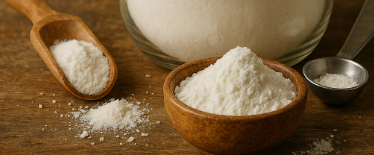
Appearance: white to cream powder, neutral to lightly lactic note; high solubility near neutral pH, reduced solubility close to the isoelectric point.
Caloric value (per 100 g)
Typically ~350–380 kcal/100 g.
Indicative composition (dry basis): protein ~88–92%, fat ~0.5–2%, carbohydrate (residual lactose) ~0.5–3%, ash ~4–6% (varies with the salt). Sodium is higher in sodium caseinate; calcium higher in calcium caseinate.
Key constituents
Caseins (αs1, αs2, β, κ) with a complete essential amino-acid profile (high PDCAAS/DIAAS).
Minerals: Na/K/Ca bound to the protein; phosphorus (phosphoserine residues).
Trace lactose; controlled moisture.
Typical analytics: protein on dry matter, insolubility index / NSI, dispersion pH ≈6.5–7.0, moisture ≤6–8%, particle size, microbial counts.
Production process
Skim milk → acidification (starter or mineral acid) to pI ≈4.6 → precipitate acid casein → wash and press.
Neutralization with NaOH/KOH/Ca(OH)₂ → corresponding caseinate → emulsify/homogenize → spray-dry → sieve and pack.
Quality under GMP/HACCP with CCP on pH/neutralization, heavy metals, microbiology, moisture, and seal integrity.
Sensory and technological properties
Functionality: excellent emulsification of fats, foam stabilization, water binding (improves yield/juiciness).
Solubility: high at pH 6–7; precipitation near pI; calcium caseinate is generally less soluble than sodium/potassium caseinate.
Heat stability: good in slightly acidic to neutral systems; flocculation at low pH.
Maillard reactivity present under prolonged heating in the presence of sugars.
Food uses
Processed meats (binder, water retention, yield).
Emulsified sauces, soups/cream soups, processed/cheese sauces, ice cream (body), desserts/creams.
Protein beverages, bars, meal replacements (slow AA release).
Coffee creamers/whiteners; bakery (structure) and coatings.
Typical use levels: 0.3–2% (tune to target texture and stability).
Nutrition and health
Complete protein with high PDCAAS/DIAAS; casein provides slow amino-acid release.
Sodium: sodium caseinate raises Na intake—consider for low-sodium diets.
Low lactose but not zero—note for severe lactose intolerance.
Allergy: milk protein → contraindicated for milk-allergic individuals; not vegan.
Quality and specifications (typical topics)
Protein ≥88–90% db, moisture ≤6–8%, fat ≤2%, insolubility/NSI within spec, pathogens absent/25 g and low totals.
Metals/pesticides compliant; good flowability, no lumps; neutral color/odor.
Labeling: declare salt type (e.g., Sodium Caseinate), milk allergen, and any added emulsifiers/flavors.
Storage and shelf-life
Store dry, tightly closed, away from light and odors; avoid humidity (caking).
Typical shelf-life 12–24 months in barrier packs; reclose promptly after use.
Allergens and safety
Contains milk (major allergen). Possible traces of soy, gluten, egg from mixed facilities.
Follow GMP/HACCP; key CCP: neutralization pH, microbiology, foreign-body control.
INCI functions in cosmetics
Sodium Caseinate, Potassium Caseinate, Calcium Caseinate: film-forming, skin/hair conditioning, viscosity-increasing, binding roles in specific formulations.
Troubleshooting
Poor solubility/lumps: disperse into water at ≤25–35 °C, rain-in under high shear, adjust pH to 6.6–7.0.
Precipitation in acidic systems: pH near pI → raise pH, use stabilizers, or consider whey proteins in blends.
Chalky/lactic note: excessive dose or low grade → reduce level, choose fine spray-dried grade.
Excess viscosity: over-hydration → lower solids, increase process temperature within limits.
Browning during cooking: Maillard → reduce available sugars, shorten time/temperature.
Sustainability and supply chain
Sourced from the dairy chain (notable GHG/water footprint); mitigation via energy efficiency, heat/solvent recovery, and effluent control to BOD/COD targets.
Recyclable packaging, low-humidity logistics; full traceability under GMP/HACCP.
Conclusion
Caseinates are versatile functional proteins with high nutritional quality and strong emulsifying/binding/stabilizing performance across many applications. Salt selection (Na/K/Ca), pH, and hydration method determine solubility, texture, and finished-product stability.
Mini-glossary
pI — Isoelectric point: pH where net protein charge is ~0 (casein ≈ 4.6), with minimal solubility.
NSI — Nitrogen solubility index: standardized index of protein solubility.
PDCAAS — Protein digestibility-corrected amino acid score: legacy index for protein quality (essential AA + digestibility).
DIAAS — Digestible indispensable amino acid score: modern index of protein quality based on ileal digestibility.
GMP/HACCP — Good Manufacturing Practice / Hazard Analysis and Critical Control Points: hygiene/preventive systems with defined CCP.
CCP — Critical control point: step where a control prevents/reduces a hazard (e.g., neutralization pH, sealing).
aw — Water activity: “free” water; lower aw improves powder stability.
BOD/COD — Biochemical/Chemical oxygen demand: indicators of wastewater impact from processing.
References__________________________________________________________________________
Hassan L, Xu C, Boehm M, Baier SK, Sharma V. Ultrathin Micellar Foam Films of Sodium Caseinate Protein Solutions. Langmuir. 2023 May 2;39(17):6102-6112. doi: 10.1021/acs.langmuir.3c00192.
Abstract. Sodium caseinates (NaCas), derived from milk proteins called caseins, are often added to food formulations as emulsifiers, foaming agents, and ingredients for producing dairy products. In this contribution, we contrast the drainage behavior of single foam films made with micellar NaCas solutions with well-established features of stratification observed for the micellar sodium dodecyl sulfate (SDS) foam films. In reflected light microscopy, the stratified SDS foam films display regions with distinct gray colors due to differences in interference intensity from coexisting thick-thin regions. Using IDIOM (interferometry digital imaging optical microscopy) protocols we pioneered for mapping nanotopography of foam films, we showed that drainage via stratification in SDS films proceeds by the expansion of flat domains that are thinner than surrounding by a concentration-dependent step-size, and nonflat features (nanoridges and mesas) form at the moving front. Furthermore, stratifying SDS foam films show stepwise thinning, such that the step-size and terminal film thickness decrease with concentration. Here we visualize the nanotopography in protein films with high spatiotemporal resolution using IDIOM protocols to address two long-standing questions. Do protein foam films formulated with NaCas undergo drainage via stratification? Are thickness transitions and variations in protein foam films determined by intermicellar interactions and supramolecular oscillatory disjoining pressure? In contrast with foam films containing micellar SDS, we find that micellar NaCas foam films display just one step, nonflat and noncircular domains that expand without forming nanoridges and a terminal thickness that increases with NaCas concentration. We infer that the differences in adsorbing and self-assembling unimers triumph over any similarities in the structure and interactions of their micelles.
Liu J, Liu W, Salt LJ, Ridout MJ, Ding Y, Wilde PJ. Fish Oil Emulsions Stabilized with Caseinate Glycated by Dextran: Physicochemical Stability and Gastrointestinal Fate. J Agric Food Chem. 2019 Jan 9;67(1):452-462. doi: 10.1021/acs.jafc.8b04190.
Abstract. Incorporation of fish oil containing ω-3 polyunsaturated fatty acids (PUFAs) into functional foods remains challenging. In this study, caseinate and glycoconjugates (CD6, CD40, CD70, CD100) of caseinate to dextrans of different molecular weights (D6, D40, D70, D100 kDa) were used to stabilize fish oil emulsions, and the impact on physicochemical stability and gastrointestinal fate was investigated. The glycoconjugate of CD6 exhibited significantly higher conjugation efficiency, lower surface hydrophobicity ( H0), and lower surface activity than other glycoconjugates. The glycoconjugate of CD70 displayed the best emulsifying activity and emulsion stability. Except CD6 stabilized emulsions, all other emulsions showed fine storage stability over 14 d at 22 ± 1 °C. The glycoconjugate stabilized emulsions exhibited significantly lower peroxide value (PV) ( P < 0.05) than that of the caseinate stabilized one. During in vitro gastrointestinal tract digestion, the glycation of caseinate with dextrans changed the ζ-potential, average particle size ( D32), and particle size distribution of the emulsions, which influenced flocculation and coalescence of droplets, as demonstrated by confocal microscopy. Caseinate after glycation with dextrans significantly retarded the release of free fatty acids from emulsions ( P < 0.05) during in vitro lipolysis. These results suggested that the dextrans attached to caseinate by glycation played a vital role in physicochemical stability and gastrointestinal fate of emulsions, mainly by its steric hindrance to effectively prevent flocculation and coalescence of droplets.
Patel AR, Bouwens EC, Velikov KP. Sodium caseinate stabilized zein colloidal particles. J Agric Food Chem. 2010 Dec 8;58(23):12497-503. doi: 10.1021/jf102959b.
Abstract. The present work deals with the preparation and stabilization of zein colloidal particles using sodium caseinate as electrosteric stabilizer. Colloidal particles with well-defined size range (120-150 nm) and negative surface potential (-29 to -47 mV) were obtained using a simple antisolvent precipitation method. Due to the presence of caseinate, the stabilized colloidal particles showed a shift of isoelectric point (IEP) from 6.0 to around pH 5.0 and thus prevent the aggregation of zein near its native IEP (pH 6.2). The particles also showed good stability to varying ionic strength (15 mM-1.5 M NaCl). Furthermore, stabilized particles retained the property of redispersibility after drying. In vitro protein hydrolysis study confirmed that the presence of caseinate did not alter the digestibility of zein. Such colloidal particles could potentially serve as all-natural delivery systems for bioactive molecules in food, pharmaceutical, and agricultural formulations.
Anjani G, Ohta A, Yasuhara K, Asakawa T. Solubilization of genistein by caseinate micellar system. J Oleo Sci. 2014;63(4):413-22. doi: 10.5650/jos.ess13198.
Abstract. This study investigates the aggregation behavior of caseinate and the solubilization of genistein in aqueous caseinate solution. The critical aggregation concentration (CAC) of caseinate was obtained from the fluorescence intensity of 8-anilino-1-naphthalenesulfonic acid (ANS), which was enhanced by ANS-protein interactions and the hydrophobicity of caseinate. The increasing solubility of genistein in caseinate was confirmed by HPLC measurements; above and below the CAC, the genistein/caseinate molar ratio is 1:1 and 10:1, respectively. The latter ratio indicates that more caseinate molecules surround genistein below the CAC. However, the solubility of genistein in caseinate is unaffected by calcium ions. Atomic force microscopy (AFM) shows that casein sub-micelles are similarly structured in the presence and absence of genistein. In AFM phase images, the caseinate sub-micelle is brightened in the presence of genistein, implying that the particle becomes more rigid, probably because genistein attaches to the surface or to the narrow part of the sub-micelle. The diameter of sub-micelle aggregates is two times that of caseinate alone (24 nm versus 12 nm). These results were confirmed by cryo-TEM observations.
Jordan KV, Drouillard JS, Douthit TL, Lattimer JM. Effects of sodium caseinate on hindgut fermentation and fiber digestion in horses. J Anim Sci. 2019 Feb 1;97(2):813-819. doi: 10.1093/jas/sky436.
Abstract. Eight cecally cannulated Quarter Horses were used in a replicated 4 × 4 Latin square experiment conducted in four 14-d periods to determine effects of sodium caseinate (casein) on hindgut fermentation and fiber digestion. During each period, horses were assigned to one of four treatments consisting of control (water; CON), 0.125 g casein/kg BW (LOW), 0.25 g casein/kg BW (MED), or 0.5 g casein/kg BW (HI). Casein was solubilized in 800 mL water and dosed directly into the cecum at 0700 and 1900 hours using a metal dosing syringe. Smooth Bromegrass hay (CP 8.50%), water, and salt were provided ad libitum. New hay was fed at 0700 and 1900 hours, and orts were recorded at 1900 daily. During the final 3 d of each period, cecal digesta were collected every 6 h, pH was measured, and samples were frozen for subsequent analyses of VFA and NH3 concentrations. Feed intake during the final 4 d of each period was recorded. Feces were collected during the 3-d sampling period, pooled, subsampled, and frozen. Fecal samples were analyzed for pH and used to determine digestibilities of DM, OM, NDF, and ADF. Statistical analyses were performed via the GLIMMIX procedure of SAS 9.4. Linear and quadratic effects of sodium caseinate on pH, VFA concentrations, and apparent digestibility were assessed by SAS. Digestibilities of DM, OM, ADF, and NDF were unaffected by treatment (P > 0.40). Horses dosed with CON and MED treatments had greater cecal pH than those fed LOW or HI treatments (P < 0.01). Cecal NH3 concentrations increased linearly in response to the amount of casein administered (P < 0.01). Cecal NH3 decreased 6 h after dosing and addition of new hay, regardless of treatment (P < 0.01). Total cecal VFA were unaffected by treatment (P > 0.10), but VFA changed over time with the greatest concentrations observed 6 h after treatments were administered and introduction of new hay (P < 0.01). Treatment did not affect DMI (P ≥ 0.17). In this experiment, cecal infusions of sodium caseinate had minimal to no effect on fermentation parameters or fiber degradation in the horse. A type II error may have occurred due to small population size or the medium quality hay fed to these horses provided sufficient N for microbial fermentation.




