



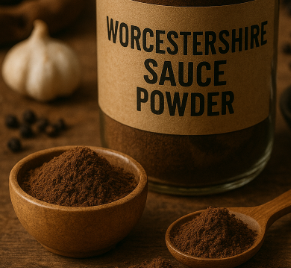
Worcestershire sauce powder
Description
• Dehydrated seasoning made by spray-drying concentrated Worcestershire sauce onto a carrier (e.g., maltodextrin, glucose syrup solids, starch), often followed by agglomeration for easy dispersion.
• Liquid base typically contains vinegar, molasses/sugars, salt, anchovy extract, tamarind, garlic, onion, spices, and flavorings; some formulas include caramel color (E150).
• Sensory profile: tangy–salty with pronounced umami, caramel/roasty notes, and spice; amber–brown color when reconstituted.
Caloric value (per 100 g)
• Powder: typically ~200–380 kcal/100 g (varies with carrier and solids).
• Reconstituted (e.g., 1:4 powder:water): ~10–25 kcal/100 ml—actual value depends on dilution and the manufacturer’s recipe.
• Sodium can be high; check the nutrition panel.
Key constituents
• Organic acids: mainly acetic acid (from vinegar); traces of tartaric acid (tamarind).
• Sugars: sucrose, glucose, fructose (from molasses/added sugars).
• Amino acids/peptides from fish (anchovy) providing umami; salt (NaCl).
• Maillard products/caramel color (body and color); spice volatiles (eugenol, aldehydes, etc.).
• Carriers: maltodextrin/glucose syrup/starches (must be labeled).
Production process
• Prepare Worcestershire base (macerate/infuse spices; dissolve vinegar, molasses, tamarind, salt, extracts) → concentrate → spray-dry with selected carrier → optional agglomeration for wettability → screen and barrier-pack under GMP/HACCP.
• Some producers use encapsulation to enhance aroma stability.
Sensory and technological properties
• Delivers acidity, saltiness, and umami; rounds flavors and binds meaty/smoky notes.
• Highly soluble in water; in dry mixes, adds flavor and color without raising water activity much.
• Compatibility: synergistic with sugars, tomato, soy, mustard; watch caking at high RH.
Food uses
• Dry rubs and marinades, snack seasonings, BBQ sauces, glazes for meats, soups/broths, ready meals, cured meats and deli applications.
• Typical inclusion: 0.2–1.5% in dry mixes; 0.5–3% in sauces (or per supplier’s reconstitution guide). Validate via pilot trials.
Nutrition and health
• Often high in sodium → consider reduced-salt grades or balance at recipe level.
• May contain added sugars (molasses) → consider overall glycemic load of the final food.
• Avoid unauthorized health claims.
Lipid profile
• Total fat negligible; SFA, MUFA, PUFA only in trace amounts—nutritional impact is minimal at use levels.
Quality and specifications (typical topics)
• Moisture and aw (stability), particle size, bulk density, color (Lab*), solubility.
• On reconstituted solution: salt (NaCl), total acidity (as acetic acid), pH.
• Microbiology: low counts consistent with aw and acidity; absence of pathogens.
• Authenticity/allergens: verify raw materials (fish, gluten, soy, celery/mustard); metals/pesticides within limits.
Storage and shelf-life
• Store cool, dry, protected from light/odors in moisture-barrier packaging; keep tightly closed.
• Avoid high RH to prevent caking; consider desiccant sachets.
• Typical shelf-life 12–24 months when in spec (FIFO).
Allergens and safety
• Fish (anchovy) is a major EU allergen.
• Possible allergens: gluten (malt or wheat-derived vinegars), soy, celery, mustard; sulfites may be present depending on ingredients/process.
• Clearly label allergens; prevent cross-contact; manage CCP within HACCP.
INCI functions in cosmetics
• Uncommon as-is; related aromatic extracts would fall under fragrance/flavor and require IFRA assessment.
Troubleshooting
• Caking/clumps: high RH → upgrade barrier, add permitted anti-caking, use agglomerated grades.
• Aroma loss: oxygen/temperature → barrier packs, O₂ scavengers, strict FIFO.
• Non-uniform dissolution: pre-slurry in warm water before full make-up; prefer agglomerated powders.
• Too acidic/salty profile: rebalance with sugars, fats, or starches; adjust dilution.
Sustainability and supply chain
• Powder form reduces water transport, potentially lowering CO₂ footprint vs liquid.
• Manage liquid-line effluents to BOD/COD targets; recyclable packaging; full traceability under GMP/HACCP.
• Prefer carriers from certified supply chains.
Conclusion
Worcestershire sauce powder delivers acidity, umami, and aromatic complexity in a dry, doseable, and stable format. Careful carrier selection, tight control of moisture/aw, and accurate allergen declaration ensure consistent performance in sauces, snacks, and culinary preparations.
Mini-glossary
• aw — Water activity: lower aw improves microbial stability of powders.
• °Brix — Total soluble solids: useful on reconstituted solutions to estimate body/sweetness.
• pH — Acidity measure; guides stability and taste perception.
• SFA — Saturated fatty acids: excessive intake may raise LDL; trace here.
• MUFA — Monounsaturated fatty acids (e.g., oleic): generally neutral/favorable; trace here.
• PUFA — Polyunsaturated fatty acids (n-6/n-3): beneficial when balanced; trace here.
• GMP/HACCP — Good Manufacturing Practice / Hazard Analysis and Critical Control Points: hygiene and preventive-safety frameworks; define CCP.
• BOD/COD — Biochemical/Chemical Oxygen Demand: indicators of wastewater organic load.
• FIFO — First in, first out: inventory rotation using older lots first.
• CCP — Critical control point: a step where a control prevents or reduces a specific hazard.

