



Coconut sugar (Cocos nucifera L.)
Crystalline sweetener produced from the sap of coconut inflorescences (coconut blossom sap), concentrated and crystallized. Sold as coarse or fine granules and as powder; color ranges from amber to brown with caramel/toffee notes. Distinct from generic “palm sugar” (other palm species) and from adulterated products cut with cane sucrose.
Caloric value (per 100 g)
~375–400 kcal/100 g (predominantly sucrose; typical moisture 1–3%).
Key constituents
Sugars: sucrose typically ~70–85%; glucose + fructose ~5–15% combined.
Minerals: relatively high K; Mg, Ca, Zn in smaller amounts (ash ~0.5–2%).
Process-derived compounds: HMF and melanoidins from concentration/heating.
Typical parameters: moisture 1–3%, L*a*b* color, granulometry (D90), bulk density.
Lipid profile (per 100 g; always reported)
Total fat: <0.5 g/100 g (negligible).
SFA/MUFA/PUFA (n-6/n-3): trace, not nutritionally significant.
Trans/CLA: absent. Cholesterol: absent.
Production process
Inflorescence tapping → pre-filtration → concentration (film/vacuum evaporators or traditional kettle) to high solids → crystallization and granulation (refining/sieving) → cooling and final drying/dehumidification → barrier packaging. “Soft” styles retain slightly higher moisture.
Sensory and technological properties
Aroma/color: caramel, toffee, malt; amber–brown tones.
Functionality: sweetener with pronounced browning (Maillard/caramelization), slight humectancy; sweetness index slightly lower than white sucrose.
Compatibility: dissolves readily in hot liquids; for cold systems use fine particle sizes or a syrup pre-solution. Prone to caking at high RH.
Food applications
Bakery/pastry (cakes, cookies, muffins), granola/bars, hot/instant beverages, sauces and toppings, ice creams/sorbets, chocolate/ganache for toffee notes.
Indicative dosages: generally 1:1 vs white sugar for sweetness; consider slightly lower baking temperature to moderate browning.
Nutrition and health
Supplies simple sugars; minerals present but modest quantitatively. GI (glycemic index) is variable with composition/process—avoid unsubstantiated “low-GI” claims. Fat is negligible; no cholesterol.
Quality and specifications (typical topics)
Moisture/aw, granulometry (D90), L*a*b* color, ash/minerals, HMF (thermal severity), insoluble impurities.
Microbiology: compliant TVC/Y&M (low-aw product).
Authenticity: distinction from other palm sugars and from cane sucrose via IRMS (δ¹³C) and sugar profiling.
Contaminants: metals/pesticides within limits.
Storage and shelf life
Store cool, dry, and dark in low-permeability containers; keep RH <60% to prevent caking. Reseal to minimize headspace; apply FIFO. Powders are more hygroscopic.
Allergens and safety
Coconut is not among the EU major 14 allergens (check local rules; in some jurisdictions it is treated as a “tree nut” for labeling). Low-aw product with generally low microbiological risk.
INCI functions in cosmetics
Typical entry: Sucrose (origin: coconut sugar).
Roles: humectant, physical exfoliant (fine grades), osmotic viscosifier; ensure adequate preservation in aqueous systems.
Troubleshooting
Caking/clumps → high RH or poor packaging → upgrade barrier, add permitted anti-caking aids, or finish-dry.
Excessive browning in baking → high time/temperature → lower setpoint, increase dough moisture, or replace a portion with white sucrose.
Burnt/ bitter notes → high HMF from overheating → reduce thermal severity.
Slow dissolution in cold systems → coarse particles → use fine/powder or pre-dissolve.
Sustainability and supply chain
Tapping does not fell the palm (continuous yield). Improve footprint via efficient evaporation, heat recovery, effluent management to BOD/COD targets, recyclable packaging, and controlled RH/T in logistics.
Conclusion
Coconut sugar is an aromatic sweetener with strong browning behavior, ideal for recipes seeking caramel/toffee notes. Performance depends on particle size, moisture, thermal parameters (HMF/color), and humidity protection, with a negligible lipid profile.
Mini-glossary
°Brix — soluble solids of the starting sap.
HMF — 5-hydroxymethylfurfural (thermal marker).
aw — water activity.
RH — relative humidity.
L*a*b* — CIELAB color space.
D90 — 90th-percentile particle diameter (fineness).
GI — glycemic index.
IRMS (δ¹³C) — isotope-ratio mass spectrometry (authenticity test).
TVC/Y&M — total viable count / yeasts and molds.
FIFO — first in, first out.
SFA/MUFA/PUFA (n-6/n-3) — saturated/monounsaturated/polyunsaturated fatty acids (omega-6/omega-3).
BOD/COD — biochemical/chemical oxygen demand (effluent load).
HACCP — hazard analysis and critical control points.
Studies
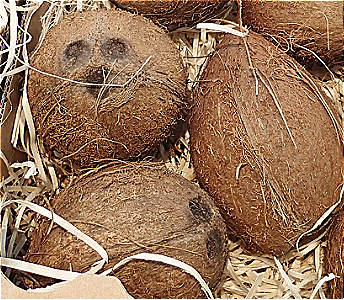
There are two groups of coconut trees: tall and dwarf. The tall variety gives fruits between 6 and 10 years, while the dwarf variety between 4 and 5 years. The coconut is quite caloric, 354 calories in 10 grams of pulp.
Content (1):
- Ascorbic acid
- Caffeic acid
- Vitamin B3, nicotinic acid or niacin
- Vitamin B5, pantothenic acid
- Vitamin B7, biotin
- Vitamin B2, riboflavin
- Vitamin B9, folic acid
- traces of vitamin B1 thiamine
- traces of vitamin B6 pyridoxine
- selenium
- sugars
- L-Arginine
- Lauric acid
- Myristic acid
- Palmitic acid
The kernel contains about 70% oil that is used in cosmetics and nutrition.
What it is used for and where
Medical
The ethanol extract at 1.5% of the coconut husk has shown an antibacterial action against dental biofilm and can be used as an irrigation solution to overcome bacterial resistance with synthetic agents (2).
Some components of green dwarf coconut water, mainly caffeic acid and ascorbic acid, have demonstrated antioxidant and hepatoprotective activity and reduce DNA damage, thus reducing oxidative stress induced by ethanol metabolism in steatosis and alcoholic steatohepatitis (3).
Coconut water has been used as an intravenous solution in surgery (4).
This study believes that the fiber extract from the lemon peel acts, in certain amounts, on the central nervous system. The resulting anxiolytic and antidepressant effect is related by interaction with the serotonergic system (5).
Cosmetics
Coconut is used as a topical skin care treatment and for repairing the natural function of the skin barrier (6) due to the emollient and anti-infective properties of phenolic acids, vitamins and flavonoids.
Emollients have the characteristic of enhancing the skin barrier through a source of exogenous lipids that adhere to the skin, improving barrier properties by filling gaps in intercorneocyte clusters to improve hydration while protecting against inflammation. Emollients are described as degreasing or refreshing additives that improve the lipid content of the upper layers of the skin by preventing degreasing and drying of the skin. The problem with emollients is that many have a strong lipophilic character and are identified as occlusive ingredients; they are oily and fatty materials that remain on the skin surface and reduce transepidermal water loss. In cosmetics, emollients and moisturisers are often considered synonymous with humectants and occlusives.
Safety
Coconut and its derived products were initially classified as unhealthy due to the significant presence of fatty acids believed to be saturated, but scientific research has recently shown that there are in fact medium-chain fatty acids (7). In particular, lauric acid, as a primary fatty acid behaves as a medium and long chain fatty acid (8).
The most relevant studies have been selected to explore this in more depth:

