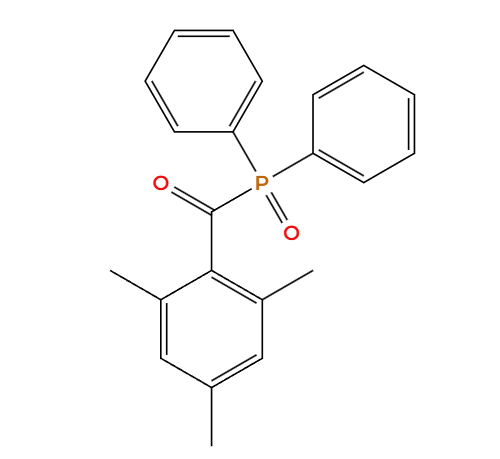
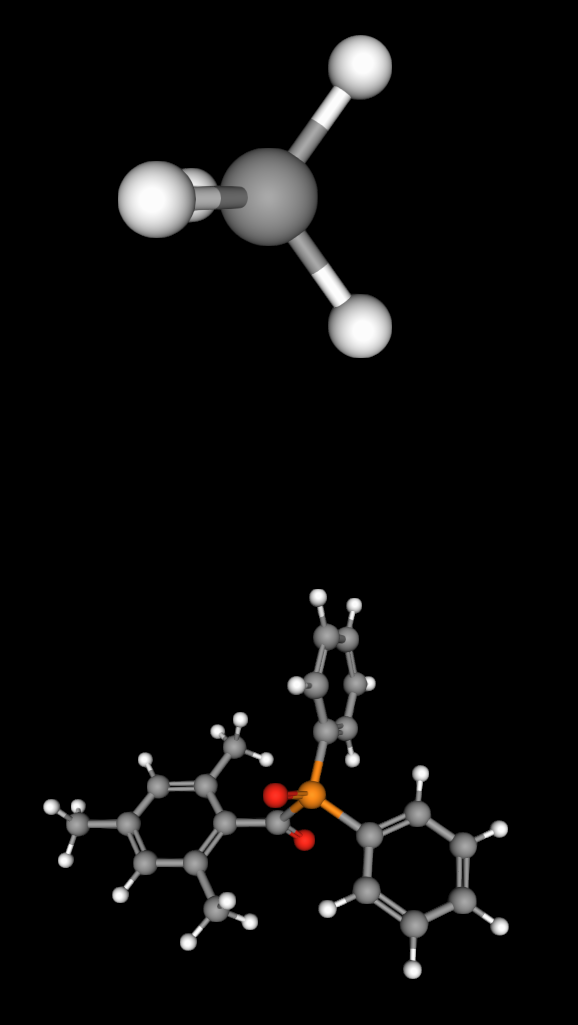
Trimethylbenzoyl diphenylphosphine oxide (TPO) is a high-efficiency organic photoinitiator used in UV-curable systems. Its primary role in cosmetics—particularly in UV nail gels—is to initiate free-radical polymerization when exposed to ultraviolet (UV-A) light, allowing rapid, even curing of formulations.
TPO is also widely used in coatings, adhesives, dental resins, and high-performance polymers due to its excellent light absorption and curing depth.
1. Chemical structure and physical properties
IUPAC name: [2,4,6-trimethylbenzoyl]diphenylphosphine oxide
Molecular formula: C₂₂H₂₁O₂P
Molar mass: 364.38 g/mol
Chemical class: aromatic phosphine oxide
Functional groups: phosphine oxide (P=O), aromatic rings
Physical properties:
Appearance: white to pale yellow crystalline powder
Odor: virtually odorless
Melting point: 90–95 °C
Water solubility: insoluble
Solubility: soluble in acrylates, methacrylates, and organic solvents
UV absorption: strong peak around 380 nm (UV-A)
Stability: stable in visible light, reactive under UV light
2. Main constituents
TPO is a pure synthetic compound, but it is often used in conjunction with:
Other photoinitiators (e.g. benzoyl peroxide, camphorquinone)
Methacrylate or acrylate monomers
Polymer stabilizers to improve shelf-life and performance
These combinations improve polymerization speed, depth, and color stability.
3. Production or synthesis method
TPO is synthesized industrially via multi-step organic synthesis that includes:
Condensation of benzoyl precursors with aryl phosphine oxides
Reaction carried out under anhydrous and controlled conditions
Final purification through crystallization or vacuum distillation
It is not naturally occurring and is used exclusively in technical and polymer chemistry applications.
4. Functional properties
Parameter | Performance |
|---|
Photoreactivity | Very high under UV-A (365–400 nm) |
Curing depth | Excellent (even in thick layers) |
Polymerization speed | Fast |
Color stability | Low yellowing compared to BPO |
Compatibility | Good with acrylates and LED/UV dual systems |
5. Applications
In cosmetic formulations (professional use only):
UV-curable nail gels: initiates cross-linking and hardening
Hybrid LED/UV gel polishes: compatible with broad-spectrum lamps
Top coats and base gels: ensures hardness and gloss
Builder gels and thick layers: cures evenly throughout
CAS 75980-60-8
EC number 278-355-8
In non-cosmetic fields (for context only):
Dental materials: light-cured composites
UV adhesives: for electronics and optics
Clear coatings: scratch-resistant or high-gloss polymers
6. Safety and regulatory status
Skin irritation: may be irritating in raw form
Sensitization: possible if not fully cured
Phototoxicity: not phototoxic when fully polymerized
CLP (EU) classification:
Harmful to aquatic life with long-lasting effects
Not classified as CMR (carcinogenic, mutagenic, or reproductive toxicant)
Cosmetic regulation:
Use allowed only in UV-cured products (e.g., nail gels)
Not permitted in leave-on or rinse-off skin care products
Safe only when fully polymerized under correct UV exposure
EU Cosmetic Regulation (1223/2009): allowed with restrictions
IFRA: not applicable (not a fragrance compound)
7. Conclusion
TPO is a next-generation photoinitiator valued for its fast-curing performance, deep penetration, and low yellowing potential in UV-cured cosmetic systems—particularly in nail gels and LED-compatible hybrid polishes. Its use is restricted to professional, polymerized products and must be fully cured under appropriate UV or LED lamps to ensure safety and effectiveness.
When used according to guidelines, TPO contributes to durability, gloss, and aesthetic finish in nail cosmetics without compromising user safety.
The TPO is banned in the European Union from 1.9.2025
References__________________________________________________________________________
Zeng B, Cai Z, Lalevée J, Yang Q, Lai H, Xiao P, Liu J, Xing F. Cytotoxic and cytocompatible comparison among seven photoinitiators-triggered polymers in different tissue cells. Toxicol In Vitro. 2021 Apr;72:105103. doi: 10.1016/j.tiv.2021.105103. Epub 2021 Jan 29. Erratum in: Toxicol In Vitro. 2022 Sep;83:105411. doi: 10.1016/j.tiv.2022.105411. PMID: 33516932.
Kowalska A, Sokolowski J, Bociong K. The Photoinitiators Used in Resin Based Dental Composite-A Review and Future Perspectives. Polymers (Basel). 2021 Feb 2;13(3):470. doi: 10.3390/polym13030470.
Abstract. The presented paper concerns current knowledge of commercial and alternative photoinitiator systems used in dentistry. It discusses alternative and commercial photoinitiators and focuses on mechanisms of polymerization process, in vitro measurement methods and factors influencing the degree of conversion and hardness of dental resins. PubMed, Academia.edu, Google Scholar, Elsevier, ResearchGate and Mendeley, analysis from 1985 to 2020 were searched electronically with appropriate keywords. Over 60 articles were chosen based on relevance to this review. Dental light-cured composites are the most common filling used in dentistry, but every photoinitiator system requires proper light-curing system with suitable spectrum of light. Alternation of photoinitiator might cause changing the values of biomechanical properties such as: degree of conversion, hardness, biocompatibility. This review contains comparison of biomechanical properties of dental composites including different photosensitizers among other: camphorquinone, phenanthrenequinone, benzophenone and 1-phenyl-1,2 propanedione, trimethylbenzoyl-diphenylphosphine oxide, benzoyl peroxide. The major aim of this article was to point out alternative photoinitiators which would compensate the disadvantages of camphorquinone such as: yellow staining or poor biocompatibility and also would have mechanical properties as satisfactory as camphorquinone. Research showed there is not an adequate photoinitiator which can be as sufficient as camphorquinone (CQ), but alternative photosensitizers like: benzoyl germanium or novel acylphosphine oxide photoinitiators used synergistically with CQ are able to improve aesthetic properties and degree of conversion of dental resin.
Rudenko, Y., Kozlov, V., Burmistrov, D., Fedyakova, N., Bermeshev, M., & Chapala, P. (2025). Comprehensive investigation of phosphine oxide photoinitiators for vat photopolymerization. Progress in Additive Manufacturing, 1-14.
Abstract. Herein for the first time comprehensive analysis of commercial phosphine oxide-based photoinitiators was done for vat photopolymerization 3D printing resins. Resin accuracy, reactivity and cytotoxicity have been evaluated for the studied photoinitiators in different UV curable systems. Different methods for the accuracy assessment (pin hole, Dp) were used and it was shown that phenylbis(2,4,6-trimethylbezoyl)phosphine oxide (BAPO) possessed the highest x–y–z accuracy. It was shown that the increase of photoinitiator content in all cases resulted in the increase of accuracy and reactivity. The higher absorption value of a photoinitiator at a wavelength resulted in a higher reactivity and higher accuracy of corresponding VPP resin. It has been also estimated that for all studied samples, HSF cell viability was higher than 90%. Cell nuclei area and cell size have been also investigated in for the studied resins to evaluate the performance of photoinitiators after incubation with resin extracts and 3D printed parts. Newly developed 2,4,6-trimethylbenzoyl bis(4-methylphenyl)phosphine oxide (TMO) photoinitiator is considered as a more biocompatible alternative to the widely used 2,4,6-trimethylbezoyldiphenylphosphine oxide (TPO).