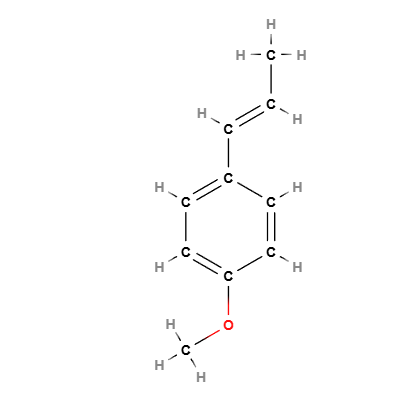
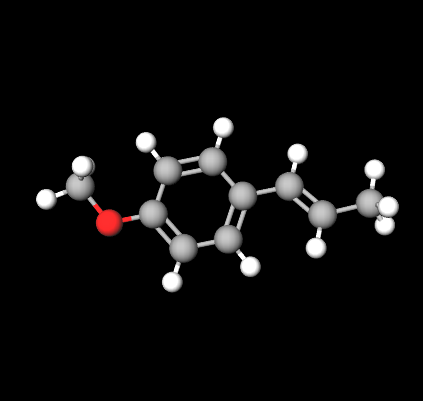
L’anetolo è un composto organico aromatico appartenente alla famiglia dei fenilpropanoidi. Si presenta come un eteroarene metossilato con formula molecolare C₁₀H₁₂O. È il principale responsabile dell’aroma caratteristico di anice, finocchio e anice stellato.
È utilizzato ampiamente come aroma naturale, ma anche per le sue proprietà antimicrobiche, antinfiammatorie e antifungine.
Proprietà chimiche
Nome IUPAC: 1-metossi-4-(1-propenil)benzene
Formula molecolare: C₁₀H₁₂O
Massa molare: 148,20 g/mol
Aspetto: liquido limpido incolore o leggermente giallo
Punto di fusione: circa 21 °C
Punto di ebollizione: circa 234 °C
Solubilità: poco solubile in acqua, molto solubile in etanolo, etere e oli
Isomeri
Esistono due isomeri geometrici:
trans-anetolo (la forma più abbondante e stabile, presente in natura)
cis-anetolo (meno stabile, può formarsi durante trattamenti termici o esposizione alla luce)
Fonti naturali
L’anetolo si trova principalmente in:
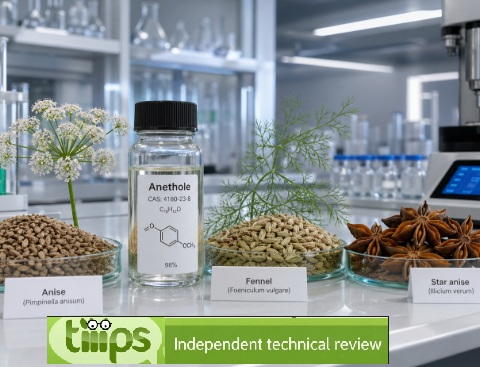
Anice verde (Pimpinella anisum)
Finocchio (Foeniculum vulgare)
Anice stellato (Illicium verum)
Basilico, dragoncello, chiodi di garofano (in quantità minori)
Nelle piante, è presente nell’olio essenziale, dove può costituire fino al 90% della composizione.
Proprietà organolettiche e biologiche
Odore e sapore: dolce, aromatico, simile alla liquirizia
Azione aromatizzante: molto potente, ne basta una bassa concentrazione
Attività antimicrobica: efficace contro batteri e lieviti
Attività antifungina: utile contro Candida albicans
Attività antinfiammatoria: evidenziata in studi preclinici
Effetto estrogenico debole: può mimare parzialmente gli estrogeni
Usi principali
Alimentare
Aromatizzante in prodotti da forno, caramelle, liquori (es. sambuca, pastis, ouzo)
Impiegato in gomme da masticare e dentifrici
Utilizzato anche per mascherare sapori amari o sgradevoli
Cosmetico e profumeria
Presente in profumi, creme e saponi per la sua fragranza dolce
Inserito in oli da massaggio e deodoranti naturali
Funzioni INCI:
Denaturante. Rende i cosmetici poco gradevoli. Viene a volte aggiunto ai cosmetici contenenti alcol etilico per renderlo inadatto all'ingestione. Le molecole ioniche o polari di questo ingrediente inserite in formulazioni che interagiscono con i gruppi proteici, modulano le proprietà della soluzione in modo da modificarla per esigenze specifiche.
Fragranza. Ha un ruolo importante nella formulazione di prodotti cosmetici in quanto fornisce la possibilità di migliorare, mascherare o aggiungere profumo al prodotto finale aumentandone la commerciabilità. E' in grado di creare un odore gradevole percepibile, mascherare un cattivo odore. Il consumatore si aspetta sempre di trovare un profumo gradevole o particolare in un prodotto cosmetico.
Sicurezza cosmetica
Ingrediente cosmetico soggetto a restrizioni III/329 come Voce pertinente negli allegati del regolamento europeo sui cosmetici n. (EU) 2023/1545. Sostanza o ingrediente segnalato: 1-Methoxy-4-(1E)- 1-propen-1-yl- benzene (trans- Anethole)
Farmaceutico e fitoterapico
In rimedi naturali per problemi digestivi (carminativo, antispasmodico)
In alcuni collutori e sciroppi per tosse e gola
Industriale
Sicurezza e considerazioni tossicologiche
Generalmente riconosciuto come sicuro (GRAS) quando usato come aroma a basse dosi
Può causare reazioni allergiche cutanee in soggetti sensibili (dermatite da contatto)
A dosi elevate (molto superiori all’uso alimentare) mostra potenziale tossicità epatica e neurotossica
Il cis-anetolo è considerato più reattivo e potenzialmente più tossico rispetto al trans-isomero
Sconsigliato in gravidanza a dosi farmacologiche
Conclusione
L’anetolo è un composto aromatico naturale ad ampio impiego, apprezzato per il suo profumo intenso e per le sue proprietà funzionali. È un ingrediente chiave negli oli essenziali di anice e finocchio, con applicazioni che spaziano da alimenti e liquori a cosmetici e prodotti erboristici.
Pur essendo sicuro nelle dosi normalmente utilizzate, va maneggiato con attenzione in forma pura o concentrata.
Molecular Formula C10H12O
Molecular Weight 148.20 g/mol
CAS 104-46-1
UNII Q3JEK5DO4K
EC Number 203-205-5
DTXSID9020087
Synonyms:
1-(4-methoxyphenyl)propene
1-methoxy-4-(1-propenyl)benzene
Bibliografia__________________________________________________________________________
Aprotosoaie AC, Costache II, Miron A. Anethole and Its Role in Chronic Diseases. Adv Exp Med Biol. 2016;929:247-267. doi: 10.1007/978-3-319-41342-6_11.
Abstract. Anethole is the main fragrance and bioactive compound of anise, fennel, and star anise spices and more than other 20 plant species. It is widely used as flavor agent in food industry and other industries, in cosmetics, perfumery, and pharmaceuticals. In the last few years, various studies have revealed multiple beneficial effects of anethole for human health, such as anti-inflammatory, anticarcinogenic and chemopreventive, antidiabetic, immunomodulatory, neuroprotective, or antithrombotic, that are mediated by the modulation of several cell signaling pathways, mainly NF-kB and TNF-α signaling, and various ion channels. This chapter aims to review the scientific data and attempts to provide an insight into pharmacological activity of anethole and its therapeutic potential in human chronic diseases.
Contant C, Rouabhia M, Loubaki L, Chandad F, Semlali A. Anethole induces anti-oral cancer activity by triggering apoptosis, autophagy and oxidative stress and by modulation of multiple signaling pathways. Sci Rep. 2021 Jun 22;11(1):13087. doi: 10.1038/s41598-021-92456-w.
Abstract. Oral cancer is one of the major public health problems. The aim of this study was to evaluate the effects of anethole, 1-methoxy-4-[(E)-1-propenyl]-benzene, on growth and apoptosis of oral tumor cells, and to identify the signaling pathways involved in its interaction with these cancer cells. Cancer gingival cells (Ca9-22) were treated with different concentrations of anethole. Cell proliferation and cytotoxic effects were measured by MTT and LDH assays. Cell death, autophagy and oxidative stress markers were assessed by flow cytometry while cell migration was determined by a healing capacity assay. The effect of anethole on apoptotic and pro-carcinogenic signaling pathways proteins was assessed by immunoblotting. Our results showed that anethole selectively and in a dose-dependent manner decreases the cell proliferation rate, and conversely induces toxicity and apoptosis in oral cancer cells. This killing effect was mediated mainly through NF-κB, MAPKinases, Wnt, caspase 3, 9 and PARP1 pathways. Anethole showed an ability to induce autophagy, decrease reactive oxygen species (ROS) production and increased intracellular glutathione (GSH) activity. Finally, anethole treatment inhibits the expression of oncogenes (cyclin D1) and up-regulated cyclin-dependent kinase inhibitor (p21WAF1), increases the expression of p53 gene, but inhibits the epithelial-mesenchymal transition markers. These results indicate that anethole could be a potential molecule for the therapy of oral cancer.
Sharafan M, Jafernik K, Ekiert H, Kubica P, Kocjan R, Blicharska E, Szopa A. Illicium verum (Star Anise) and Trans-Anethole as Valuable Raw Materials for Medicinal and Cosmetic Applications. Molecules. 2022 Jan 19;27(3):650. doi: 10.3390/molecules27030650.
Abstract. Illicium verum Hook f. (star anise) is considered an important species in Traditional Chinese Medicine and is also used in contemporary medicine in East Asian countries. It occurs in natural habitats in southeastern parts of China and Vietnam, and is cultivated in various regions in China. The raw materials-Anisi stellati fructus and Anisi stellati aetheroleum obtained from this species exhibit expectorant and spasmolytic activities. The European Pharmacopoeia (4th edition) indicates that these raw materials have been used in allopathy since 2002. The biological activities of the above-mentioned raw materials are determined by the presence of valuable secondary metabolites such as monoterpenoids, sesquiterpenoids, phenylpropanoids, and flavonoids. Recent pharmacological studies on fruit extracts and the essential oil of this species have confirmed their antibacterial, antifungal, anti-inflammatory, and antioxidant activities and thus their medicinal and cosmetic value. The aim of this review was to examine the progress of phytochemical and pharmacological studies that focused on possible cosmetic applications. In addition to fruit extracts and essential oil, the current consensus on the safety of trans-anethole, which is the main compound of essential oil used in cosmetology, is underlined here.
Cao Y, Zhong Q, Tang F, Yao X, Liu Z, Zhang X. Anethole ameliorates inflammation induced by monosodium urate in an acute gouty arthritis model via inhibiting TLRs/MyD88 pathway. Allergol Immunopathol (Madr). 2022 Nov 1;50(6):107-114. doi: 10.15586/aei.v50i6.682.
Abstract. Objective: To assess the effects of anethole on monosodium urate (MSU)-induced inflammatory response, investigate its role in acute gouty arthritis (AGA), and verify its molecular mechanism. Methods: Hematoxylin and eosin staining assay and time-dependent detection of degree of ankle swelling were performed to assess the effects of anethole on joint injury in MSU-induced AGA mice. Enzyme-linked-immunosorbent serologic assay was performed to demonstrate the production levels of inflammatory factors (interleukin 1β [IL-1β], interleukin 6 [IL-6], interleukin 8 [IL-8], tumor necrosis factor α [TNF-α], and monocyte chemo-attractant protein-1 [MCP-1]) in MSU-induced AGA mice. Western blot assays were used to confirm the effects of anethole on oligomerization domain-like receptor family pyrin domain-containing 3 (NLRP3) inflammasome activity and the activation of toll-like receptors (TLRs)-myeloid differentiation factor 88 (MyD88) pathway in MSU-induced AGA mice. Results: We observed that a significant joint injury occurred in MSU-induced AGA mice. Anethole could alleviate the pathological injury of the synovium in MSU-induced AGA mice and suppressed ankle swelling. In addition, we observed that anethole could inhibit MSU-induced inflammatory response and inflammasome activation in MSU-induced AGA mice. Moreover, we discovered that anethole enabled to inhibit the activation of TLRs/MyD88 pathway in MSU-induced AGA mice. Our findings further confirmed that anethole contributed to the inhibitory effects on progression in MSU-induced AGA mice. Conclusion: It confirmed that anethole ameliorated the MSU-induced inflammatory response in AGA mice in vivo via inhibiting TLRs-MyD88 pathway.
Ritter AMV, Hernandes L, da Rocha BA, Estevão-Silva CF, Wisniewski-Rebecca ES, Cezar JDS, Caparroz-Assef SM, Cuman RKN, Bersani-Amado CA. Anethole reduces inflammation and joint damage in rats with adjuvant-induced arthritis. Inflamm Res. 2017 Aug;66(8):725-737. doi: 10.1007/s00011-017-1053-3.
Abstract. Aim: This study evaluated whether anethole attenuates the inflammatory response and joint damage in a model of adjuvant-induced arthritis (AIA) in rats. Methods: The animals were treated with 62.5-, 125-, or 250-mg/kg anethole daily for 21 days after AIA and necropsied on days 14 and 21 to evaluate the number of serum and synovial leukocytes (total and differential), serum cytokines (IL-2, IL-6, IL-12, IL-17, and TNF-α), and nitric oxide concentrations. Morphologic changes in the cartilage and bone of the femorotibial articulation in both left paw and right paw were studied in hematoxylin/eosin and Sirius Red-hematoxylin sections. Results: Different doses of anethole suppressed paw swelling and the number of serum and synovial leukocytes. However, 250 mg/kg of anethole more effectively controlled local and systemic inflammation. Histological evaluation revealed significant prevention of cartilage damage and inflammatory infiltrate scores. Morphometric analysis showed pannus formation, the thickness of the articular cartilage, and bone resorption lower in the anethole-treated AIA group compared to untreated AIA group on both days 14 and 21. These significant anti-inflammatory effects in the anethole-treated AIA group were associated with downregulation of cytokines and nitric oxide levels. Conclusion: Therefore, anethole may be a useful intervention to treat inflammatory arthritis.
Barbosa-Ferreira BS, Silva FERD, Gomes-Vasconcelos YA, Joca HC, Coelho-de-Souza AN, Ferreira-da-Silva FW, Leal-Cardoso JH, Silva-Alves KSD. Anethole Prevents the Alterations Produced by Diabetes Mellitus in the Sciatic Nerve of Rats. Int J Mol Sci. 2024 Jul 25;25(15):8133. doi: 10.3390/ijms25158133.
Abstract. Anethole is a terpenoid with antioxidant, anti-inflammatory, and neuronal blockade effects, and the present work was undertaken to study the neuroprotective activity of anethole against diabetes mellitus (DM)-induced neuropathy. Streptozotocin-induced DM rats were used to investigate the effects of anethole treatment on morphological, electrophysiological, and biochemical alterations of the sciatic nerve (SN). Anethole partially prevented the mechanical hyposensitivity caused by DM and fully prevented the DM-induced decrease in the cross-sectional area of the SN. In relation to electrophysiological properties of SN fibers, DM reduced the frequency of occurrence of the 3rd component of the compound action potential (CAP) by 15%. It also significantly reduced the conduction velocity of the 1st and 2nd CAP components from 104.6 ± 3.47 and 39.8 ± 1.02 to 89.9 ± 3.03 and 35.4 ± 1.56 m/s, respectively, and increased the duration of the 2nd CAP component from 0.66 ± 0.04 to 0.82 ± 0.09 ms. DM also increases oxidative stress in the SN, altering values related to thiol, TBARS, SOD, and CAT activities. Anethole was capable of fully preventing all these DM electrophysiological and biochemical alterations in the nerve. Thus, the magnitude of the DM-induced neural effects seen in this work, and the prevention afforded by anethole treatment, place this compound in a very favorable position as a potential therapeutic agent for treating diabetic peripheral neuropathy.
Raposo A, Raheem D, Zandonadi RP, Suri N, Olukosi A, de Lima BR, Carrascosa C, Sharifi-Rad J, Ryu HB, Han H, Calina D. Anethole in cancer therapy: Mechanisms, synergistic potential, and clinical challenges. Biomed Pharmacother. 2024 Nov;180:117449. doi: 10.1016/j.biopha.2024.117449. Epub 2024 Sep 25. PMID: 39326099.