



Polyglyceryl-4 Oleate: properties, uses, INCI functions, safety
Polyglyceryl-4 Oleate is composed of 1,2,3-Propanetriol, homopolymer, (Z)-, 9-octadecenoate. This compound is widely used in the cosmetic industry for its emulsifying, conditioning, and moisturizing properties, enhancing various skincare and haircare products.
Chemical Composition and Structure
Polyglyceryl-4 Oleate combines the beneficial properties of Polyglycerin-4, known for its emulsifying and hydrating capabilities, with oleic acid, which provides rich emollient and nourishing properties. The resulting esters improve the stability of emulsions and offer superior conditioning and moisturizing benefits for the skin and hair.
Physical Properties
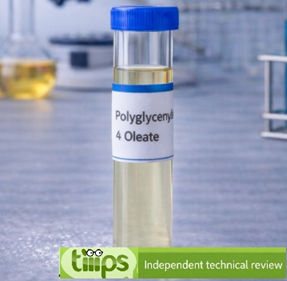
Polyglyceryl-4 Oleate typically appears as a viscous or semi-solid substance, with a color ranging from clear to pale yellow. It is soluble in oils and has limited water solubility, making it ideal for use in various cosmetic formulations. It contributes to a rich, non-greasy texture, enhancing the sensory experience of cosmetic products.
Production Process
- Esterification: The production involves the esterification of oleic acid with Polyglycerin-4. This process requires precise control of reaction conditions to ensure the formation of stable and effective esters.
- Purification: Following esterification, the product undergoes extensive purification to remove any unreacted materials and by-products, ensuring its purity and suitability for cosmetic use.
- Quality Control: Rigorous testing is conducted on the final product to assess its purity, stability, and performance in various cosmetic formulations. These tests often include evaluations of emulsion stability, viscosity, and compatibility with other cosmetic ingredients.
Applications
Cosmetic Products: Widely used in creams, lotions, and serums for its emulsifying and moisturizing properties, improving the texture and feel of the product on the skin.
Skin Care: Ideal for moisturizing and nourishing products, providing a smooth and enriching feel to the skin due to its emollient properties.
Hair Care: Incorporated into conditioners and hair masks, contributing to the nourishment, softening, and conditioning of the hair.
INCI Functions:
- Surfactant - Emulsifying agent. Emulsions are thermodynamically unstable and are used to soothe or soften the skin and emulsify, so they need a specific, stabilising ingredient. This ingredient forms a film, lowers the surface tension and makes two immiscible liquids miscible. A very important factor affecting the stability of the emulsion is the amount of the emulsifying agent. Emulsifiers have the property of reducing the oil/water or water/oil interfacial tension, improving the stability of the emulsion and also directly influencing the stability, sensory properties and surface tension of sunscreens by modulating the filmometric performance.
CAS: 9007-48-1 71012-10-7
Health and Safety Considerations
Safety in Use
Polyglyceryl-4 Oleate is generally considered safe for use in cosmetic products. It is well-tolerated by the skin and is not known to cause irritation or sensitization, even on sensitive skin. It is often used in gentle formulations, such as those for babies or individuals with sensitive skin.
Allergic Reactions
Allergic reactions to Polyglyceryl-4 Oleate are rare. Being derived from vegetable oils and glycerol, it is well-tolerated by most people, though it is recommended to perform a patch test on very sensitive skin.
Toxicity and Carcinogenicity
There is no evidence that Polyglyceryl-4 Oleate is toxic or carcinogenic. It is considered safe for cosmetic use and poses no known health risks when used at recommended concentrations.
Environmental and Safety Considerations
Derived from natural sources such as vegetable oils and glycerol, Polyglyceryl-4 Oleate is biodegradable and has a minimal environmental impact. It is an eco-friendly and sustainable choice for cosmetic formulations, especially in natural and organic products.
Regulatory Status
Polyglyceryl-4 Oleate is approved for use in cosmetics in many regions, including the European Union and the United States. It is regulated to ensure safe use in cosmetic formulations.

