



Ruta graveolens oil (rue essential oil): properties, uses, pros, cons, safety, alternatives
Ruta graveolens oil is the essential oil obtained (typically by steam distillation) from the aerial parts of Ruta graveolens (family Rutaceae), commonly “rue”. In cosmetics it is used primarily as an odorant and masking ingredient; however, it is a raw material that requires particularly careful management due to the potential photoreactivity associated with furocoumarins (variable by botanical origin, plant part, and process).
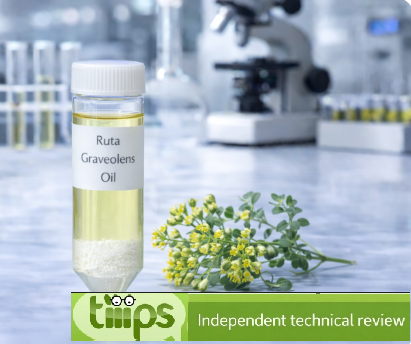
Definition
It is not a single molecule: it is a complex mixture of volatile constituents. The profile is highly batch-dependent and may include, in addition to terpenes, a relevant fraction of non-terpenic compounds. From a formulation standpoint, the main criticality is not “skin-care functionality” per se, but the balance between olfactive performance and safety requirements (especially for products exposed to sunlight).
Main uses
Food.
It is not a typical food ingredient. Any use as a flavor requires a specific framing (grade, compliance, and intended use) distinct from the cosmetic perimeter.
Cosmetics.
Used mainly as a perfuming/masking component in personal care products. Practical use tends to be cautious and at low levels, considering the risk profile (phototoxicity/irritation), especially in leave-on products.
Cosmetic Safety
Restricted cosmetic ingredient as III/358 a Relevant Item in the Annexes of the European Cosmetics Regulation 1223/2009. Substance or ingredient reported:
Furocoumarines (e.g. trioxysalen (INN), 8-methoxypsoralen, 5-methoxypsoralen) except for normal content in natural essences used. In sun protection and in bronzing products, furocoumarines shall be below 1 mg/kg.
May be used in cosmetic products, provided that the total concentration of furocoumarin-like substances in the finished cosmetic product do not exceed 1ppm.(An initial list of perfumery materials which must not form part of cosmetic products except subject to the restrictions and conditions laid down -adopted by the SCCNFP during the 18th Plenary meeting of 25 September 2001)
Cosmetics - INCI Functions
Fragrance. It plays a very important role in the formulation of cosmetic products as it provides the possibility of enhancing, masking or adding fragrance to the final product, increasing its marketability. It is able to create a perceptible pleasant odour, masking a bad smell. The consumer always expects to find a pleasant or distinctive scent in a cosmetic product.
CAS: 8014-29-7 84929-47-5 EC number 284-531-5
Key constituents
The composition can include (qualitatively), with broad variability:
Aliphatic ketones (often among the most characteristic constituents of rue profile, impacting the herbaceous/pungent note and persistence).
Monoterpenes and oxides (e.g., 1,8-cineole) and other terpenes in variable amounts.
Phenylpropanoids (e.g., methyl eugenol) in some batches, relevant for compliance and safety evaluation.
Coumarins and furocoumarins (not always at high levels, but critical for photoreactivity risk): total content and specific profile depend on raw material and process.
Practical note: automatically assigning “skin-care benefits” to an essential oil is inappropriate; this material is first and foremost an olfactive ingredient and should be managed as such, with a conservative approach on dose and intended use.
Nutritional use note and bioactive compounds
It is not a nutritional ingredient and is not used to deliver bioactive compounds for food purposes. “Bioactives” are relevant here only for risk assessment (compositional profile) and formulation compatibility.
Identification data and specifications
| Characteristic | Value |
|---|---|
| INCI name | Ruta graveolens oil |
| Botanical source | Ruta graveolens (family Rutaceae) |
| Type | essential oil (mixture) |
| CAS number | 8014-29-7; 84929-47-5 |
| EC number (EINECS) | 284-531-5 |
| Molecular formula | not applicable (mixture) |
| Molecular weight | not applicable (mixture) |
| Cosmetic function (CosIng) | masking |
| Regulatory note | attention to furocoumarins (consistency with applicable limits and finished-product assessment) |
Physico-chemical properties (indicative)
| Characteristic | Indicative value | Note |
|---|---|---|
| Physical state | liquid | fragrance raw material |
| Color | pale yellow to amber | batch/oxidation dependent |
| Odor | herbaceous, pungent, characteristic | intense profile, not “neutral” |
| Water solubility | very low | typical of essential oils |
| Solubility in organic solvents | good | depends on product base |
| Volatility | medium-high (light fraction) | with persistence of some fractions |
| Stability | sensitive to light/air/temperature | possible olfactive drift and oxidation |
Functional role and mechanism of action (practical)
In formulation, the main effect is olfactive: perfuming and especially masking of base notes. It should not be treated as a dermocosmetic “active”. Technical attention focuses on: olfactive stability, compatibility with the surfactant/emulsion system, and risk management linked to photoreactive components.
Formulation compatibility
Generally compatible with anhydrous systems and with the oil phase of emulsions; in detergency it often requires suitable solubilization to avoid haze or phase separation. Practical drivers:
compatibility with solubilizers and fragrances,
possible impact on base color/odor over time,
oxidation sensitivity (barrier packaging and controlled storage),
strict management of furocoumarin limits for products exposed to sunlight.
Safety, regulation, and environment
The key criticality is potential phototoxicity associated with furocoumarins and, more broadly, irritation/sensitization typical of some natural odorant materials.
Regulatory framework (principle).
In the EU context, furocoumarins fall under restricted substances: they must not be intentionally added (with an exception for “normal” content naturally present in essential oils used). For sun-protection and tanning products, a specific limit is set (practically 1 mg/kg, i.e., 1 ppm) for furocoumarins in the finished cosmetic product. In addition, historical European scientific opinions support a precautionary approach at very low levels (order of 1 ppm) for furocoumarins in cosmetics, especially where UVA exposure is reasonably expected.
Allergen.
It is not a single “allergen” per se. Actual risk depends on batch profile (including oxidation) and the possible presence of odorant components requiring specific management in the finished product.
Contraindications (brief).
High caution in leave-on products and in products intended for use before sun exposure. Avoid batches with uncertain/uncontrolled profile and apply conservative criteria for dose, target use, and conditions of use.
Environment.
Impact depends mainly on agricultural supply chain and extraction process. Traceability, responsible cultivation/harvesting, and appropriate waste/solvent management (if any) are the main process drivers.
Formulation troubleshooting
Haze or phase separation in detergents.
Action: optimize solubilizer/perfuming system; verify compatibility with electrolytes and cloud point.
Odor changes over time.
Action: barrier packaging, reduced headspace, light/temperature control, and evaluation of compatible antioxidants.
Reports of irritation or reactions after sun exposure.
Action: review dosage, verify furocoumarin profile of the batch, reassess suitability for UVA-exposed products, and repeat finished-product safety assessment.
Alternatives
| Option (INCI) | Product type | Key advantages |
|---|---|---|
| Lavandula Angustifolia (Lavender) Oil | Essential oil | Clean herbal-floral note, widely available, generally easier to manage than Ruta graveolens from a tolerability standpoint (still contains naturally occurring allergens). |
| Rosmarinus Officinalis (Rosemary) Leaf Oil | Essential oil | Green-aromatic profile for herbal accords; often considered more manageable than furocoumarin-rich oils. |
| Salvia Sclarea (Clary) Oil | Essential oil | Herbal with soft ambery facets, useful to replace part of the “green” character without harsher notes. |
| Citrus Aurantium Amara (Bitter Orange) Leaf/Twig Oil (Petitgrain) | Essential oil | Elegant green-citrus note, typically less problematic than phototoxic peel oils; good for freshness and “green” lift. |
| Pelargonium Graveolens Flower Oil | Essential oil | Green-rosy (geranium) character that builds herbal/floral accords with good roundness; manage naturally occurring allergens. |
Conclusion
Ruta graveolens oil is an essential oil used in cosmetics mainly as a masking and odorant ingredient. Its use requires strict control of compositional profile and, above all, of furocoumarin content to mitigate photoreactivity risk and ensure compliance and tolerability in the finished product.
Mini-glossary
Furocoumarins. Class of natural compounds with potential phototoxic activity under UVA. Benefit: enables targeted risk management for botanicals and essential oils.
Phototoxicity. Skin reaction triggered by the interaction between a substance and light (especially UVA). Benefit: key concept to assess ingredients containing furocoumarins.
Masking. Cosmetic function: covers or reduces undesirable odors. Benefit: improves the olfactive perception of the finished product.
ppm. Parts per million (mg/kg). Benefit: practical unit for regulatory limits on trace components/impurities.

