



Hexapeptide-11: properties, uses, pros, cons, safety
Hexapeptide-11 is a synthetic peptide made of six amino acids linked in a chain. It contains alanine, phenylalanine, proline, and small parts of valine (i.e., residues of these amino acids are part of the sequence). In cosmetics it is mainly used for skin conditioning, often in anti-age and “firming” products, with the aim of improving the perception of elasticity, firmness, and overall skin surface quality.
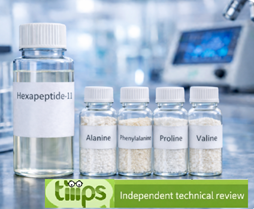
Synthetic peptides can be generated as copies of protein fragments by incorporating non-proteinogenic amino acids and modifications to enhance the proteolytic stability of the molecules. Peptides are used in the development of therapeutic drugs for their antimicrobial activity, and for their bioactive interest (1).
Definition
Hexapeptide-11 is an oligopeptide (six amino-acid residues) commonly placed—within formulation and marketing language—among signal peptides. Practically, it is used at low concentrations, and performance depends primarily on stability, the vehicle, and consistent use over time. For this reason, it is more accurate to view it as a conditioning and functional “skin feel” modulator rather than an active with immediate, universally reproducible effects.
Production process
It is typically produced via controlled peptide synthesis (chemical), followed by purification and standardization. Key cosmetic-grade quality points include purity, the profile of synthetic impurities, residual salts/solvents, and peptide stability in the commercial form (powder or solution).
Key constituents
The functional component is the peptide itself. In a well-specified ingredient, traces (within specification) are mainly counter-ions/salts, water, and minor process-related impurities. The amino-acid composition you cited (alanine, phenylalanine, proline, valine) suggests a peptide with hydrophobic portions (phenylalanine) and potentially more “rigid” structural features (proline), which may influence surface interaction and behavior in formula.
Identification data and specifications
| Characteristic | Value | Note |
|---|---|---|
| INCI name | Hexapeptide-11 | cosmetic denomination |
| Origin | synthetic | industrially produced peptide |
| Composition (as provided) | alanine, phenylalanine, proline, valine | amino acids present in the chain |
| Typical cosmetic function | Skin conditioning | primary function |
| CAS number | 161258-30-6 | frequently shown in technical sheets |
| Molecular formula | C36H48N6O7 | reported in chemical databases |
| Molecular weight | approx. 684.8 g/mol | indicative from formula |
Physicochemical properties (indicative)
| Characteristic | Indicative value | Note |
|---|---|---|
| Physical state (raw material) | powder or aqueous solution | depends on grade |
| Solubility | good in water/aqueous systems | often supplied in solution |
| Stability | sensitive to extreme pH and oxidants | formula must protect it |
| Heat sensitivity | moderate | avoid thermal process stress |
| Compatibility | variable with preservatives and solvents | watch high alcohol levels |
| Sensory impact | neutral (low-use levels) | effect is more functional than tactile on its own |
Functional role and mechanism of action
In cosmetics, Hexapeptide-11 is used with a conditioning rationale and to support the appearance of more toned skin. In practical terms, expected effects fall into three areas:
Improvement of perceived skin quality, especially with consistent routine use.
Support for claims related to elasticity and firmness (dependent on the full formula and use context).
Possible contribution to narratives around protection from oxidative stress or “proteostasis” support in certain technical/marketing frameworks, with evidence that varies in quality and transferability to finished products.
Main uses
Cosmetics
Common in:
anti-age and “firming” serums
light face creams or treatment emulsions
products aimed at mature skin or loss of tone
“booster” formulas combining peptides with humectants (e.g., glycerin, hyaluronic acid) to enhance perceived performance
INCI functions
Skin conditioning agent. It is the mainstay of topical skin treatment as it has the function of restoring, increasing or improving skin tolerance to external factors, including melanocyte tolerance. The most important function of the conditioning agent is to prevent skin dehydration, but the subject is rather complex and involves emollients and humectants that can be added in the formulation.
Pros and cons
Pros
Consistent with anti-age.
Used at low concentrations, with limited impact on formula odor/color.
Integrates well into aqueous bases and serums when the preservative system is compatible.
Cons
Performance depends strongly on stability (pH, oxidants, temperature) and the vehicle.
Expectations: results may be gradual and vary between individuals; it is not an “instant” active.
Possible variability among commercial grades (true peptide assay, solution quality, salt content), so supplier documentation is crucial.
Safety, regulatory, and environmental aspects
Safety profile (practical)
In general, cosmetic peptides like Hexapeptide-11 are used at low dosages. Practical safety depends mainly on purity, control of synthetic impurities, and proper formulation (preservatives, solvents, pH). If the base formula is very “active” or contains high levels of solvents/surfactants, tolerability may decrease—not so much due to the peptide itself but due to the overall system.
Allergen
Not a typical fragrance allergen. Any reactions are more often linked to irritation or sensitivity to the finished product (preservatives, fragrance, solvents).
Contraindications and cautions
Use caution on very reactive skin or compromised barrier: prefer formulas with moderate pH and a well-balanced preservative system. In product development, always verify peptide compatibility and stability in the finished product across shelf life.
Conclusion
Hexapeptide-11 is a synthetic peptide used for skin conditioning in anti-age and “firming” formulas, with an amino-acid composition including alanine, phenylalanine, proline, and valine. Its value is highest when incorporated into systems designed for stability and tolerability; main limitations relate to performance variability driven by the full formula and the need for strong supplier qualification.

