



Oligopeptide-81: properties, uses, pros, cons, safety
Oligopeptide-81 is a synthetic peptide composed of 15 amino acids linked in a chain; among those reported as constituents are alanine, glutamine, glycine, leucine, proline, serine, and threonine. In cosmetics it is typically used as a skin protecting ingredient, with a use rationale linked to its peptide nature (and therefore general compatibility with aqueous matrices and systems aimed at barrier/comfort support), while real-world performance depends on dose, grade, purity, and stability in the finished product.
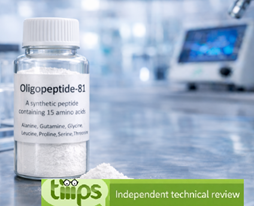
Synthetic peptides can be generated as copies of protein fragments by incorporating non-proteinogenic amino acids and modifications to enhance the proteolytic stability of the molecules. Peptides are used in the development of therapeutic drugs for their antimicrobial activity, and for their bioactive interest.
Definition
It is an oligopeptide of synthetic origin (non-botanical), marketed as a cosmetic raw material. Compared with extracts, the key driver here is not botanical variability but synthetic reproducibility, management of impurities (residual reagents/solvents, salts), the distribution of related species (truncations, deletions, deamidations), and batch-to-batch consistency in terms of content and analytical profile. The full sequence may be proprietary depending on the supplier; therefore, quality should be governed by specifications and methods (HPLC/UPLC, MS, peptide content, water/residual solvents, microbiology).
Production process
The most common industrial route for cosmetic oligopeptides is peptide synthesis (often SPPS, solid-phase peptide synthesis) followed by deprotection, resin cleavage, purification (typically chromatographic), concentration, and standardization. The cosmetic grade is then supplied as a solution (water, glycols, glycerin) or as a powder (lyophilized/spray-dried), with controls on purity, identity, microbial load, metals, and process-related residues consistent with the intended use.
Key constituents
The active ingredient is the peptide itself. In practical terms, a batch “component profile” also includes trace amounts of synthesis-related impurities (shorter-chain peptides, isomers, oxidized species) and, if supplied in solution, the carrier (e.g., water/glycerin/glycols) plus any stabilizers permitted by the specification. From a chemical-functional standpoint, the cited amino acids (alanine, glutamine, glycine, leucine, proline, serine, threonine) influence polarity, conformational flexibility, and water interactions, but they should not be interpreted as separate actives: what matters is the integrated sequence.
Identification data and specifications
| Parameter | Value | Note |
|---|---|---|
| INCI name | Oligopeptide-81 | label denomination |
| Origin | synthetic | peptide obtained by synthesis |
| Composition | oligopeptide (15 amino acids) | single “active” component + related impurities within spec |
| Cosmetic function | skin protecting | function reported in EU cosmetic ingredient databases |
| CAS number | not uniquely public | may vary / may not be declared consistently across commercial sources |
| EC number (EINECS/ELINCS) | not always available | not always reported for this entry |
| Molecular formula | sequence-dependent | cannot be stated without full sequence and counterions |
| Molecular weight | indicative ~1.6 kDa | theoretical estimate for 15 aa; varies with sequence/modifications and salification |
| Commercial form | solution or powder | supplier-dependent |
Physico-chemical properties (indicative)
| Property | Indicative value | Note |
|---|---|---|
| Appearance | whitish/off-white powder or clear solution | grade-dependent |
| Odor | none or slight | may depend on carrier |
| Solubility | good in water and hydrophilic systems | typically compatible with aqueous/glycerin phases |
| Stability | sensitive to hydrolysis/oxidation (variable) | managed via pH, chelators, antioxidants, and packaging |
| Formulation pH range | to be defined per grade/supplier | peptide stability can worsen at extreme pH |
| Compatibility | possible interaction with surfactants/electrolytes | check turbidity/precipitation and potency loss |
Functional role and rationale of use
In cosmetics, skin protecting aligns with “supportive” use in formulas aimed at comfort, barrier, and reducing the sensation of dryness/irritation (as a formulation concept, not a therapeutic promise). Peptides, being relatively polar molecules and generally compatible with aqueous systems, fit well into serums, gels, and light emulsions; outcomes depend on effective concentration, molecule protection (pH, oxygen, light, metals), and the actual peptide content of the grade.
Main uses
In practical formulation, it may appear in barrier/comfort serums and creams, post-cosmetic-treatment products, light emulsions for reactive skin, and generally in lines seeking a “peptide-based” ingredient with a technical positioning.
Cosmetics
From a formulation standpoint, it is useful to treat it as a sensitive active: preferably add at cool-down or low temperature when possible, pay attention to compatibility with preservatives and salts, and verify peptide content over time during stability testing.
Cosmetics - INCI Functions
Skin protectant. It creates a protective barrier on the skin to defend it from harmful substances, irritants, allergens, pathogens that can cause various inflammatory conditions. These products can also improve the natural skin barrier and in most cases more than one is needed to achieve an effective result.

