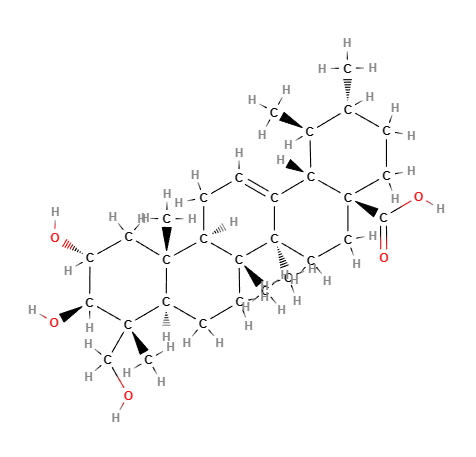
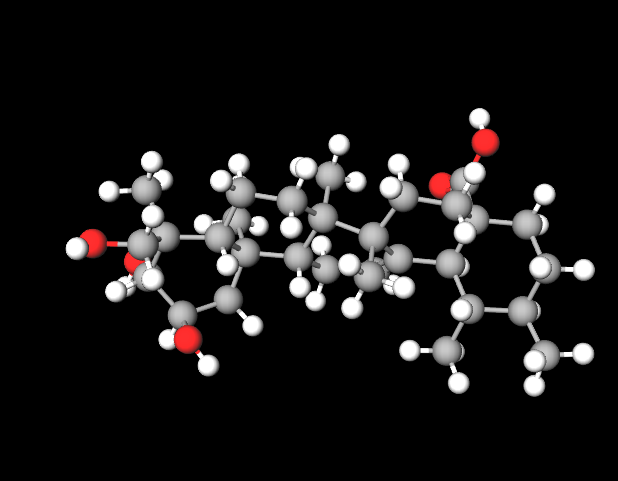
Acido asiatico è un terpene naturale, un composto derivato dalla pianta Centella Asiatica, appartenente alla famiglia delle Apiaceae.
Processo di produzione industriale
- Raccolta di Centella asiatica. Le piante vengono raccolte quando sono mature, poiché in questo momento contengono la più alta concentrazione di composti attivi.
- Essiccazione e macinazione. Le piante raccolte vengono essiccate in ambienti controllati per preservare i composti volatili, poi macinate in polvere per aumentare l'efficienza dell'estrazione.
- Estrazione con solvente. La polvere essiccata viene immersa in un solvente organico come etanolo o metanolo per estrarre i composti triterpenici. Viene riscaldata e agitata per migliorare l'efficienza dell'estrazione.
- Filtrazione e concentrazione. La miscela viene filtrata per rimuovere i solidi, e il solvente viene poi evaporato sotto vuoto per concentrare gli estratti triterpenici.
- Isolamento di acido asiatico. Gli estratti concentrati vengono purificati mediante tecniche come la cromatografia a colonna per isolare l'acido asiatico dai composti correlati.
- Purificazione finale. L'acido asiatico isolato viene ulteriormente purificato tramite ricristallizzazione per rimuovere qualsiasi impurità residua e migliorare la purezza del prodotto.
- Controllo di qualità. Il prodotto finale viene sottoposto a rigorosi test di qualità per verificarne la purezza e la conformità agli standard.
A cosa serve e dove si usa
Acido asiatico ha la prerogativa di stimolare la produzione di collagene e migliorare la cicatrizzazione, aiutando a ridurre l'aspetto delle rughe e delle linee sottili. Questo composto è particolarmente efficace nei prodotti anti-invecchiamento, dove promuove una pelle liscia, compatta e radiosa, migliorando la barriera cutanea e la resilienza della pelle agli stress ambientali.
Cosmetica - Funzioni INCI
- Agente condizionante della pelle. Rappresenta il perno del trattamento topico della pelle in quanto ha la funzione di ripristinare, aumentare o migliorare la tolleranza cutanea a fattori esterni, compresa la tolleranza dei melanociti. La funzione più importante dell'agente condizionante è prevenire la disidratazione della pelle, ma il tema è piuttosto complesso e coinvolge emollienti ed umettanti che possono essere aggiunti nella formulazione.
- Light stabilizer. Impedisce alla luce di degradare i componenti sensibili alla luce e rallenta le reazioni di degradazione già iniziate. Il meccanismo è, in un certo senso, simile agli antiossidanti e l'efficacia dipende dalla complessità della formulazione e dalla densità del prodotto.
Applicazioni Cosmetiche
Rigenerazione della pelle. L'acido asiatico stimola la produzione di collagene e la rigenerazione cellulare, contribuendo a migliorare l'aspetto di cicatrici, smagliature e segni di invecchiamento.
Effetti Anti-invecchiamento. Grazie alla sua capacità di promuovere il collagene, aiuta a ridurre le rughe e le linee sottili, migliorando l'elasticità della pelle.
Proprietà antiossidanti. Protegge la pelle dai danni dei radicali liberi, prevenendo l'invecchiamento precoce e migliorando la salute della pelle.
Effetti lenitivi. Riduce l'infiammazione cutanea e calma la pelle irritata, risultando adatto per pelli sensibili o danneggiate.
Versatilità di Applicazione. Può essere incorporato in vari prodotti cosmetici, come sieri, creme, lozioni e maschere, per migliorare l'aspetto e la salute della pelle.
Altre applicazioni
Proprietà Anti-infiammatorie. È studiato per la sua capacità di ridurre l'infiammazione e potrebbe essere impiegato in integratori o farmaci per alleviare condizioni come l'artrite (1).
Supporto alla guarigione delle ferite. Viene utilizzato per promuovere la guarigione di ulcere e ferite grazie alla sua capacità di stimolare la crescita dei tessuti (2).
Neuroprotezione. La ricerca suggerisce che l'acido asiatico possa avere effetti neuroprotettivi, potenzialmente utili per malattie neurodegenerative come l'Alzheimer (3).
Supporto alla salute cardiovascolare. Può contribuire a ridurre i livelli di colesterolo e a migliorare la circolazione, supportando la salute cardiovascolare (4).
Molecular Formula C30H48O5
Molecular Weight 488.7 g/mol
CAS 464-92-6
UNII 9PA5A687X5
EC Number 482-720-9
Synonyms:
Dammarolic acid
Asiantic acid
Asiaticacid
Bibliografia_____________________________________________________________________
(1) Zhang L, Liu ZN, Han XY, Liu X, Li Y. Asiatic acid inhibits rheumatoid arthritis fibroblast-like synoviocyte growth through the Nrf2/HO-1/NF-κB signaling pathway. Chem Biol Drug Des. 2024 Mar;103(3):e14454. doi: 10.1111/cbdd.14454. PMID: 38477392.
(2) Diniz LRL, Calado LL, Duarte ABS, de Sousa DP. Centella asiatica and Its Metabolite Asiatic Acid: Wound Healing Effects and Therapeutic Potential. Metabolites. 2023 Feb 14;13(2):276. doi: 10.3390/metabo13020276.
Abstract. An intense effort has been focused on new therapeutic approaches and the development of technologies for more efficient and rapid wound healing. The research for plants used for long time in traditional medicine in the treatment of wound has become a promising strategy to obtain drugs therapeutically useful in the acute and chronic wound management. In this context, Centella asiatica (Apiaceae) has been used to treat a variety of skin diseases, such as leprosy, lupus, varicose ulcers, eczema and psoriasis, in Asiatic traditional medicine for thousands of years. Studies have shown that Centella asiatica extracts (CAE) display activity in tissue regeneration, cell migration and wound repair process by promoting fibroblast proliferation and collagen synthesis. Preliminary findings have shown that the asiatic acid is one of the main active constituents of C. asiatica, directly associated with its healing activity. Thus, this study discusses aspects of the effects of Centella asiatica and its active component, asiatic acid, in different stages of the healing process of cutaneous wounds, including phytochemical and antimicrobial aspects that contribute to its therapeutic potential.
(3) Ahmad Rather M, Justin Thenmozhi A, Manivasagam T, Nataraj J, Essa MM, Chidambaram SB. Asiatic acid nullified aluminium toxicity in in vitro model of Alzheimer's disease. Front Biosci (Elite Ed). 2018 Jan 1;10(2):287-299. doi: 10.2741/e823.
Abstract. Aluminium (Al) is a ubiquitously distributed environmental toxicant that lacks biological functions; however, its accumulation in the brain has been demonstrated to be linked to several neuropathological conditions particularly Alzheimer's disease (AD). Asiatic acid (AA), a triterpene extracted from Centella asiatica, has been reported to cross the blood brain barrier and also displayed antioxidant and neuroprotective activities. The present study was aimed to explore the neuroprotective effect of AA against aluminium maltolate (Al(mal)3) induced neurotoxicity by assessing cell viability, mitochondrial membrane potential, levels of reactive oxygen species (ROS), DNA damage and apoptosis (Hoechst and dual staining, comet assay; expressions of pro-apoptotic, anti-apoptotic and signaling indices) via AKT/GSK-3β signaling pathway in SH-SY 5Y neuroblastoma cells. Pre-treatment with AA significantly enhanced cell viability, attenuated rotenone-induced ROS, mitochondrial membrane dysfunction and apoptosis regulating AKT/GSK-3β signaling pathway. Downregulation of Al induced neurodegeneration may be one of the approaches to control the impairment of metal ion homeostasis leading to neuronal injury in early development of AD. However, more extensive work in animal model is desirable to confirm its neuroprotective action.
(4) Razali NNM, Ng CT, Fong LY. Cardiovascular Protective Effects of Centella asiatica and Its Triterpenes: A Review. Planta Med. 2019 Nov;85(16):1203-1215. doi: 10.1055/a-1008-6138.
Abstract. Centella asiatica, a triterpene-rich medicinal herb, is traditionally used to treat various types of diseases including neurological, dermatological, and metabolic diseases. A few articles have previously reviewed a broad range of pharmacological activities of C. asiatica, but none of these reviews focuses on the use of C. asiatica in cardiovascular diseases. This review aims to summarize recent findings on protective effects of C. asiatica and its active constituents (asiatic acid, asiaticoside, madecassic acid, and madecassoside) in cardiovascular diseases. In addition, their beneficial effects on conditions associated with cardiovascular diseases were also reviewed. Articles were retrieved from electronic databases such as PubMed and Google Scholar using keywords "Centella asiatica," "asiatic acid," "asiaticoside," "madecassic acid," and "madecassoside." The articles published between 2004 and 2018 that are related to the aforementioned topics were selected. A few clinical studies published beyond this period were also included. The results showed that C. asiatica and its active compounds possess potential therapeutic effects in cardiovascular diseases and cardiovascular disease-related conditions, as evidenced by numerous in silico, in vitro, in vivo, and clinical studies. C. asiatica and its triterpenes have been reported to exhibit cardioprotective, anti-atherosclerotic, antihypertensive, antihyperlipidemic, antidiabetic, antioxidant, and anti-inflammatory activities. In conclusion, more clinical and pharmacokinetic studies are needed to support the use of C. asiatica and its triterpenes as therapeutic agents for cardiovascular diseases. Besides, elucidation of the molecular pathways modulated by C. asiatica and its active constituents will help to understand the mechanisms underlying the cardioprotective action of C. asiatica.